
This Go-with-the-Flow Garden Trend Has Everyone Embracing Their “Wild Side”
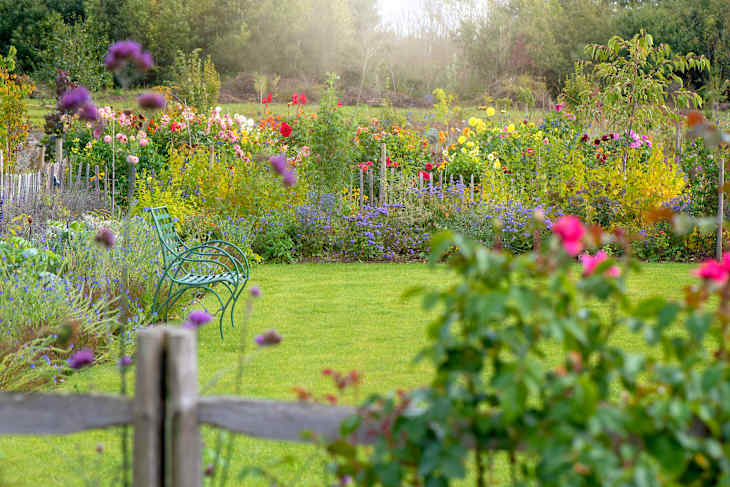
Escaping into a garden on a warm day sounds like the best way to unplug and reconnect with nature. The only problem? When you look outside at what could be a space for flowers and plants to grow, all you currently see is a tired, forgotten patch. Starting a garden can be a significant undertaking, but it does pay off in the long run — both in the form of fresh produce and flowers, as well as a mental health boost.
“You can get an enormous sense of satisfaction from engaging with your garden,” says Kevin Lenhart, design director at Yardzen. “Medical research shows that simply looking at planted scenes produces multiple positive wellness outcomes, including decreased stress, increased creativity, and faster healing times.”

If you’ve committed to transforming a patch of land or a corner of a balcony into a garden this spring, there’s no better time than now to begin honing your green thumb to create a beautiful and vibrant landscape. We tapped Lenhart and Los Angeles-based landscaper Rob Jones to help with ideas for how to get your outdoor oasis going, including the biggest garden trend of 2025.

The Biggest Garden Trend of 2025
Clients are asking for recommendations for the best native plants to grow in their areas, Lenhart and Jones say, with a concern for biodiversity and hopes to have a positive impact on their community. They want gardens that are relatively low-lift endeavors, so that they can care for them without losing sight of other needs. If there’s one particular motto that seems to be getting more attention than usual, it’s this: Natural is back, and bigger than ever.
“Across the style spectrum, people consistently want at least some degree of the looseness and fluidity that you see in wild plantings,” Lenhart says. “Even formal clients who often prefer straight rows, clear layers, and symmetry want to incorporate some shagginess.”
Lenhart says clients are requesting this detail because they’re maybe willing to give up a little control to connect more with nature. Jones is also seeing a slight shift away from more straight-lined succulents, like cacti, and requests for more free-flowing flowers. “Succulents will always be in my repertoire, but I’m seeing more flower power,” he says.
Overall, Lenhart notes that this trend is good for the soul. “We’re acknowledging that crisp perfection is a show, and real life a much messier affair,” he says. “By adding a bit of free-wheeling looseness into our designs, we’re creating spaces that give us permission to be human.”
Less Water, More Style
If there’s a secondary trend that seems to be taking hold, it’s that gardeners want options that don’t suck up their water supply. “Clients consistently request low-water, drought-tolerant planting designs,” Lenhart says. “This demonstrates an ever-growing awareness of water scarcity and the impact irrigation has on water supply.”
Lenhart says that this often comes to fruition in the form of ground-cover plants that can handle a bit of foot traffic over classically green lawns, as well as planting grass-like alternatives, such as Carex pansa or Carex tumulicola. Succulents still make an appearance, as Jones noted, and they’re often paired with more ornamental grasses that don’t require as much water or maintenance.
“As a landscaper in California, I’m always looking for ways to be more responsible and sustainable with plants that are adaptable to our climate,” he says. “California natives pair well with Australian and South African native plants, which are very attractive. As long as you research the habitat and find complementary options, your garden will thrive.”