
This 200-Year-Old “Belfast” Kitchen Feature Is So Practical, I Wish My Home Had It
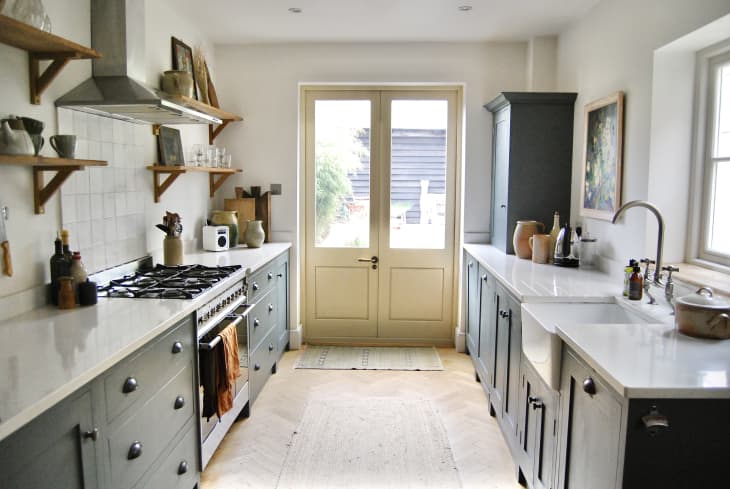
I don’t have a farmhouse sink, but I’ve always wanted one in my own kitchen. They’re iconic and trendy — I love the idea of a protruding, white ceramic sink that looks like it would exist in a rural Vermont kitchen. I thought I knew everything there was to know about them — so that’s why I was surprised when I came across a TikTok about something called a “Belfast sink.” It looked a whole lot like a farmhouse sink, but after doing some digging, I found out that it’s actually more like its cousin — and that I actually like it more.

What Are Belfast Sinks? Why Are They Called That?
A Belfast sink is a sink with an apron-front basin and a built-in weir overflow. A weir overflow, is a small, sloped slot near the top that diverts excess water into the drain so the bowl doesn’t spill. If you’re not laser-focused on conservation, that overflow is a clutch safety feature because you can keep water running while you work without flooding the floor.
Wayne Spriggs, award-winning designer and CEO of LUSSO, says it simply. “Belfast sinks are a variation of the traditional apron style sink, originally designed in Belfast, Northern Ireland. They evolved from butler sinks but were traditionally smaller and often had a drainage hole, known as a drainage weir, incorporated in the design.”

Are They the Same as Farmhouse or Butler Sinks?
They’re cousins, not twins. Think of the deep basin, apron front sink as an umbrella term based on its common features.
Belfast sinks traditionally have a weir overflow. Butler (London) sinks traditionally do not include overflow design and often run shallower and wider with conservation in mind. French “farmhouse” versions track with butler sinks in spirit (no overflow). Today, the lines blur: You can even buy a butler-style with an overflow, which is why, at a glance, many models look the same.
As Todd Harmon, principal designer and cofounder of Starfire Direct and Harmonia Living, put it, “Every Belfast sink is a farmhouse sink, but not every farmhouse sink is a Belfast sink.”
When Were They Invented?
Belfast sinks didn’t exist in 1790. What shows up first are “work sinks” — in the late 1700s/early 1800s in London pantries. Eventually, the Belfast sink was adapted and the overflow weir was added to it.
In 1865, Robert Kerr’s The Gentleman’s House lists the butler’s pantry with “a pair of small lead sinks … for hot and cold water.” Eventually, the phrase “butler’s sink” was popularized in 1872 and “Belfast sink” in 1929. In the U.S., apron-fronts showed up by the early to mid-20th century, then boomed in the 2000s and 2010s with the modern farmhouse sink. A lot of those are Belfast features (deep bowl and weir), whatever the box says.

Where Were Belfast Sinks Most Popular?
Historically: Irish and British homes — especially Victorian/Edwardian kitchens built for serious, daily washing. “Belfast sinks spread quickly through Irish and British homes … [They were] staples in Victorian and Edwardian households, fitted by joiners directly into wooden counters,” Harmon says.
The butler’s pantry lived near the dining room with its own sinks and scullery — function-first long before Instagram loved an apron front.
Spriggs supports that use: “Their size and depth made them ideal for washing pots and pans, food or even clothes. [They were] associated with class and elegance, often chosen as a stylish and practical addition to a family kitchen.”
No wonder they’re so popular, even a few centuries later.
Belfast Sinks in Homes Today
In the end, the label is history. If the apron-front look drew you in, the Belfast twist — that built-in overflow — makes it a workhorse, not just a mood board. Depth for stockpots, a lip that saves your counters, and a quiet safety valve so you’re not babysitting the tap. If you want something beautiful that keeps up with real life, this is the apron-front that earns its keep — proof that a 200-year-old idea can still be the smartest thing in the room.