
My Dad’s a Plant Whisperer — These Are His 10 Best Tips for Thriving Houseplants
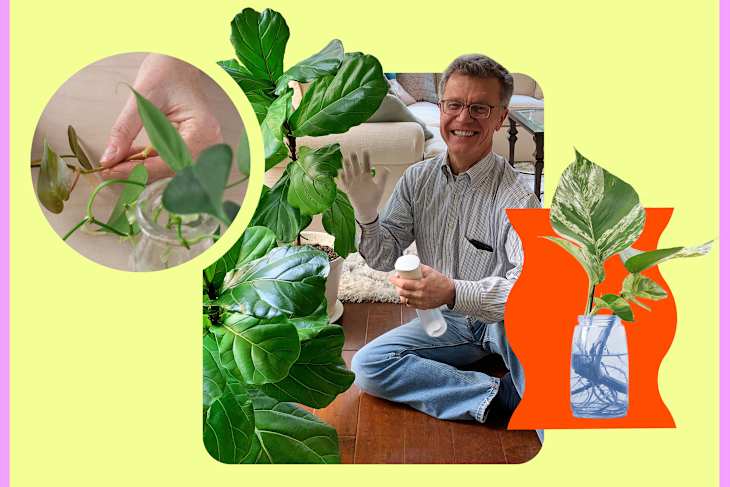
My sister and I learned years ago that it was moot to argue over which of us is our dad’s favorite, as we’ve long been outshined by our father’s true pride and joy: a majestic, 7-foot-tall fiddle leaf fig (notably, the most statuesque sister).
Growing up in LA, I took my dad’s innate green thumb for granted — and frankly, didn’t even consider his skills as covetable until my late 20s. But after killing an alarming number of plants in my own NYC apartment, one day I thought to myself, “perhaps this is as good a time as any for a few pointers?”
My pragmatic, Hungarian-born father — with the loving candor of both a lawyer and an immigrant — shared with me the hottest of hot tips: “Plants have survived for millennia without your assistance. It’s all common sense, so don’t take it too seriously.”
Well, there you have it, folks! Let the plants be plants and just follow your gut!
Jokes aside, once he elaborated, this advice actually did make a lot of sense. As he pointed out, most houseplants as we commonly know them are native to temperate or even tropical environments. Think about what it would be like for, say, your monstera deliciosa in its natural habitat. Would the temperature be warm or cool? How often would it rain? Would they be exposed to the sun directly or protected by the canopy above?
Considering all that is when it finally clicked for me. Plant care does feel instinctual when you frame it in the context of the natural habitat your plant was plucked from, before it was dropped into that terracotta pot in your living room. That mindset is what helps my dad keep his collection thriving without overthinking. Below, check out my dad’s top 10 instinctual tips for making your plants happy. (Don’t worry, I did indeed fact-check each of them myself, and it turns out my dad was right about everything. Per usual.)
1. Maintain a stable temperature.
An environment that vacillates between hot and cold will lead to all sorts of issues, so keep your plants in a place where the temperature is stable. The spot where my dad’s prized plants live — like the aforementioned fiddle leaf fig — stays consistently around 70 degrees. (This was surprising to hear as I’ve never personally seen the thermostat hover above 65, especially when my sister and I are freezing and pleading to turn the heat on. But that’s a conversation for another day.)
2. Protect the leaves from scorching.
Most common houseplants thrive in indirect light. Or, as my dad describes it, “during the brightest part of the day, the sun just misses the plant.” When plants are living behind the glass of a window, the leaves are more vulnerable to harsh UV rays — especially if you have south-facing windows. “In nature,” my dad reminds me, “there’s filtered light from trees above, which protects them from sitting in long periods of uninterrupted sun.”

3. Pay attention to the water.
If you live in a city with hard tap water, all those minerals can cause buildup in your soil. In Los Angeles, for example, where my parents live, the water has high levels of minerals like calcium and magnesium. “These additives make it drinkable for humans,” my dad points out, “but they’re not good for plants over a cumulative period.” Purify the water in one of two ways: Fill up your vessel the night before and allow it to breathe, or, for the less patient gardener (me!) you can purchase a water filter. My dad recommends a Brita.
4. Flush your plants when needed.
If you happen to live in a city with hard water — a few of those with the highest level of parts per million (ppm) in the U.S. include Las Vegas, San Antonio, and Indianapolis — and have been using tap water, you may notice a gray film forming on our soil. “Don’t worry,” my dad reassures, “as long as your pot has a hole at the bottom, you can flush the soil of buildup.” Flushing is a process in which you slowly and methodically pour three to five times the amount of water you normally would over the soil, and allow the liquid to pour out the bottom, draining hard minerals and excess salts with it.
5. Water regularly (but not too regularly).
One of the things I love about my dad is his commitment to a schedule, and that’s something that works in his favor when it comes to plant care. He recommends figuring out a watering cadence and keeping it regular so you don’t go long periods of time without watering (or, alternatively, drenching your plants too often and ending up with soggy roots). My dad’s schedule? “It’s part of my early Sunday morning ritual. I’m awake by 7 a.m., put on a pot of coffee, and spend about an hour taking care of all the plants,” he says. The exception is the peace lily, he says, “which wilts after three days, so that one gets watered twice a week.”

6. Make a spray bottle part of your toolkit.
Spritz the leaves to give them some moisture — it’s like giving them the feel of that fresh layer of dew in the morning. I gave my dad this spray bottle as a gift a couple of years back, and he uses it frequently. (When I asked my dad about potentially getting a humidifier, which I myself use, his exact words were: “I’m not going to steam up our living room!” So, we’ll leave humidifiers out of this one. A spritz of dew will do.)

7. Gently remove dust.
“I don’t wipe down the leaves nearly enough,” my dad admits. “You can tell when they need it after a couple of months; they start to look a little gray.” But when he does get to it, my exceptionally sustainable father — a compost bin loves to see him coming — uses these cotton gloves to clean the lushest plants of his collection. His current cadence is around every three months or so; he’ll wet the gloves, wipe off the dusty film, and hand-wash them in the sink to use over and over again.
8. Trim plants for peak health.
“Once a leaf is turning from yellow to brown, I’ll trim them off,” my dad says. It’s natural for plants to shed their leaves, and my dad doesn’t fret about waiting until the perfect moment to cut the dying leaf off — he kind of just goes for it. And it seems to be working!
9. Snip for aesthetics, too.
If a vining plant — a pothos, for example — has begun to thin at the roots, it may be time to consider cutting it back. “The plant is pushing its energy to the newest point of growth,” my dad points out. “The vines are lengthening while the mature part of the plant [around the soil] is dropping leaves.” To avoid a bald pothos (my words, not his), my dad recommends regularly pruning your vining greens to encourage growth without losing the bulk of the original plant.

10. Fertilize — but do it sparingly.
My dad was hesitant to suggest using fertilizer in a big way, but shared that there is a need for plants to get a boost of phosphorus, nitrogen, and potassium, which most store-bought fertilizers will provide. Nitrogen helps with growing new leaves, phosphorus is beneficial for flowers and root systems, and potassium keeps roots healthy. He picked up this basic, water soluble fertilizer at his local hardware store and has been making it last. “I use much, much less than what they recommend,” he says. “Just add a couple of drops to the water every few weeks, which the plants will absorb better over time.”