
I Grew Up in a Black Home, Where the Books on Display Meant More Than Decor
Content Warning: This story includes language that may be harsh, jarring, or uncomfortable for some readers.
All my life, I wanted an apartment filled with books. Maybe because in my canon of romance movies, the 1997 classic Love Jones showed a bookish, thoughtful life that seemed attainable. The lead character Darius’ space is peppered with Black ephemera, art, records, and, most importantly, books — a mix of romance, poetry, prose, and intellectual curiosity I thought I should have in my life. Or maybe it’s because books were a visual linchpin in my childhood home. From what I understand now, looking back on my parents’ love story as an adult, to be grown was to read.
My Well-Read Childhood Home
My mother has had a book club for as long as I can remember. According to her, it’s been 30 years — a seed planted while she was in the throes of her dissertation that gave way to our home as a museum of the Sundays she hosted and the titles she’s amassed over the years. I remember the steady hum of adult chatter; Sunday brunch not for showmanship, but like a town hall on the latest literary darling. Her books mirror the flow of her proclivities, serving as much more than mere decoration. In our living room, a scattered stack of her book club titles sits on a side table below a framed photo of her grandparents.
Even in the pesky clutter, the books hold as much visual weight as the ancestors watching over them. “I would change books based upon my feelings, you know, like what I might display, maybe about how I’m feeling that day,” she told me. “When I walk through a room, I want to see something that kind of fits my mood or may uplift my mood or may remind me to do something.”
In her office — where she runs virtual speech therapy appointments, and makes soaps and sundries — the ebb and flow of books as design is literal. Happy to Be Nappy by bell hooks sits on display with test candles and pipettes for body-oil making. Below it, tossed onto her office chair, is James McBride’s The Heaven & Earth Grocery Store. It’s positioned as a physical reminder for her to actually sit down and read it.
Although she is an audiobook reader — with strong convictions about the validity of the medium — she’s also deeply attuned to books as visual objects. “I love book jackets and covers,” she says. “It’s kind of like album covers that went away when everything went digital.” What we lost, she believes, was tactility: “I think we missed so much of life depicted in photographs and just images, color.”
My mom recalls my late father’s love language as books. She talks about titles he gave her when they were dating, like The Miseducation of the Negro; titles they shared, like the Easy Rawlins series by Walter Mosley and novels by John Grisham; and titles he coveted, like The $40 Million Slave. She remembers all without hesitation, years after their divorce and his passing. Books outlasted their marriage and his death — and while listening to her recall his titles over the phone, I felt my own eyes well up, wistful.
That conversation sent me back home. Revisiting these books now, many of which I once knew only as spines and covers, I tangentially bear witness not simply to a display of Black intellectual curiosity — the books were tokens of kinship.

The Books We Keep
In my current apartment, however, the books are, well, just there. Not picturesque, even if unorganized like my mom’s home or Darius’ in Love Jones. What am I actually doing when I think about displaying books? What would I be trying to say? Sometimes I stand before them — spines facing out, titles both read and unread — wondering what narrative they’re composing.
It made me think back to when I lived with my cousin and her husband, Eric Eddings, between 2024 and 2025. I’ve never had an explicit conversation about books as design with them, but their collection was vast. Their guest room — also her office — held stacks of books: some hidden in the closet where I kept my things, others mid-use, like the copy of James by Percival Everett (which I promptly ruined after spilling water on it). In the living room, the books functioned as anchors, arranged in conversation with Black film posters and graphic art.

When I later asked Eric, a podcast executive and the host and creator of podcasts like The Nod and For Colored Nerds, how he thought about his collection, he describes it as “reflecting all the tiny nooks and crannies of Blackness that I find interesting and that my family finds interesting,” adding that he tries “to hold onto the things that have mattered beyond the moment.”
He offered an example. “This was a moment,” he says. “I have a copy of Nigger by Dick Gregory. I have a couple copies of this book, but I kept buying it until I got this specific one that I bought when I was like 15 or 16. It invoked very much like an awakening in me.”

But Eric is also wary of the performance. Citing the mid-2010s ubiquity of Ta-Nehisi Coates’ Between the World and Me as an example, he’s less interested in whether someone owns the book than in how they engage it in their space. “It’s different if I just have it on my bookshelf,” he says, versus when it’s framed, opened to the page where Coates signed it at a book event, and placed by the front door — something you “talk to everybody about.” In that shift, the book moves from marking participation in a shared intellectual moment to functioning more like a relic. Not a bad thing, he notes, but a way to vocalize an investment in the work — unmistakably a performance, but one “we all have.”

Books as Company, Not Just Decor
In the current zeitgeist of home styling, books are often treated as mandatory decor — a shortcut to making a first apartment look “put together” regardless of whether you actually read. I’ve always felt a bit conflicted about using literature just to fill a visual void, because while I love the look, I want the objects to be ones I actually care about.
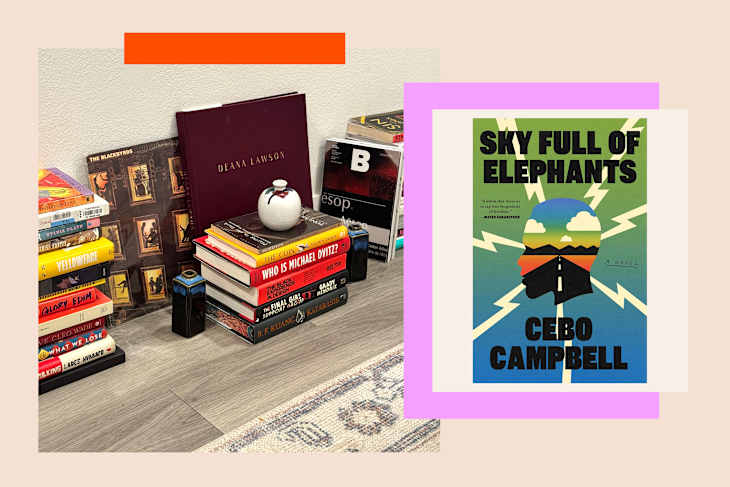
In my apartment, Deana Lawson’s An Aperture Monograph — wine-colored, with an introductory essay by Zadie Smith — sits displayed under my television. It’s propped in front of The Blackbyrds’ Night Grooves record, with three small Japanese vases arranged in front of both.
I want the stacks around it styled better. I wish I had more stories to tell about them. But I do have a story for this photo book. I bought it at the Boston Institute of Contemporary Art on a day I went shopping with my ex. This is the second copy. It’s a reminder of a shared visual language we built looking at images together — one anchored in Black intimacy and the slice-of-life energy of staged tableaux. It is a memento of the domesticity of an apartment I no longer visit.

Through a conversation with art director and one half of The Very Black Project, Justin Fulton, who had an installation called Rest Here, It’s OK in 2025 at The Los Angeles Line Hotel, I found language for it: books as emotional architecture. Fulton described the exhibition’s modest four-shelf display as “tools rather than like didactic text.” For him, both in this creative expression and in his interior life, books are the anchors of a specific tradition: “In Black histories,” he told me, “restorative care is inseparable from the idea of home as sanctuary.”
Fulton was candid about his evolution: “I don’t need to collect all these markers of things beyond me — aesthetics and such that I don’t need to be valid.” He now edits heavily, ensuring each book earns its place through emotional resonance or spiritual return. “Even one book placed with intention can carry more meaning than abundance.”

For a long time I thought the hallmark of adulthood — the intersection of allure and intellectual hunger — was to have a home that reflected the life of a tortured reader. But the books I witnessed, I stole, I destroyed, I lost, and I inherited aren’t mere performance. They are company. In my apartment now, books are scattered — A Sky Full of Elephants, The School for Good Mothers, slim stacks of everyone I’ve ever met. Living alone can be lonely, but I glance at my books while I’m working, while I’m cleaning, and remember.
As James Baldwin once wrote, “It was books that taught me that the things that tormented me most were the very things that connected me with all the people who were alive, who had ever been alive.”