
See How a Stager Dramatically Transformed an “Outdated” Home into a Modern Oasis
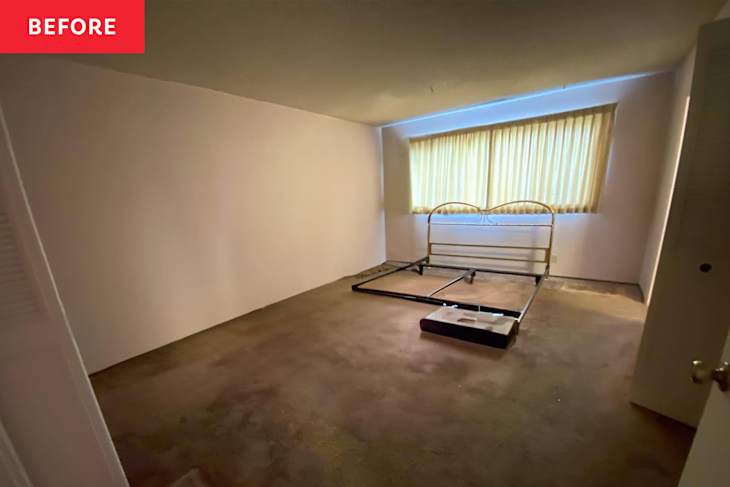
For Vanessa Nielsen, owner and principal designer of Encore Staging Services, staging a partially renovated 1976 home in San Jose, California, was going to be a big project. The house had brown carpet, outdated wall paint, and other dated features that would require more than just new furniture — but the investment that went into renovating and staging the home paid off completely.
Luckily the whole team was up to the job. Nielsen was hired by Mark Martinho and Vivienne Kelvin of Vabrato Real Estate to provide design consultation and home staging for the four-bedroom, two-bathroom, 1,843-square-foot property. Martinho’s background as a general contractor often means he chooses listings that need substantial updating.

First, Nielsen tackled the flooring. “The home’s overall aesthetic was negatively impacted by brown carpet, which made it appear outdated and tired,” she says. “I advised a full carpet upgrade, recommending a light, off-white carpet with a subtle pattern for every room, to bring the home in-line with the contemporary standards found in national builder model homes.”

Next up was the paint throughout the house. Nielsen had everything painted white, including the walls and ceilings. She did note that all trim should be semi-gloss, and all of the main surfaces should be flat sheen. “The ‘sterile’ look often associated with all-white interiors is due to people incorrectly using glossy sheen on textured walls,” she says.

As far as updating the rooms themselves, Nielsen began with the kitchen and dining room, which share an open layout. The goal was to provide a cohesive design throughout the space. She first removed the kitchen window valance to allow more light to come in and to create a more expansive view through the window. Nielsen says removing the valances enhanced the perception of space.

In the dining room, Nielsen installed a contemporary chandelier that would go well with the track lighting in the kitchen, and then painted the dining room’s wood wainscotting. This move, she says, was meant “to create a less busy aesthetic and ensure the space complemented, rather than competed with, the wood elements in the kitchen.” She also added a live-edge dining room table and brought in dark gray chairs with steel accents to play off the black appliances and stainless steel range hood.

Underneath the table, Nielsen added a rug to anchor the dining room as its own space and break up the monotony of tiled floors. The peninsula separating the kitchen and dining room got counter-height stools with white seats and metal legs, which were selected to increase functionality of the peninsula while not adding any visual weight that could overwhelm the space.

In the family room Nielsen brought modernity to the fireplace by painting the brick wall surrounding it white, which also made the room look both larger and taller.

She placed an accent chair in the corner, drawing on what she calls the visual triangle technique. “This helps distribute weight across a long space for balance and functional seating,” she says, noting she also added an arc lamp for supplemental lighting that’s also a striking visual element.

In the home’s bathrooms, Nielsen added large mirrors (a 60-inch mirror in the hall bathroom and a 70-inch mirror in the primary bathroom) to make the spaces seem larger. She also replaced the vanity lights with more modern LED light fixtures.

Outside, Nielsen staged the enclosed gazebo, taking an all-white, blank-canvas approach to maximize the space’s potential for buyers.

The entire staging project to prepare the home for sale cost $56,000, but that money was quickly recouped during the sale itself. It lasted on the market for just seven days.

The initial list price was $1,398,000, but thanks to the new look the home sold at $1,865,000 — that’s a full $467,000 more than the asking price.