
My ’80s Condo Is an Unexpected Sanctuary from the Arizona Heat — These Are the 4 Standout Features
Rebuild, Relocate, Rethink: What Happens to Our Homes in a Changing Climate examines how climate change intersects with our homes and the way we live. Check out the stories here.
When I relocated from Beijing to Scottsdale in May 2020, I was immediately captivated by the Arizona light cascading through what would become my condo’s generous windows. As a design enthusiast, I envisioned sun-drenched reading nooks and airy mornings in the condo’s radiant rooms. Climate resilience hardly crossed my mind.
After years navigating Beijing’s sweltering urban grind, the Arizona desert’s clear skies felt like a reward. Yet as Phoenix’s summers grew fiercer — 2023 saw a record 54 days at or above 110 degrees — I began to see my 1980s time capsule not as outdated, but as ingeniously attuned to its environment. All the aesthetic quirks of my condo — the thick block walls and dappled shade of old mesquites outside — revealed themselves as quiet acts of desert wisdom.
I decided to layer in modern upgrades that honored its original instincts but made my home more efficient, including solar screens on those sweeping windows and honeycomb shades to trap the cool air. These were small tweaks with a big impact. What started as a lucky real estate find slowly transformed into a kind of climate haven — not through glossy overhauls, but through a quiet dialogue between past and present.
Green Canopy, Cooler Climate
My older neighborhood is blessed with mature mesquites and palo verdes — some nearly 40 years old — a choice the builders made to preserve native trees and desert plantings. The trees initially won me over with their golden-hour glow. Now, I recognize their true value: These stoic desert natives form a living parasol, cooling the air beneath their canopies by up to 15 degrees through evapotranspiration, per studies by the National Renewable Energy Laboratory.
On a 110-degree day, their shade delivers respite closer to 95 degrees — a lifeline in the Sonoran Desert. Our tree-lined streets register several degrees cooler than nearby treeless blocks, creating a microclimate my neighbors and I dub “the oasis.” A mature tree that covers just 17% of your home saves roughly $10 monthly in cooling costs — a figure that multiplies across our grove-like community. These aren’t just trees — they’re infrastructure, and a perfect example of how preservation can be the ultimate form of sustainability.
But as Phoenix and Scottsdale continue to experience remarkable growth (Maricopa County alone added 57,000 residents just between July 2023 and July 2024, making it one of the fastest-growing counties in the U.S.), manynewer developments will push into virgin desert landscapes, stripping away the native vegetation that gives this region its distinct character and purpose. Good design respects what came before it. When desert ecosystems are bulldozed, visual beauty is lost and urban heat islands are created, disrupting the natural balance that took centuries to perfect.
My Concrete Home
When I first noted my condo’s concrete block construction, I dismissed it as utilitarian. Yet these unglamorous walls hold a secret: thermal mass. By absorbing heat by day and releasing it at night, they act as a thermal battery, moderating indoor swings. These materials reduce my reliance on my HVAC system, ultimately cutting my utility bill in half (the average monthly bill in Phoenix hovers around $253, per ApartmentList).
During Phoenix’s searing afternoons, my interior remains stable compared to friends’ newer wood-frame homes. Come evening, the walls exhale stored warmth as cool night air flows through open windows. In winter, they reverse roles by trapping daytime solar gain. It’s a low-tech dance with the desert’s rhythms — proof that sometimes, the humblest materials age into eco-heroes.
Desert-Smart Retrofits
Those same expansive south-facing windows that lured me to the condo with light did prove challenging. After a summer of sun-bleached furnishings and soaring bills, I installed exterior solar screens that ended up blocking 65 to 90% of heat gain, and interior honeycomb shades. The result? My energy bills dropped 30%, and my rooms were awash in soft, not scorching, light.
Desert living isn’t about rejecting sunlight, but collaborating with it. Like the condo’s original design, my upgrades harmonize with the environment — screens as sunglasses, shades as insulators — transforming a liability into an asset.
Community as Climate Refuge
The shared pool, once a mere social perk, has morphed into a climate lifeline. On nights when temperatures cling to 90 degrees, it’s a communal cooling station. Even the “dated” terracotta roof tiles reveal purpose: Their curved forms and pale hue deflect heat, while allowing airflow — a stark contrast to heat-trapping asphalt shingles.
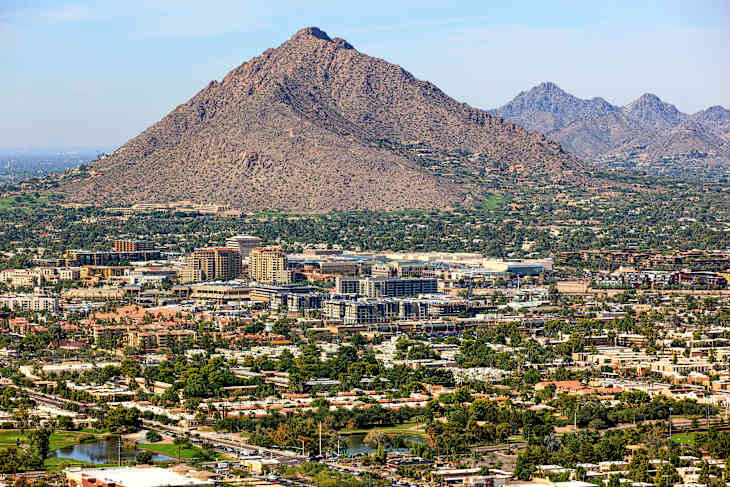
Established neighborhoods like mine in Old Town Scottsdale — buffered by mature trees and set comfortably beyond wildfire-prone fringes — now enjoy a kind of quiet, unflashy resilience. While friends in newer developments on the city’s edge have seen their energy bills spike by 25% or more year-over-year, mine have ticked up only modestly — about 5% since I moved in — despite record-breaking heat.
That kind of stability is becoming rare. Insurance rates here have also held steady — in comparison to some homeowners across the state who have seen a 50 to 100% increase in their rates, thanks in part to our vegetation buffers and location outside high-risk zones.
Looking back, I realize I got incredibly lucky. I didn’t move in because I knew the building’s bones or trees would buffer me from climate extremes. I was just drawn to the light. But knowing what I know now, I’d make the same choices for more intentional reasons. In a state dominated by rapid new development — often at the cost of native landscaping and thoughtful orientation — homes like mine are increasingly hard to find.
My next home will follow this blueprint: mature trees, solid materials with thermal mass, and a neighborhood with built-in buffers that serve both people and the planet.