

Design Changemakers 2021: For Carmeon Hamilton, Great Interior Design Is a Feeling
The Apartment Therapy Design Changemakers Class of 2021 is made up of 24 of the most talented and dynamic people in the design world. We asked an assortment of last year’s Design Changemakers and Apartment Therapy staffers (and you!) to tell us who we needed to spotlight — see the rest of the list here.
Who: Carmeon Hamilton, interior designer, lifestyle blogger, and creator of Nubi Interiors
Nominated by: Medina Grillo, founder of Grillo Designs
Where to follow her: Instagram

Why Hamilton is part of the Class of 2021: “I would like to put forward Carmeon, as I think that she is one of the most bold and creative designers out there. I LOVE the multifacetedness of her Instagram and style and that she is at the forefront when it comes to advocating for diversity and inclusion within interior design. She is definitely one to watch, and I look forward to seeing big things from her in the coming year.” —Medina Grillo, founder of Grillo Designs
Carmeon Hamilton’s first interior design project was her college dorm room. “I walked into a room with cinder block walls and concrete floors, and I wanted it to not feel like a prison,” she says. “With the help of my mom, I decorated it.” When another student — now Hamilton’s best friend — walked in and suggested she check out the school’s interior design program, Hamilton did just that.
Years later, Hamilton’s Memphis, Tennessee, home is still a strong piece of her portfolio, which she has used to grow her business, Nubi Interiors, specializing in design consultation, staging, and interior styling. At home, she takes a DIY approach to design, giving her laundry room a hand-painted facelift, or doing a gradual renovation of her kitchen to make it match the rest of the house.
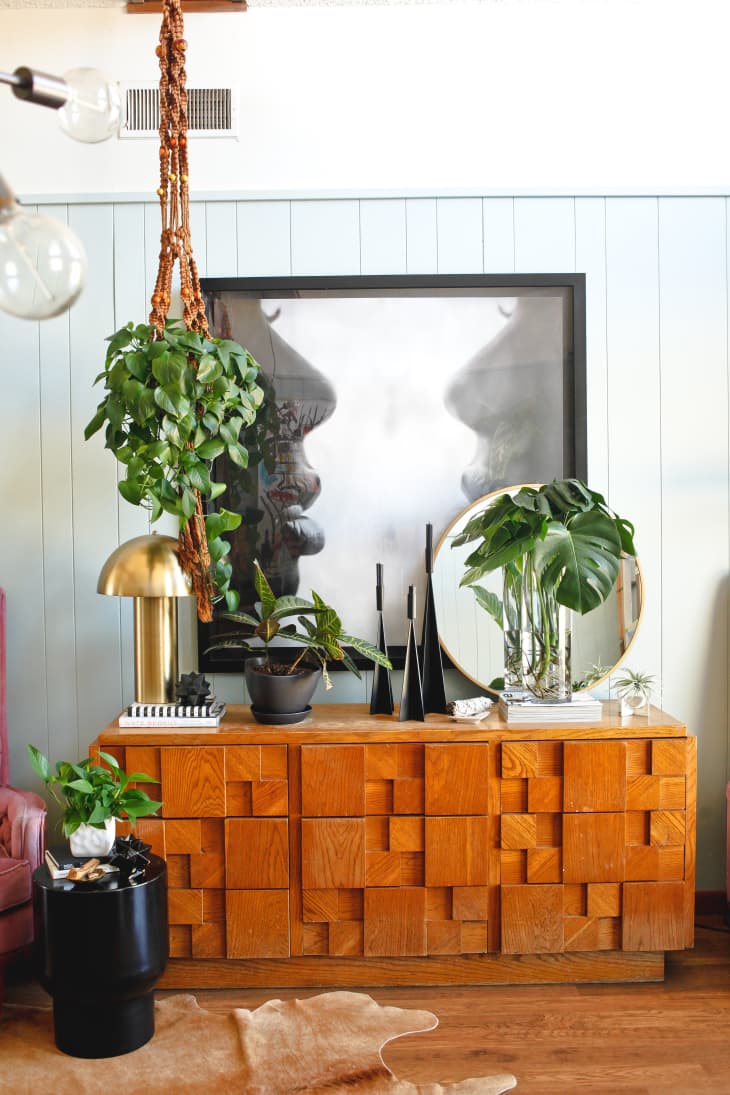
Hamilton, her husband, and their son share the space with a whopping 98 plants. She estimates that 60 percent of them live in her main living and working space, which has the best light. It’s one of her hacks for elevating any room. “Especially when it comes to styling spaces for photography,” she says, “you put a plant in it and you’re already 10 steps ahead of the game.”

Apartment Therapy: What were your design inspirations growing up? What is your inspiration now?
Carmeon Hamilton: My mom was definitely an inspiration and still is. I grew up in a home that was always put together and well done.
Now, being a part of the interior design universe for 14 years, I’m constantly digesting new design content, whether it’s Pinterest or magazines like Architectural Digest or following my favorite designers, like Kelly Wearstler. But also traveling and hospitality design is a huge inspiration of mine; hotel lobbies and restaurants are always at the top of the list for me when I’m looking for inspiration.
AT: Have you always had that talent for painting — not just a steady hand, but a great eye — or is that something you’ve developed over time as you got into design?
CH: It’s something I’ve had for a very long time. I remember being in art class in college. I don’t think I’d ever sketched or drawn anything after kindergarten or first grade. But being in art class, really understanding principles and theories of art and being able to apply it to paper with different mediums, I really realized that I had an eye for things that I didn’t even know I did. But also I get a lot more joy out of being able to transform things with my hands. I’ve built furniture — I haven’t in a long time — but building furniture and painting, those are things I really enjoy. It’s one of those things that naturally happens for me.
AT: What’s your favorite project you worked on in 2020, and why?
CH: My favorite project this year is my own home. We’ve been here four years, but this was the first year we really got to do anything. We made over our kitchen. Our living room got a major paint upgrade. It was the most transformative thing we’ve probably done in our whole house, and it was just paint. We finally got to wallpaper our hallway, and our main bedroom and bathroom were done within the last year as well. So our house has been my favorite. It’s been the one [where] I’ve been able to be the most creative and really go for what I wanted without the constraints of client parameters.

AT: What three words would you use to describe your work or style?
CH: Modern, bohemian, cultured.
AT: Is there a specific piece or design of yours that you think is particularly indicative of who you are or what you’re trying to do?
CH: My home is most indicative of my style, and it’s also the portfolio that gets me hired by so many clients. I think my dining space — with my hand-painted mural, the black walls, a really bold, simple light fixture, and mid-century, and vintage touches — is very much me and my aesthetic.
AT: What makes you feel at home in your own space?
CH: I ensure that I include pieces that represent who I am and who my family is. So we have a lot of cultural elements in our home, but whether it’s mud cloth from Africa or personally created artwork from my friends, people that know me and are a part of my life can also be a part of my home and the interiors that I create. So I always am sure to include personal touches that way. Also the color black is just very grounding for me. So I ensure that I include that in every space that I create in some form or fashion.

AT: How do you think the past year will impact the design world moving forward?
CH: E-design isn’t going anywhere now. Being able to create spaces virtually is something that was a part of life prior to 2020, but now is beyond necessary. And I think a lot of businesses, especially mine, have seen a major increase due to virtual design.
But with that, a lot of people are also understanding how important our spaces are to our well-being. And a lot of people are now investing in interior designers because they’re understanding how important their spaces are. So now I think a lot of people are seeing it [as] less of a luxury and more of a necessity to get the spaces that they want.
AT: How has 2020 changed your perspective on or approach to your work?
CH: On the business side of design, we have timelines and we’re wanting to get in a project, get it done, and get out. But this year, especially with availability of manufacturers and things like that, you have to slow down and you have to take your time. A lot of the time things are out of your control and you just have to roll with it. So being able to slow down and accept things for what they are, where they are, has kind of spread from business to personal life to self-awareness. It’s everywhere now.
AT: People are spending a lot more time at home now. As someone focused on environmental design, how does that impact your client work?
CH: I’ve always had a wellness approach to design. If your space doesn’t feel good, you’re not going to sit in it. So wellness and how we see ourselves in spaces is the foundation of how I create a space outside of function. But now that people are having to actually dwell in these spaces for more hours in a day than they typically have, and also trying to create multiple uses out of spaces, just maximizing square footage, it has definitely stretched me as a designer trying to come up with creative ideas for people to do that.

AT: Any big plans for 2021 or beyond you can share with us?
CH: People will see me on TV in 2021. I just can’t say what I’m doing on TV.
Also, 2021 is where we start to build up our home’s exterior. We have basically stripped away everything around it. So landscaping and a new deck and whole new patio and things outside our house are the focus for 2021.
AT: What, in your mind, is the power of good design?
CH: The power of good design is changing the way people feel about themselves and interact with the other people that have to use those spaces. You can take a space like a dorm room that’s got cinder block walls and concrete floors, and if you just throw a sheet on the bed and stick a lamp on the table, you’re not likely to spend any time there. But if you can figure out a way to soften the hardness of those spaces and bring in color and bring in life with some plants, you’re more likely to be happy in that space. You’re more likely to bring other people within that space. Those people will feel better in that space, and you will likely create better connections with people in that space.
Interior design is more than just looking at pretty things. It’s changing the way people feel about themselves and others.
Interview has been edited and condensed.