
How a 456-Year-Old Tool Helped This Ceramicist Fall in Love with Woodworking (She Keeps It Old School!)
Get to know Apartment Therapy’s 2025 Design Changemakers, the talented risk-takers, disruptors, and doers leading by example and pushing their industries forward. This content is presented by Benjamin Moore; it was created independently by our editorial team.
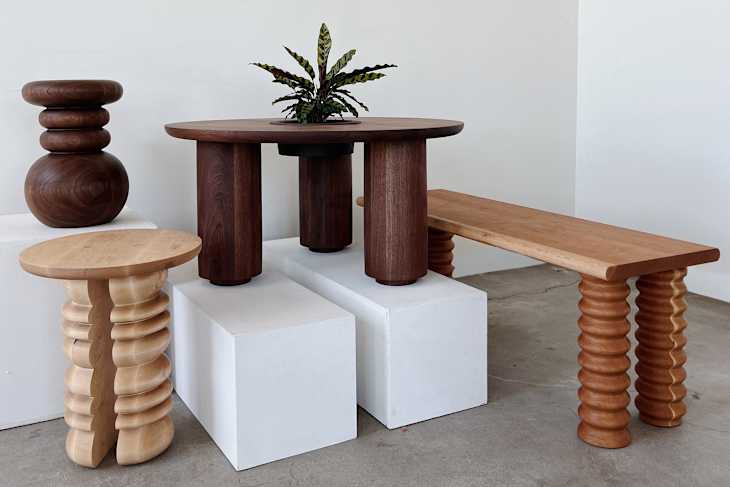
When woodworker Hanna Dausch envisions the perfect setting for her custom-made pieces, she pictures a mid-century modern house in California with the sun shining through the windows. “My favorite wood is cherry, which is a very warm wood,” she says, and she particularly loves the way sunlight hits cherry wood and transforms a space.

It’s fitting, then, that Dausch’s Pittsburgh-based workspace and business, Han Studio — where she makes vases, tables, bowls, candlesticks, and more — is filled with natural light. “I’m very lucky. One whole wall is all windows,” she says.
Dausch set up her 750-square-foot woodshop so that there’s a rhythm and order to everything. “The machines are organized in the order that I use them,” she says. First she picks out her lumber — sourced from a small supplier in Ohio — and cuts it on the chop saw. Then, she puts it on the jointer; next, the planer.
“I have it all organized in a flow, and then my lathe is actually in the corner right next to the windows for natural light,” she says. The lathe is one of six machines (it comes between the band saw and the disc sander) in Dausch’s process — but it’s an important (and traditional) one. Wood lathes were used in France as far back as 1569, according to Brittanica, but there’s also evidence of lathes dating back to 1300 BC in Egypt. A lathe is a machine tool used for turning legs and making other cylindrical details (like baseball bats or spindles), and full transparency: Dausch says it’s also in the corner because it makes a messy pile of woodchips.
The mess is worth it, because Dausch likes the feel of turning by hand — something that’s not so common in mass production. “[Lathes are] still definitely used nowadays, but mainly everything that would be traditionally turned on the lathe … it’s all computer-done,” she explains. A CNC, which stands for computer numerical control, takes care of all the steps Dausch still prefers to do herself.
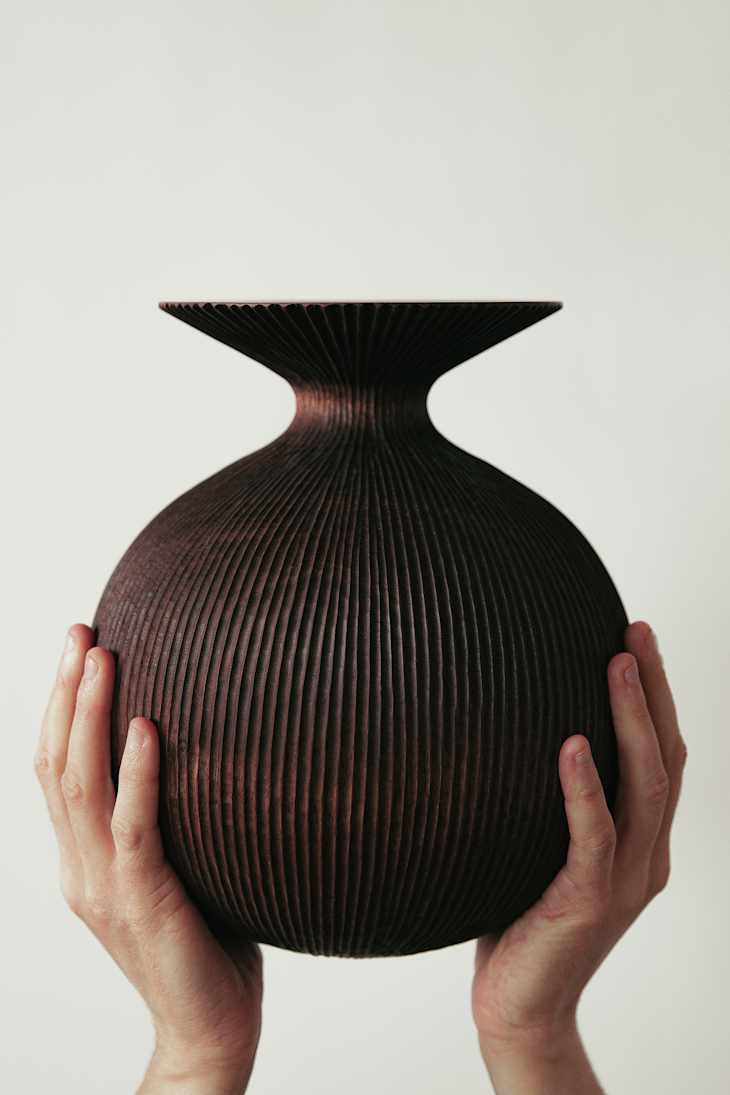
Authenticity is huge for Dausch. “I like a lot of character in my work,” she says. “I keep any knots, I keep sap wood, anything that makes it interesting.” She stays true to herself, too, leaning into the fact that she doesn’t come from a furniture design or carpentry background.
You might be surprised to learn she started out intending to study ceramics and sculpture at The School of the Art Institute of Chicago — but after a ceramics class filled up before she could enroll, Dausch quickly turned her attention to the woodshop.
“All of my sculptures at school just became woodworking sculptures,” she says, and still today, her work is very sculptural. “I’m kind of over all of the hard edges and the big hardware and everything being chunky and big,” she says.
Dausch comes from a family of creatives — her mom is a professional seamstress, and her grandfather (whom she didn’t get to meet because he passed away before she was born) was a woodworker. “I remember I was going home for Christmas break one year, and I asked my mom, ‘Hey, we have all these pieces of Grandpop’s, what did he use to make them? And she said, ‘there’s this machine called a lathe.’”
Back at school, Dausch pestered the woodshop managers to teach her how to use it. “The first thing I made was horrendous,” she says. “I still have it.” Normally, there’s a set of 10 to 20 tools to accompany a lathe, but because they were hardly ever sharpened (it wasn’t a popular machine), she learned with three tools — and she still makes everything that way. She says using the lathe is like “learning to drive a stick shift — you just have to feel it and put the right pressure.”
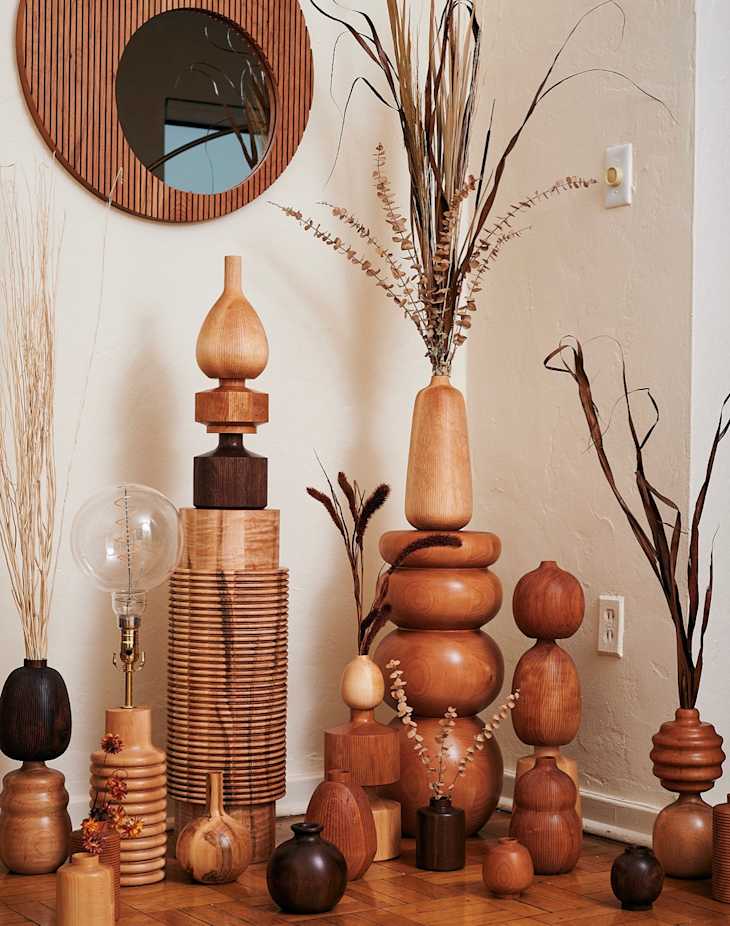
As a small business owner and creative, Dausch feels another kind of pressure, needing to “defend your work and say why your work is good and why it is important,” she says. She describes the struggle to help the public understand what real wood looks like and feels like.
“You see all these big-box stores and, well, most of the stuff is not even hardwood; most of it’s plywood with veneer, and they’re only picking perfect, pristine pieces,” Dausch says. She gets frustrated that consumers then will think that’s what wood should look like.
With a nontraditional woodworking background, Dausch has also dealt with doubters. “I’ve had my business for six years, gotten my fair share of criticism of not going to school for furniture design … and I get it, people have a point, but you just can’t know it all.”
Dausch is “okay with not knowing.” She says it even helps her feel more creative at times because she doesn’t think about the “rules” of woodworking or what won’t work.
Of course, Dausch’s pieces don’t look “perfect” or “pristine” — but for her, that’s the whole point. “I try to keep it all as natural as possible and as close to the tree that it came from,” she says.