
A “Bland,” Underused Dining Room Transforms into a Jewel-Box Family Room
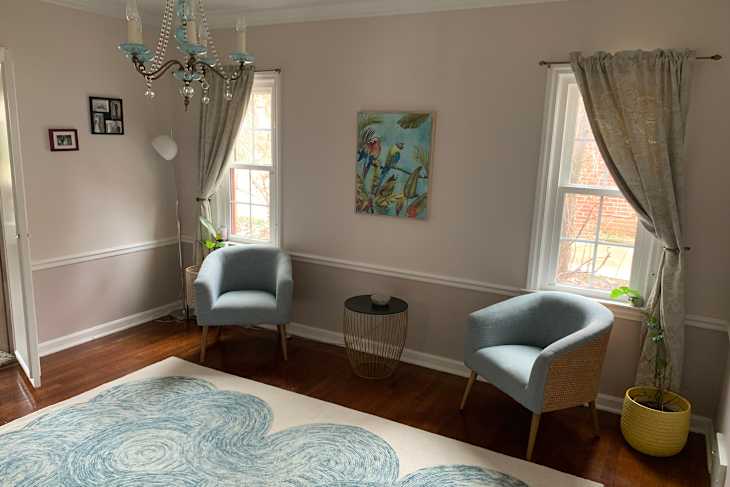
The only good thing about the dining room in my Ohio home was the chandelier — a confection of glass, brass, and crystal baubles. Sandwiched between a sunroom and a parlor room, the space is situated in a railroad-style layout, with a doorway that also leads into the kitchen. Placing a dining table in the middle of the room would have completely messed up the flow. Not to mention, my kids would eventually pile their toys on it.
Essentially, the room was a greige box that only gets good light in the morning. So not only would a dining table hamper the flow of the room, but it would also make dinnertime feel like eating in a dungeon. The one thing I learned as an interior design writer and editor is that just because a room is meant to have a certain purpose, it doesn’t mean it has to stay that way forever.


My husband and I first tried using the space as a movie room by placing a sectional against the back wall, but it felt too claustrophobic. Then we had a lightbulb moment to bring in a piano to make it into a music room. Shortly after our brilliant idea, we stumbled across a vintage player piano with Arts and Crafts-style stained glass. It was $300, and we had to pay another $400 to get it moved from the estate sale where we snagged it (that took four people!). But it was worth it: The room started taking shape.
Once the piano was in situ, our DIY wheels started turning. I jumped at the chance to put up a patterned William Morris wallpaper. Because I have experience putting up peel-and-stick and needed to stay on budget, I opted for the NextWall version of Pimpernel style in a gardenia and sage colorway from The Home Depot. At $60 per roll, I saved big on four rolls, as the original Morris & Co. wallpaper is $350 per roll.

Putting the paper up was the easy part; coordinating the paint colors in the rest of the room took over a month. Using the colors in the wallpaper, I started my search. The room has a chair rail, and I wanted two different colors for the top and bottom to create a high-contrast, more contemporary feel. The folks at the local Benjamin Moore store eventually knew me by name, as I picked up close to a dozen samples. While I tried the creams on the top section and the greens on the bottom, the combination read too predictable and traditional.
I landed on Benjamin Moore’s Thousand Oceans (1645) as the bottom shade to ground the room, a gem of a tone that picked up on some of the muted foliage in the wall pattern. Plus, I wasn’t going to replace the chandelier with the blue glass, so it was a good way to tie the two together.

Exhausted by the Benjamin Moore options, I ordered dusty pink sample pots from Little Greene Paint, and while I liked Dorchester Pink (213), it was a bit too lavender. I finally took the plunge with the brand’s Light Peachblossom (3) in eggshell that winked at the delicate posies. At $155 per gallon, it’s the most indulgent paint in the whole house. But because it changes the entire mood of the space, it was worth it, and I still have some left over for another project. I drenched the top section of the wall and all the doors.
At this point, the white door and window trim, as well as the molding, looked out of place. This was yet another lesson in (paint) chemistry. My sample testing led me to rich violet-brown Benjamin Moore’s Sequoia (1245). Even though I liked the hue, it was a smidge too dark, so I adjusted the saturation by 50%.


To give the door personality and keep the door paneling from being matchy-matchy with the trim, I opted for Benjamin Moore’s Mulberry Wine (1251) on the door paneling. Luckily, all I needed was a sample size, which I already had on hand from my extensive search for the perfect wall color. One of my most favorite details is the spiral knobs that I found at a local salvage warehouse, Rebuilders Exchange. I purchased them on a whim, and they were a perfect replacement for the crystal knobs that were there.
The last painting project was a built-in shelf across from the piano. In theory, we wanted to have a full built-in bookcase; however, bathroom pipes are behind that wall, and I’m just too nervous to drive anchors into plaster walls. At this point, I had paint decision fatigue. So I went back to Little Greene to see what pairs well with Light Peachblossom. Nether Red (315) in satin was the winner. It’s almost like Sequoia used on the trim, just a bit lighter, and gives the corner added depth. I added Crate & Barrel’s smoked glass candlestick holders (a gift from my mom) and a ceramic sculpture by my friend and artist Lindsay Bergquist.


Just above are two frames from HomeGoods with vintage map prints of New York — these were pulled from a guest book from our wedding. I love that behind the images are congratulatory missives from friends.
For the rest of the artwork, especially the space above the player piano, I opted to go with modern motifs that balance out the historical Arts and Crafts vibes. I opted for Half Forms No. 3 and Half Forms No. 1 from LNDN Gray. The minimalist shapes break up the busy Pimpernel print, and because the art has an element of unfinished pencil marks, it doesn’t read as sterile.

I also created a seating nook that serves as a perch for other family members when my son practices the piano. The light blue chair matched the chandelier so well, I kept it in the space. A nearby side table works perfectly for a vintage vase and a spot for my teacup, should I be inclined to curl up with a book.
Each morning, I love the way the light streams through the semi-opaque curtains, a $30 HomeGoods clearance find. Between the button detail, cascading, and pooling at the bottom, these give the room a romantic flair. To complete the look, I wanted a green canvas that spoke to the William Morris wallcovering and the stained glass on the piano yet commanded its own attention against the mauvy pink wall. Deseno, the Scandinavian online art retailer, is my go-to because you can search by color and style, and something is always on sale. I was drawn to “Abstract Greenscape” because it makes you pause and figure out the essence of the design. To avoid any other pattern competition and anchor the room, I went with a Ruggable Harlequin Trellis Re-Jute rug underfoot in a rusty brown.
The dining room makeover took about a year to complete. I loved the process of slow design, taking time to carefully consider every choice. In the end, I created a confection of a space that I can keep building upon. Perhaps a record player is in this music room’s future?
Design Defined
Never miss the style inspo and recommendations you crave with Design Defined. Follow along each week as our Home Director Danielle shares the best style advice, latest trends, and popular decor finds you just can't miss.