
I Asked an Expert to Help Me Organize My 320-Square-Foot Studio Apartment in Paris
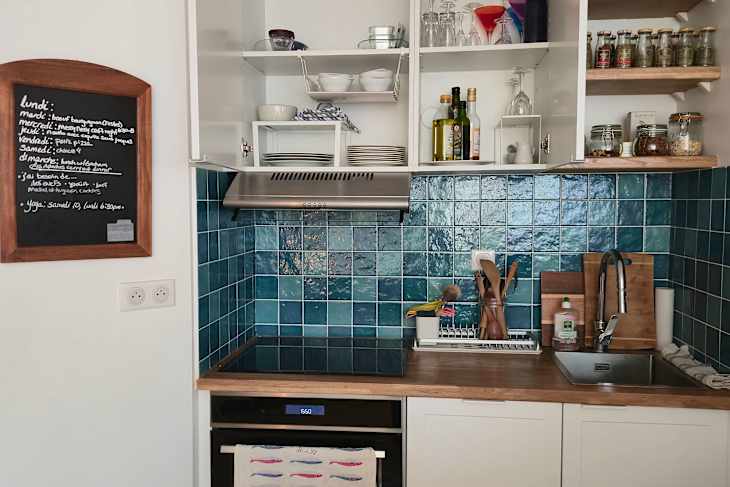
When I moved to Paris for three months, I brought my American experience with me — including my lifelong approach to kitchens that would need serious adjustment for my rental studio, which clocks in at 320 square meters. Not only was I downsizing significantly, but I’d also be sharing the space with the owner’s belongings (they rented me the space while they’re away for a few months).
Fortunately, I had a plan. I called upon Kim Jones of Lock & Key Home, the professional organizer who’d already helped me through two moves back home, to help me bring some systematic order to this small space. I sent her photos and a video walkthrough, focusing mostly on the kitchen. Using Jones’ advice, and some takeaways I’d already learned through working with her twice before, here’s what worked.

Embrace the chaos method.
Jones taught me her approach to unpacking after a move, and I put that to use here. Her chaos method looks like this: Take everything out, assess whether it’s necessary, then group it with like items before deciding where to put it away. Now, she does this from boxes on move day, but it worked equally well in setting up this kitchen for my own use after arriving and using the space for a few days to learn its ins and outs.
This helped me see, for instance, that because I want to use the excellent selection of cooking spices, it would help me to have them where I could see them, rather than in the pull-out “pantry” drawer. Voila! They got a prominent place on one of the open shelves, and I reclaimed some of that drawer for other purposes.
Even though it’s more of a time investment this way than if I’d just tried to move things around, it honestly saves more time and gets better results in the end.
Purge ruthlessly.
Now, granted, it’s easier to cull other people’s things that you have no attachment to than it is to cull your own possessions. But I had to remind myself that just because another person might, say, make toast and tea, it’s OK that I don’t allocate limited counter and shelf space to accouterments for that. I also won’t be hosting dinner parties while I’m here, so it was an easy choice to set aside anything used only for that purpose.
The large entry closet has become a holding area for things like that toaster I won’t use, or will use only rarely (like a roasting pan). This doesn’t feel so different from organizing projects at home when I evaluate how often I really use, say, the KitchenAid stand mixer, and decide to keep it stored out of the way — and it results in a kitchen that feels much more aligned with how I cook and use it.

Increase surface space.
There are only two upper cabinets (two cabinets, period, for that matter) in this apartment. However, they stretch all the way to the ceiling. There is a step stool so I can reach the top shelf, but in order to rearrange things the way I hoped, and to add the things I most wanted (namely, soup bowls), I needed more surface space.
Simple risers were the immediate suggestion from Jones. So, off to IKEA I went, where I found a large and a small shelf riser for just a few euros. This simple solution gave me a way to store bowls without precariously stacking them on top of the plates, and to bring several wine glasses down from the top shelf so I didn’t have to clamber up on the stool for apéro time (the cocktail hour before dinner) every day!
Use your under-shelf space.
While I was at IKEA I ran across an under-shelf basket. That would be perfect for the small yogurt bowls I use every day, I realized, and grabbed one of those, too. Between that and the riser, it feels like I tripled that one cabinet section! Especially using someone else’s kitchen, I’m extra cautious about handling dishes, so it’s reassuring to give everything a dedicated space that doesn’t require any special maneuvering to extract what I’m after.
Corral items.
Jones has shown me the value in gathering items together. While I couldn’t find a lazy Susan like she recommended, I simply used a plate to corral bottles of things like olive oil and vinegar in one of the cabinets. It serves the same purpose of keeping things together, and I can even (kind of) spin it like a lazy Susan (and bonus: It didn’t cost anything!).

Throw out organizing rules and mix and match where necessary.
With only three drawers, I couldn’t be a stickler for keeping different types of things separated. All the kitchen equipment, from pots and pans to small hand tools, were in a deep drawer that made it a bit tricky to get out what I needed without first removing other things.
So at Jones’ suggestion, I partially commandeered the pantry drawer for the pots and pans I use most often, nesting them to make the most of the space. While I couldn’t find a drawer divider, I just added a simple tray to keep food items together, and visually separate from the pots and pans. The tray isn’t very big, which forces me to limit purchases to what I most need right now (part of an overall shift in cooking here anyway!).
Three weeks in and this kitchen works great for me. No more frequent stool climbing or rummaging through unused items to find what I need. With only a few thoughtful tweaks and some smart storage solutions, I’ve managed to carve out my own space while respecting someone else’s kitchen.