
I Use the “Head-Chest-Shoulders” Light Formula in Every Room (the Results Are So Cozy)

I often think that great design is one part intuition, one part formula. While it’s awesome to trust your gut and lean into whatever it is you like in your home, abiding by certain guidelines or formulas can make it easier to focus all your creativity on fun stuff that will really move the needle.
You probably already know that there are plenty of number-based rules to follow — like how high to hang art or the right distance between your coffee table and couch (16 to 18 inches, for what it’s worth) — but there are also a ton of tried-and-true formulas that designers rely on to guide their layouts and inform their product selections. One of my personal favorites? The “head-chest-shoulders” lighting formula, which adds instant ambience to any space.

How the Head-Chest-Shoulders Lighting Formula Works
Similar in concept — and in name — to the “thrill, fill, spill” guideline in planting, this easy-to-follow formula is one I rely on regularly to ensure I’m crafting a lighting scheme that enlivens the space, adds a flattering glow, and, above all, makes any room functional. First, I must admit that I coined the pithy name of this strategy, but the foolproof formula behind it is one many designers have relied on for decades as they spec out spaces for clients (and themselves). To put it simply, it’s a reminder to choose lighting sources that shine on all three aforementioned parts of the body: the head, the chest (when standing), and the shoulders (when sitting).
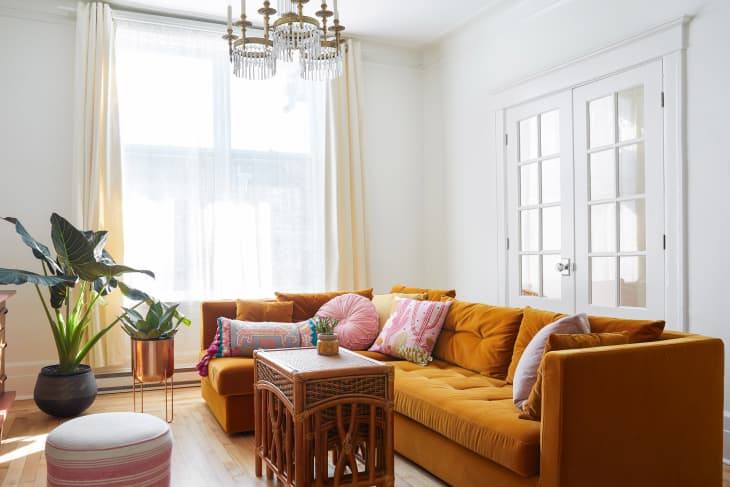
“Head” Lighting Sources
To kick off your introduction to this strategy, start from the top — of your room, that is. Beginning every lighting scheme with an overhead light is not only a logical place to start, but it also allows you to determine what your “hero” fixture will be in the space. In some instances, you may want all eyes on a funky, mid-century Sputnik style chandelier; in others, a simple flushmount might be the better choice to let a bold table lamp really shine.
Whatever style you choose, look for an overhead light that illuminates the majority of your space on its own. It’ll be the first thing you flick on when you enter the room, and likely the only light you’ll rely on daily; the other two “ingredients” in this formula will bring the ambience but won’t be as integral to day-to-day function.

“Chest” Lighting Sources
Next up, there’s chest-level lighting, which most often refers to wall sconces, but can also sometimes mean drop pendants over a kitchen table or game nook. These pieces add a flattering face-height glow and instant warmth to your space, enveloping your whole room in a cozy hug after the sun goes down.
Chest-level lighting is also much dimmer and more nuanced than overhead lighting, making it a great option for anyone who is easily overstimulated by “big lights,” especially toward the end of the day. Soften the effect even more by putting your sconces on a dimmer or opting for fixtures that filter light using paper or linen shades for a flattering cast that will make any room feel like a total vibe.

“Shoulders” Lighting Sources
Last but not least is the lowest level of lighting, which you want to hit at shoulder height when you’re sitting in the room. If you’ve peeked at any Nancy Meyers-inspired space, you’ll know that table lamps are key to a cohesive, well-designed room. Not only do they add necessary illumination for you to tear your way through your TBR pile or nightly crossword puzzle, but they can also bring a pop of color or funky texture to your space, helping to round out your design scheme. I like to aim for at least two to three lamps per room, depending on the size of the space.
Best of all, table lamps are often the most affordable lighting source of the three, and they don’t require any heavy-handed installation techniques, making them a great option for renters. Remember to have fun with this final touch; experiment with size, color, and shape to ensure your lamp choices feel like they bring a little something extra to your room — in addition to the perfect glow, of course.