
Here’s How to Make the “Scandinavian Bed-Making Hack” Actually Look Good (So Easy!)
If you share a bed with someone at night, you’re likely all too familiar with the issues that can arise. I’m talking stolen bedsheets, differences in body temperatures and blanket needs (I tend to run cold and need lots of layers, while my boyfriend runs hotter than our furnace), and blankets being ripped off due to incessant tossing and turning. In these cases, the Scandinavian bed-making method can be a game-changer and relationship-saver — take it from me!
Not everyone is a sleep match made in heaven, and that was true for me and my boyfriend, Curtis. I knew the first night we spent together that we would have problems. It was February in Boston, freezing cold in his apartment, and he was hogging the only queen-sized, thin blue blanket on his bed. Combined with his tossing and turning, my light sleeping, and our fundamental differences in how many layers are needed to sleep comfortably, let’s just say sleep doesn’t come easily to us.

Fast-forward four years, and we’re still having problems in the bedroom — sleep problems, that is. Then, six months ago, we discovered the Scandinavian sleep method, and our lives (and sleep goals) changed forever.
Our new (free!) weekly newsletter, Design Defined, has the latest style recs from design pros — all delivered straight to your inbox.
What Is the Scandinavian Bed-Making Hack?
If you aren’t familiar with the Scandinavian sleep method, it is an ingenious hack where a couple sleeps with two comforters on one bed rather than one. Each person has their own blanket and can hog their own comforter as much as they please. Typically, two twin-sized comforters or duvets are used, but you can also opt for full-sized comforters if you need a bit more space. Anything larger could get tangled or bunched together in the night, which could cause disrupted sleep.
This bed-making method accommodates different sleep needs and habits and fosters a more comfortable sleep environment for both partners. According to Courtney Sempliner, an interior designer based in Port Washington, in true Scandinavian fashion it’s fundamentally about creating a pared-back and functional sleep space. For example, traditionally, this method foregoes the use of flat sheets in the interest of simplicity — a practice common across Europe, where the top flat sheet is often obsolete.
“You would just wash the duvet cover as frequently as you do the fitted sheet and pillowcases,” Sempliner explains.
That said, the beauty of this bed-making method is that it’s designed to be tailored to your unique sleep needs and preferences, so don’t be afraid to customize your setup. While the traditional method involves using only a fitted sheet and two comforters, my partner and I use a fitted sheet, two flat twin sheets, and our comforters — that’s just what works best for us!
What Are the Benefits of the Scandinavian Bed-Making Method?
Besides putting an end to the nighttime blanket tug-of-war, the Scandinavian bed-making method offers several benefits. Namely, because each person has their own duvet and/or sheets, they can choose their preferred warmth, weight, and texture, says Isfira Jensen, founder and principal designer of Jensen & Co. Interiors.
“It allows each person to sleep more soundly and even allows for a more personalized sleeping experience,” she says.
No need to compromise on a duvet that isn’t quite right or put up with a material or texture that you don’t like. With the Scandinavian bed-making method, you can have your cake and eat it too.
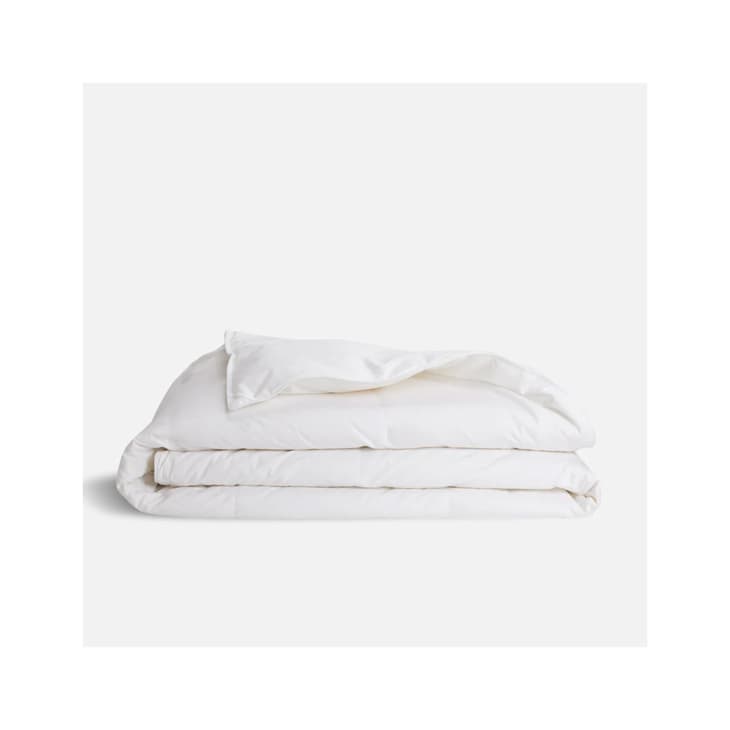
This is exactly what Curtis and I did upon implementing the Scandinavian bed-making method for ourselves (the customizing part, not the cake part). Because I have allergies, I use Brooklinen’s Down Alternative All-Season Comforter, while Curtis uses the Natural Down All-Season Comforter. As for flat sheets, Curtis loves his jersey cotton, while I chose a cool cotton blend.
Switching out our thin queen blanket for two fluffy twin comforters has saved our sleep relationship. Unfortunately, having two blankets on a bed isn’t always aesthetically pleasing, so I turned to the design pros for guidance.
How Do You Make Two Blankets on a Bed Look Good?
According to Geneviève Rosen-Biller, a decor expert and founder of Bed Threads in Sydney, Australia, there are multiple ways that you can make the Scandinavian sleep method look more presentable in your bedroom. But keep these two main tips in mind.
Use the Same Solid Color for Both Duvets
“Matching duvet covers are essential to styling a bed with two duvets, and choosing a solid color will ensure they blend together more easily than a pattern,” explains Rosen-Biller. “You can either fold them in half or thirds lengthways and lay them side by side on the bed, or another option is to spread them out next to each other on the bed, slightly overlapping down the center. A throw layered across the bottom of the bed and some extra pillows will help to streamline the look.”
“Marry” the Two Sides with Coordinating Accessories
On the other hand, Sempliner says you can easily go with a solid or a patterned duvet — just make sure you “marry the two sides of the bed with a coordinated look of decorative pillows, a long bolster pillow, and an end-of-the-bed throw.” She also suggests covering the two duvets with a single coverlet at the foot of the bed for a more uniform look.
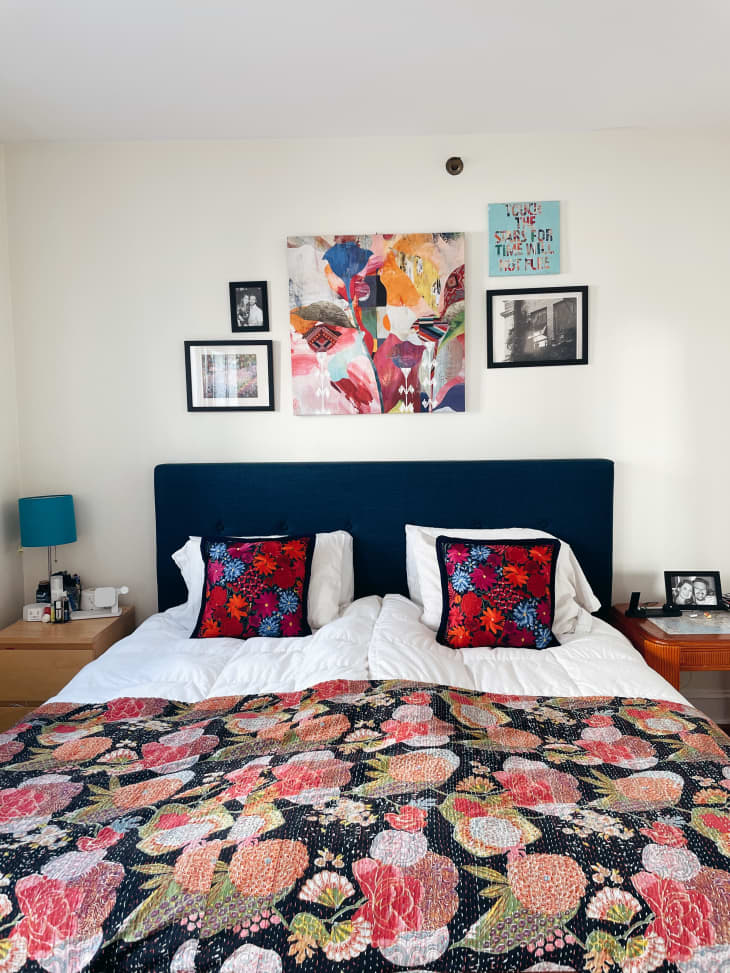
Personally, because we love the feel of our Brooklinen comforters, we’ve foregone any duvet covers and instead sleep with them bare (hence the flat sheets underneath). I’ve definitely taken the coverlet tip to heart, though, adding a colorful floral quilt to distract from that seam that runs up the middle of our bed due to having separate comforters. Certainly, the matching pillows help distract a bit there, too.
Perhaps we could add beautifully patterned duvet covers to the two comforters, but considering I’ve been getting eight-plus hours of sleep the last six months, I’m hesitant to change anything up. Truth be told, I’d opt for a full night’s sleep over a pretty-looking bed any day, but now I can have both.