
Why Were Popcorn Ceilings So Popular? The History Behind This Budget Design
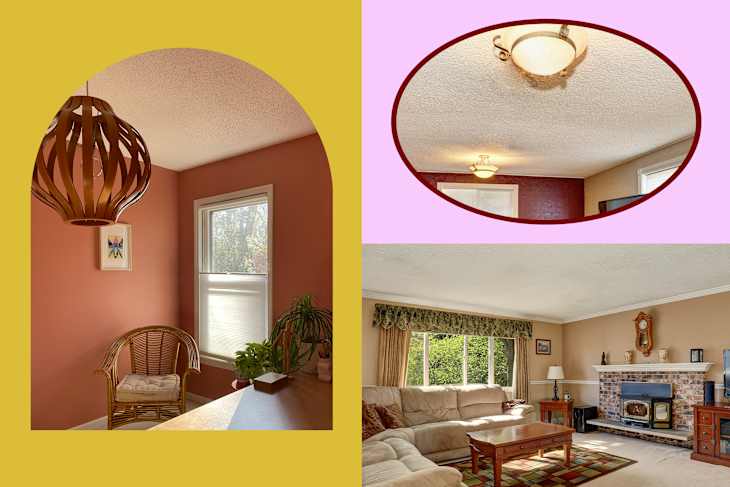
It’s a question for the ages: Should you remove that popcorn ceiling? While they may be one of the first things on the chopping block on popular home renovation shows, it wasn’t all too long ago that popcorn ceilings were en vogue (yes, really!). They became a staple in more than 40 million homes created in the years following World War II, when the U.S. economy supported a major housing boom. But what exactly was the point of this particular design?
Often referred to as “cottage cheese” ceilings, popcorn ceilings employ a brazen look that mimics the popular post-war dairy staple after it has been sprayed on. This texture is indeed helpful in that it can camouflage imperfections in a ceiling’s drywall, as well as muffle some sound (more on that later). Homeowners don’t always associate cottage cheese with stylish interiors, but many choose to leave popcorn ceilings alone for a somewhat unexpected reason.

Renovation costs, surely, are a factor; but so are health and safety. Leaving popcorn ceilings intact is a choice you’ll understand more once you hear about how this textured surface is made during construction. Read on to learn more about the history of popcorn ceilings and their initial purpose, according to those in the industry who know about their complex past.

When did popcorn ceilings become popular?
“[Popcorn ceilings] were an inexpensive and easy way to hide imperfections and still give the illusion of a dazzling white finish,” explains Tina Martindelcampo, principal designer and founder of Tina Martin Interiors.
The finish began to sweep interiors in the early 1950s, becoming a mainstay feature in new homes for more than 25 years. “Popcorn ceilings could be found in many new low- to mid-cost housing developments and multi-story residential buildings,” explains Maria DeLucia, principal and founder of square one studios. “The age and style of homes varied greatly, as it was used in both new construction and renovations of older styles.”
Believe it or not, popcorn ceilings were first seen as helpful, both by construction pros and homeowners. Applying this finish was quicker than making smooth ceilings, which have to be drywalled, primed, and painted. The texture of popcorn ceilings simply covers many irregularities and eliminates the need to apply, feather, and sand multiple layers or fill in holes, explains Jordan Fulmer, founder of Momentum Property Solutions, a real estate and home renovation services company.
Its quick and affordable application was especially useful in the 1950s, which marked the start of a construction explosion. The decade saw a sharp increase in the number of houses being built to accommodate the growing economy and burgeoning suburbs following World War II. The way that popcorn ceilings helped builders save time and energy only helped fuel this housing boom.
Along with being inexpensive and hiding imperfections, popcorn ceilings also had sound-dampening qualities. “They can reduce echoes in a room, just like carpet or acoustic wall panels,” explains Fulmer. In places where one might have loud neighbors — especially in apartment buildings and dorms — popcorn ceilings became increasingly common.

Here’s when (and why) popcorn ceilings fell out of style
A key material in mid-century popcorn ceilings was also the impetus of their downfall. Popcorn treatment originally contained asbestos, which was later discovered to be harmful to human health. A naturally occurring fiber mineral, asbestos may cause serious health issues (including cancer) when it’s released into the air and inhaled.
The key is that popcorn ceilings containing asbestos fibers aren’t harmful — until they’re disturbed. When damaged, crumbled, or removed improperly, they become unsafe, according to materials published by The Mesothelioma Center.
When the use of asbestos was banned in U.S. homes as part of the Clean Air Act in the late 1970s, manufacturers switched to tiny particles of vermiculite or polystyrene instead of asbestos, DeLucia explains. But the association these ceilings had with asbestos eventually earned them a negative reputation. Popcorn ceilings steadily declined in popularity during the ‘80s, and have yet to make a comeback since.
Are popcorn ceilings still used today?
Today, popcorn ceilings are rarely (if ever) designed into a new build. “It’s viewed as outdated and can even lower the value of your home,” says Katherine Meyers, an interior designer and project manager at design firm Chango.
While popcorn ceilings might be lacking love from the design community these days, the look certainly had its moment in history and solved problems in its heyday. In recent years, however, a new technique has filled the same time-saving, low-effort niche. “Many newly-built homes have utilized ‘knockdown texture’ instead of popcorn,” Fulmer shares. “This texture is a little more subtle, while still giving builders the benefits of masking drywall imperfections.”
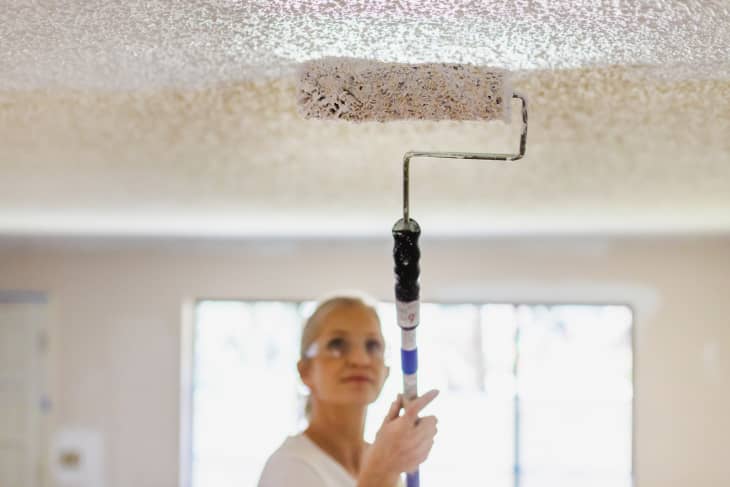
As for what to do if you have popcorn ceilings? Removing them yourself is extremely messy and labor-intensive — and possibly dangerous. You can (and should!) hire someone to do so professionally. “Expect to spend at least $1 to $2 per square foot,” Meyers says.
If you inherit popcorn ceilings in your next space and choose to leave them be, you’re not alone. Many Apartment Therapy editors have discovered ways to help soften their look; including wonderfully distracting wallpapers or unique touches like painted floors. Investing in other surfaces is always an investment that pays off in spades.