
How Holiday Inflatables Took Over Your Neighborhood — And Ignited HOA Wars
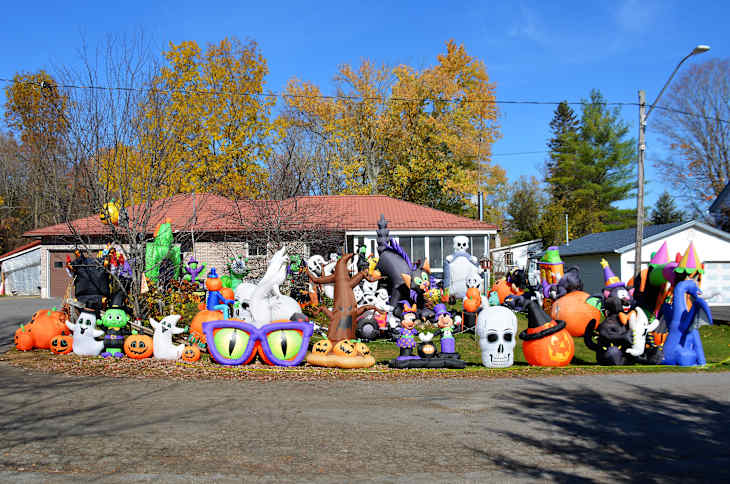
It’s October, which means homes covered in spooky decor are just about everywhere you can look. After Halloween, those same spaces — from their yard to the entryway — will quickly transform into winter villages with gigantic Santas led by reindeer. It’s easier than ever for people to create these elaborate displays because of one reason: large, outdoor inflatables.
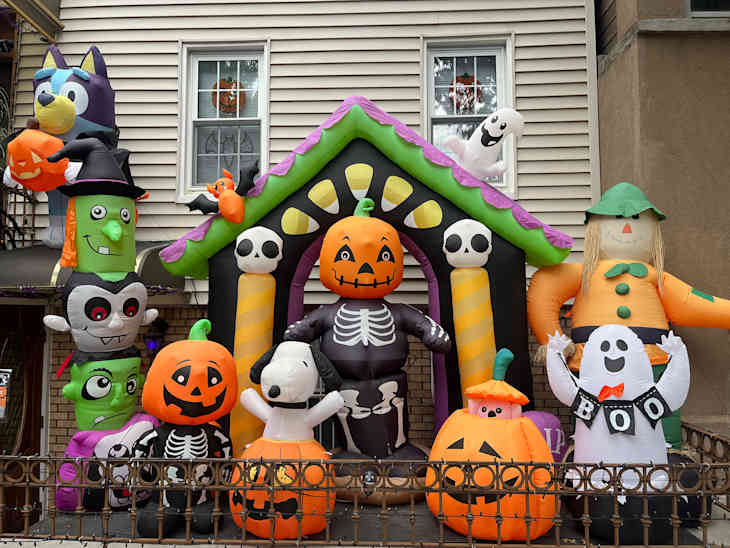
About four years ago, I noticed these massive inflatables popping up outside of brownstones, row houses, apartment buildings, and stores in Brooklyn, replacing the intricate light displays that came before them. It makes sense why people gravitate toward them: The blow-up decorations are much easier to pack and ship to a home. Plus, they can take up less space when storing them and are far less heavy than traditional outdoor decorations. But they were everywhere, and present from Halloween to New Year’s Eve.
It was cute to start, but it sent me down a rabbit hole. I had to know how inflatables had successfully converted so many decorators to change their ways. After all, there’s a ritual to holiday decor: Many decorations in my family are passed down from grandparents, given by family and friends, and have memories associated. Inflatables won the decorating game. Like lights before them, I suspected it was a matter of time until everyone started to hate them.
Where Did Inflatables Come from, and When Were They Invented?
Just 24 years ago, a Coppell, Texas-based company called Gemmy Industries blew up the inflatables craze — pun intended. (Before this, Gemmy was best known for the singing Big Mouth Billy Bass plaque that dominated living rooms across America.)
Dan Flaherty, co-owner of Gemmy, was inspired to innovate in the holiday space by the inflatable gorillas that would lurk outside car dealerships. He and the team brought their technical know-how to the Christmas decoration world and developed an eight-foot inflatable Santa in 2001. After the success of this one Christmas item, they expanded into Halloween and Thanksgiving as well, and moved into licensing a variety of brands, from Star Wars to Peanuts.
The inflatables are made of polyester fabric with coating designed to expand and look complete when fully blown up. Gemmy Industries patented their motor system that keeps the inflatable blown up and running all night. More elaborate inflatables may even have lights attached so they stay lit up in the dark of the night. Although there are options of inflatables without motors (either blown up by pump or sustained by wind), the inflatables market still largely belongs to Gemmy: Their Airblown Inflatables make up about 90 to 95% of the market share.
The inflatables shift has been creeping into home goods, outdoor, and decor stores. Now you can buy an 18-foot inflatable Jack Skellington to loom over your front yard and delight trick-or-treaters. In a story by Marketplace, consumer psychologist Kit Yarrow says shelves have changed from being stocked with a majority of twinkle lights to a majority of inflatables.
Inflatables have been growing in popularity for some time, and not just because of the motor-driven blow-up effect. In a six-year study from Growth Market Reports, a market research company, they asserted that the “global inflatable yard decoration market size reached USD $1.98 billion in 2024.” The North American market alone accounted for about 38% of that growth. Given the American pastime of obnoxious, campy decorating, it makes sense that North America is at the top.
When Holiday Decorating Goes Too Far
Laura Waterson, general manager and integrator at Koehn Painting, lives in a house in Wichita, Kansas, and absolutely loves inflatables. She has a five-foot-tall Santa for the holiday season that she places on the window of the second floor of her house so it looks like he’s trying to get in. It’s the perfect holiday decoration for Waterson — it’s “quite easy to install and doesn’t require too much power.” She says that her neighbors “expressed some amusement mixed with appreciation,” and that inflatable winter holiday decorations dot yards across her neighborhood.
Despite their popularity and whimsical nature, inflatables aren’t exactly beloved by all. I talked to a number of folks who really don’t like them or have had downright bad experiences with neighbors who over-index on these puffed-up decor gems.
Jo Hayes, an etiquette expert from Brisbane, Australia, considers holiday inflatables to be “tacky” and a sign of “profound disrespect for one’s neighbors.” Martin Orefice, a resident of Orlando, Florida, considers these decorations huge annoyances because “you’ll have gawkers hanging around for weeks, people slowing down when they drive by, and potentially even kids walking into the yard.” It’s a liability on top of a visual spectacle that not everyone even likes.
Scott Schrader, a cleaning expert at Cottage Care who lives in Littleton, Colorado, told me he doesn’t mind a small inflatable, but gets frustrated when it gets out of control: “It becomes grating when you have towering Santas and neon snowmen that essentially take over the yard, inundate the sidewalk, and become too ridiculous. I genuinely enjoy the holiday spirit but there is a threshold where it feels festive is replaced with decorated chaos.”
How Inflatables Can Cause Legitimate Safety Issues
Whether or not your holiday decor leans more camp or refined, personal taste is not the only issue for even the biggest supporters of holiday cheer. If elaborate inflatable and light displays are left on all night, neighbors are subject to all-night noise and lights.
Reuben Wilt, a pool screen repair company owner and resident of Tampa Bay, Florida, had an even worse experience. In the past, he said he didn’t particularly mind yards covered in inflatable decor. But he changed his tune when a neighbor’s inflatables actually caused a fire.
“I used to have a neighbor who had one of those big inflatables that they just kept running in their yard all the time. In the middle of the night, the motor got so hot that it shorted [out], and fire went out of their lawn display and [hit] nearby fencing.” Luckily, the fire was contained quickly, but given the time that the fire started, it could have been a much scarier situation.
He’s not the only one who’s experienced this. Last Christmas, in Napa Valley, an area prone to wildfires, an inflatable outside a home in Yountville caused a small fire; it was so thoroughly burned that its original shape was undetectable. Thankfully the fire was quickly contained, but local firefighters put out a statement to use extra caution with decorations that required outdoor electrical sockets.
When HOAs and Holiday Cheer Clash
The abundance of inflatables also has an effect on renting and buying behaviors. Gagan Saini of JiT Home Buyers in Oakland, California, notes that he’s seen potential buyers find restrictions, or a lack thereof, on holiday decor from their potential future homeowners association (HOA) to be a deal-breaker during the home-buying process. HOA rules about lawn care are common, but Saini says more are looking to address out-of-control decorations as well.
In one Oakland HOA, Saini said that after “residents of a 100-unit condo community consistently put up what their neighbors considered distasteful Christmas decorations, including large inflatables, as early as Thanksgiving,” the homeowners near the condo complex neighbors took offense — and action.
A homeowner who lived next door to the condo community “described the inflatables as an eyesore that their own guests would comment on.” They led the charge to get the HOA board to “revise the rules to prohibit large, plastic, or inflatable decorations and to limit colors and brightness.” The homeowners who detested the inflatables of the condo dwellers explained that they had concerns about “community aesthetics, property values, and the general taste level of the neighborhood.”
Whether or not you like going all out on Halloween, Thanksgiving, or Christmas, inflatables can be a strong sign of neighborhood demographics. If you’re looking for a quiet community of retirees, inflatables are probably a sign of families and therefore a very rambunctious Halloween night full of trick-or-treaters. But not all neighborhoods are decoration-phobic. If you’re looking to go all-out with holiday cheer — and don’t want anyone breathing down your neck about the types of holiday decor you do and don’t want to use — then it probably makes sense to look for neighborhoods with more festive outlooks.
Are Inflatables Here to Stay?
Inflatables are not only here to stay, but likely taking over. The aforementioned Growth Market Reports study also projects that the inflatables market could expand to $3.7 billion by 2033. Outside of what you can get from licensed inflatables and a variety of holiday scenes, customized inflatables are now an option. If you can’t find the perfect Peanut, Star Wars character, or Christmas scene, you can build your own. Maybe even an inflatable self-portrait, Zombie-fied.
Madalyn Gotschall, manager of social media marketing at Halloween Express, a Halloween merchandise and decor company, told me that this is a big year for inflatables sales, likely because of warmer weather (so fewer weather-related wear-and-tear for the inflatables) and Halloween falling on a Friday. Anyone who would usually waffle on throwing a party with decorations will surely decide to make Halloween weekend a major event.
All in all, neighbors across North America will have to accept the continued presence of these looming spectacles. Personally, I can’t hide my smile when I come across a gigantic blow-up Snoopy in a Santa hat. They feel whimsical in a way that brings up holiday nostalgia for me, and offer some much-needed silliness to a cold, dark time of year. Let’s just all agree to turn them off at night and avoid electrical fires.