
See How a Stager Transformed an “Overwhelming” Home Feature (It’s So Much More Airy!)
In interior design, the ceiling is sometimes referred to as the “fifth wall.” Like the other four, the ceiling can be accentuated with vibrant or calming paint colors, patterns, textures, and other designs to complement the room’s overall aesthetic. But what happens when a home’s ceiling is so beautiful that it threatens to steal the show? It’s a dilemma that Dianna Scarpa, CEO of Opal Home Staging, handled quite masterfully for a home in North Caldwell, New Jersey.


The geometric coffered ceiling in this four-bedroom, five-bath home “was the biggest wow factor when you walked in,” Scarpa says. But she knew it could also be distracting and even “overwhelming” to some buyers. “If you’re not this supermodern, contemporary person, that might be a turn off to you,” she explains. Her staging strategy was to let the ceiling shine on its own while choosing furniture that “kind of made it a little more approachable for your average person.”

Big Rooms Require Creative “Zone” Solutions
Stagers often struggle with figuring out how to arrange furniture in a small space. However, when rooms are large, stagers can be challenged in the opposite way. Scarpa needed to figure out how to make the most of the abundant space that was the big, long dining room.

The solution? Divide the room into different zones. Scarpa and her team created the actual dining area as well as a smaller conversation area so that buyers could see how to use the space practically. Scarpa chose furniture with clean lines and a low profile to not block any sight lines, as well as make the thick, coffered ceiling look less top-heavy.

Mimic the Architecture of the Ceiling to Create Balance
The living room had a symmetrical design — with a beautiful fireplace and lots of windows. They added bouclé sofas on either side of the fireplace and two pieces of wall art. The round mirror over the fireplace mimicked the circles and arcs in the ceiling quite nicely, too.

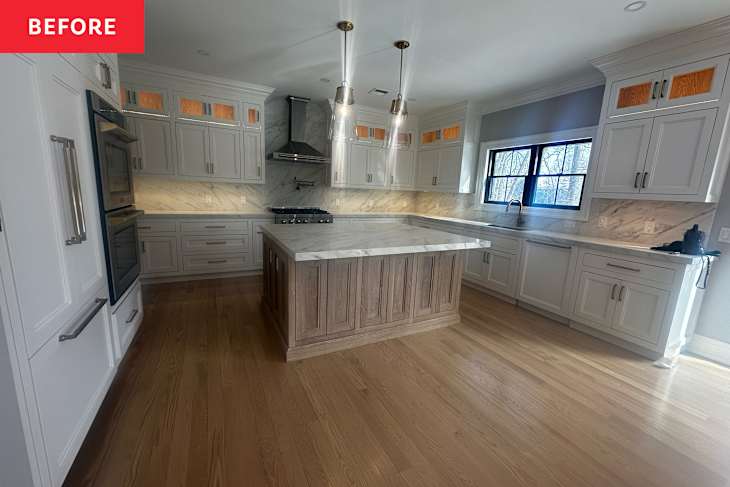
The gorgeous open kitchen required only minimal staging. Scarpa and her team added some stools and accessorized the island with a big vase filled with tall stems. The look was dramatic, but it served a purpose, according to Scarpa. “When we accessorize, we try to use bigger things so that they’re shown in the photos instead of smaller things [that] tend to kind of get washed out and look like clutter and don’t photograph as well,” she says.

A powder room on the first floor retained its minimalist design during staging, but a console located right outside was decorated with accessories and large artwork.
You Don’t Need to Stage Every Space
Only the first floor of the home was staged. The four bedrooms upstairs were large, but because they had relatively normal shapes and layouts, it was fine to skip the staging — there was no doubt that buyers could easily fit a bed and furniture in any of them, Scarpa explains.

The home was originally listed in August 2024 for $1,899,000. After two price drops, it was taken off the market with no offers. Scarpa was brought on in late January 2025 to stage the home, and it was relisted in early February for $1,699,000. At the open house that weekend, an offer was received. The house went on to sell for $1,800,000 — $101,000 over the new (but lower) asking price.

The staging was such an obvious success that one can’t help but wonder if the seller could have nabbed the original full asking price — or more! — had it been staged from the start. Scarpa says it’s hard to know for sure, but this property could very well be an example of how staging can lead to a faster and more lucrative sale. “I’m a firm believer that when you stage right out of the gate, you have better results,” Scarpa says.