
I Asked a Stager for Basically Free Hacks to Transform My Patio, and She Gave Me 5 Brilliant Ideas
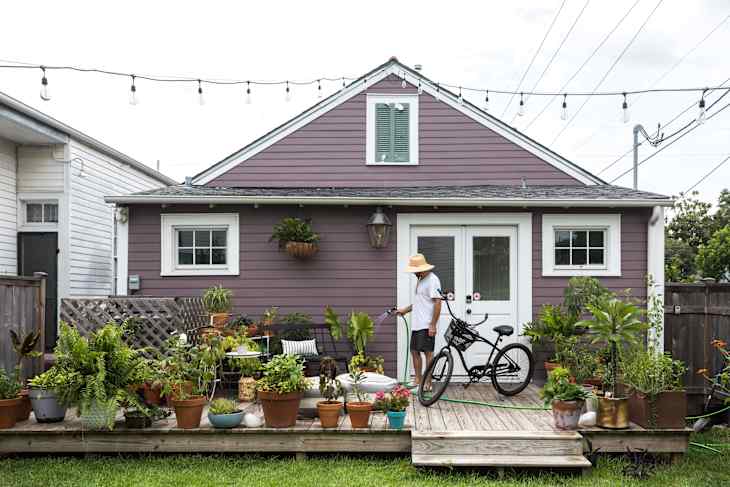
Much of home staging focuses on interiors, but it also helps to include your outdoor space in the mix — especially if you’re listing your home in the spring and summer months. Even if you’ve got a small porch, patio, or backyard like mine, it’s all valuable square footage that can be arranged in a way that woos potential homebuyers.
If you’re reserving your budget for more pressing indoor fixes before you put your house up for sale, then you’re likely eager to find ways to spruce up your outdoor space on a budget — or, better yet, for free. I had the opportunity to chat with celebrity interior designer Cathy Hobbs, ASID, author of Home Design Recipes and owner of Cathy Hobbs Design Recipes, an interior design firm that specializes in home staging. Here’s what she told me about staging an outdoor patio without breaking the bank.

Start with a good cleaning.
Cleaning up outside isn’t exactly the same as dusting and vacuuming inside. For a deck surface, Hobbs says a good sweeping, followed by soap and water, should do the trick. This would also be a good time to repaint or restain a wooden deck.
A power or pressure washer might help with the cleaning, but only if the outdoor surfaces can handle it, like a concrete patio. Be careful with it on decks, where the blast of water can splinter wooden planks or pull up nails. If you’ve got a garden hose hookup handy, Hobbs says that’s your best bet. “Some of the easier-to-maintain materials can be maintained with a traditional garden hose at a high spray point,” says Hobbs.
Anchor the space with an outdoor rug.
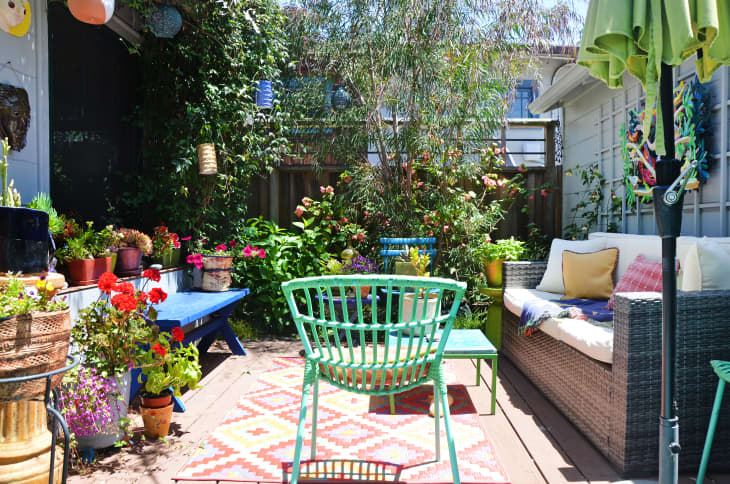
Fans of the 1998 movie The Big Lebowski already know that a rug can really tie a room together (it’s a notable line from the film!). It’s the same deal for your outdoor space, although you should select an indoor/outdoor style that can get wet and is simple to clean. “I’ve even used indoor/outdoor rugs indoors, because as a stager, you also want something that’s going to be easy to maintain,” Hobbs says.
Hobbs likes choosing a rug in a color that serves either as a “springboard to a color palette” with the throw pillows or cushions, or one that, yes, ties everything together in your outdoor space. It’s likely the most expensive “add” on this list — an outdoor rug at Wayfair can run you $300, but the site regularly runs good sales (like this 7×10 indoor/outdoor rug for $150), so you should always scope out some pre-season sales to get a good deal. The best part? Even though you’re investing in a rug now, it’s easy enough to roll up and take with you to the next place.
Create functional zones.
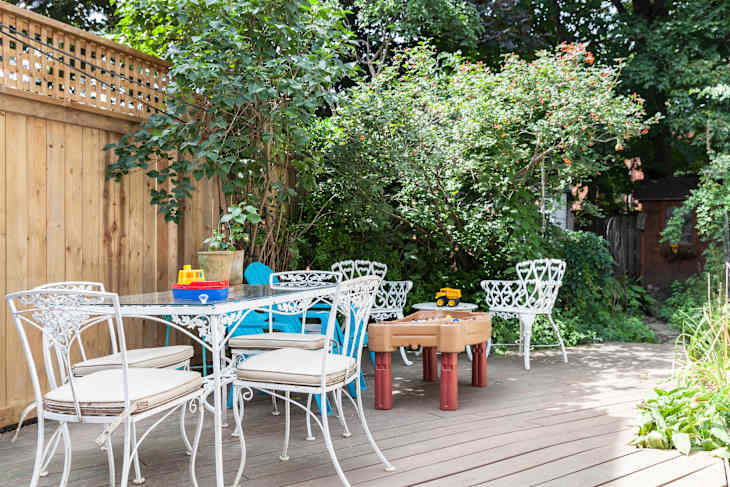
Think of your patio as an open-concept floor plan and create zones within it for different activities. Hobbs says she will typically stage zones for entertaining or dining, although homeowners with larger spaces can expand into additional zones for playing, lounging, and even working from home.
You don’t need to buy any furniture to make this work: If you have a table and chairs and maybe two lounge chairs, after giving them a good clean, move them around the space in a way that makes you feel your patio has multiple uses or places to “hang.”
Hobbs likes modular outdoor furniture for this, so that you can move chairs and tables around your yard easily for different looks and uses, rather than having the traditional round table with an umbrella. The idea is to demonstrate a function of use for your outdoor area so that potential buyers get a sense of what activities can take place in each zone, Hobbs says.
Remove personalized yard decor.
Stagers often recommend depersonalizing your space to make it more inviting to a wider variety of buyers. Indoors, this means removing family photos and painting walls in neutral colors, for example. This might seem a bit trickier outside, where Mother Nature admittedly has some say in what stays and what goes.
That said, you do have a say over yard decor; in particular, garden gnomes, says Hobbs. They’re not everyone’s cup of tea, so it’s better to remove kitschy items like that. Also on the chopping block are any religious items or seasonal decorations. Political signs should also be removed, as well as any address plaques or mailboxes that display your surname.
Spruce up the evergreen landscaping.
It goes without saying that you’ll need to keep on top of mowing your lawn if it’s during the growing season. However, if you’re looking to sell in the spring or summer, go ahead and add some blooms that produce color. “Outdoor space really becomes an extension of the home,” Hobbs says. “The outside needs to show as well as the inside.”
If you don’t have a green thumb, at least try to lean into the more evergreen landscaping that shows year-round foliage — especially if you think you’ll continue to show your home in the fall and winter. Curb appeal is important, and could be “very critical to making that first impression shine,” Hobbs says.