
How to Make DIY Reed Diffusers so Your Home Always Smells Amazing
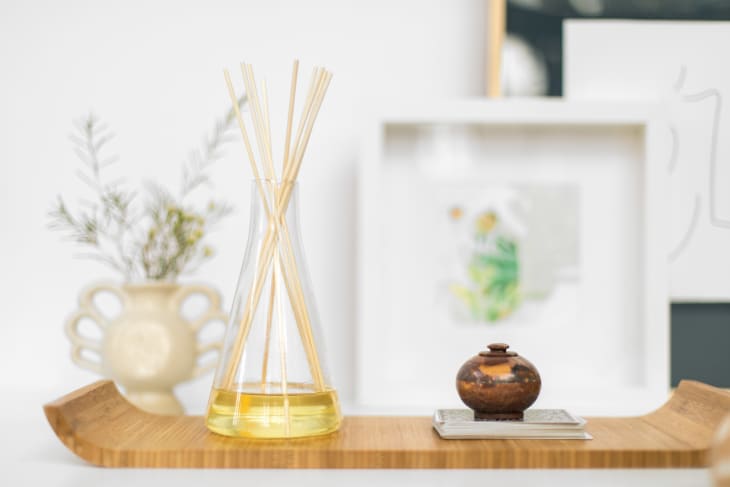
I’m not a huge fan of artificial fragrances, but I still love to have my home smell good. The answer? Essential oils — especially when used in a set-it-and-forget-it reed diffuser. These work by wicking fragrant oil through porous reeds, which help disperse scent in the air.

What I’ve also noticed, unfortunately, is that many of the nicer reed diffusers are also pretty pricey. The good news is that you can make your own DIY reed diffuser for a fraction of retail price and get the completely customized scent of your dreams.
Yep, that’s right — you don’t need to pay $20 or $30 (or more!) for a store-bought reed diffuser (especially when you can find many of the raw materials to make a DIY reed diffuser lying around your home already). Here’s how to DIY a reed diffuser for a hit of natural aromatherapy at home.
What You Need to Make DIY Reed Diffusers
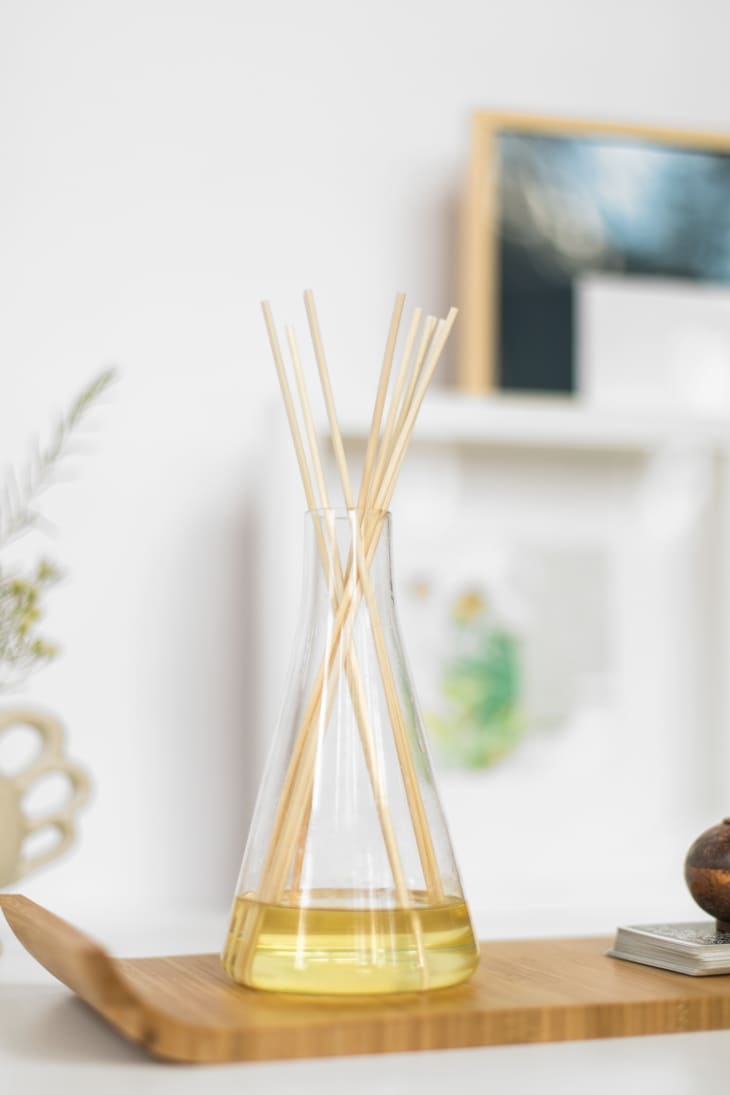
- A glass or ceramic container (make sure it’s glazed inside, so it doesn’t leak) with a narrow opening at the top. You can use one you already have, or you can buy suitable vessels online.
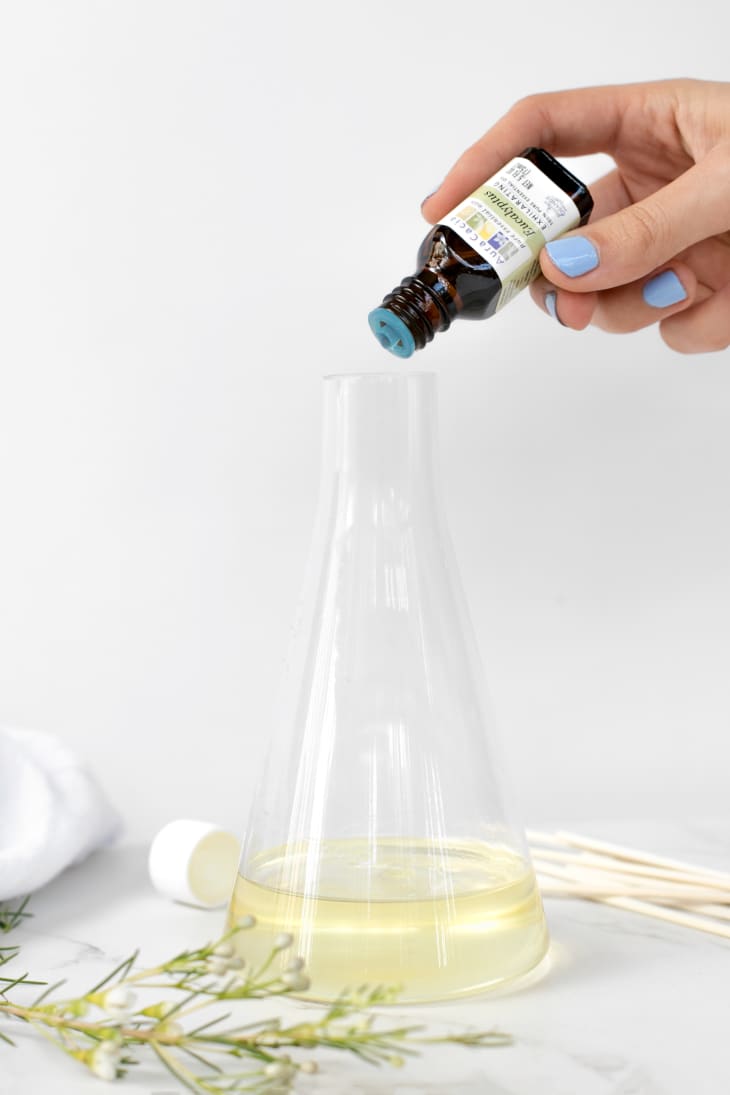
- Essential oils of your choice. I have lavender and eucalyptus.
- An oil or solvent to use as your base. I’ve heard of using mineral oil as your “base,” but I wanted to avoid petroleum-based products. Sweet almond oil, safflower oil, and fractionated coconut oil are other options, as is a mix of vodka and water. If you want the best “throw,” or strongest scent, use a reed diffuser base — it’s specifically formulated to thin out the essential oils so they can more easily flow up the reed.
- Ethanol alcohol to help essential oils dissolve into your base. Look for “perfumer’s alcohol.”
- Reeds or bamboo skewers. You can find reed diffuser sticks online pretty inexpensively.
- A funnel. Depending on the size of the vase’s opening, you might want a small funnel to help you pour in your base oil or solvent.
How to Make DIY Reed Diffusers
DIY reed diffusers can come together in just a few steps, so you can make them in a matter of minutes. Here’s what you need to do.
1. Mix your essential oil with the base.
If you’re using an oil base, you will blend a mix of 30% essential oil to 60% base oil and 10% ethanol. You can experiment with the percentages to see what works best for you.
If you’re using the vodka and water mixture, you will want to add approximately 12 drops of essential oils to about 1/4 cup of water, then add a little vodka. The alcohol in the vodka helps the oils thin out so they better absorb into the reed.
You don’t need to fill your diffuser all the way up. Instead, aim to fill it about half full.
2. Pour the mixture into your receptacle and add the reeds.
Use more reeds for a stronger scent, and fewer reeds for a more subtle scent.
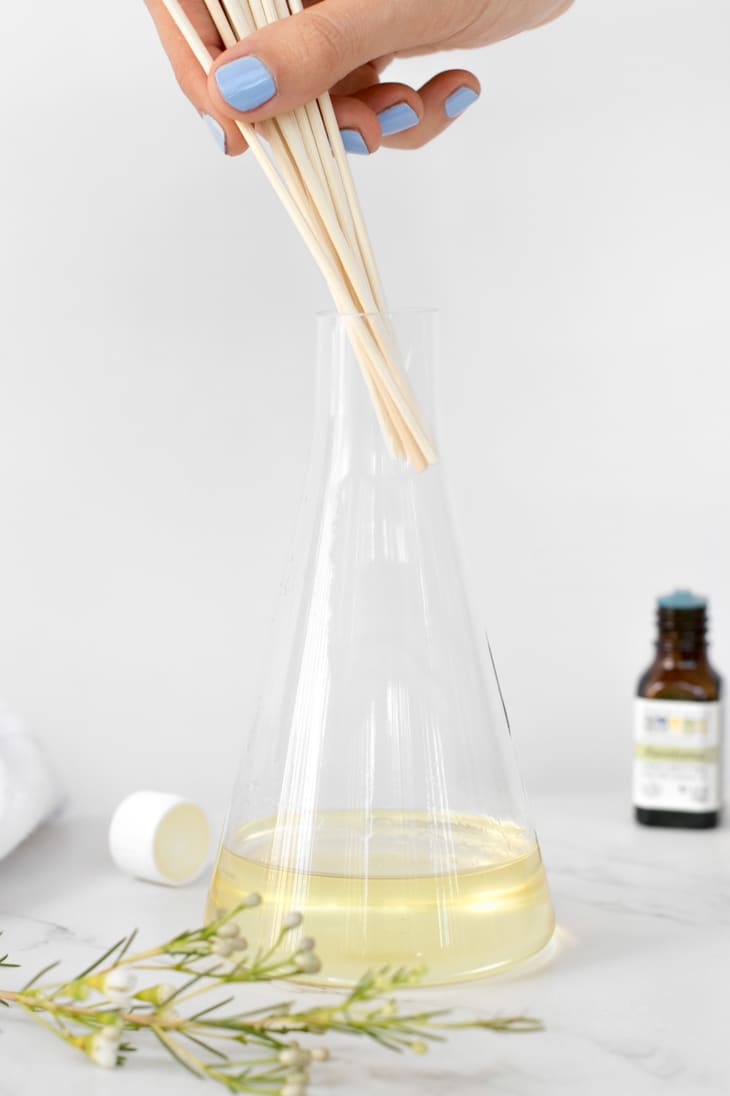
Place one end of the reeds or skewers into the solution, allowing it to saturate the reeds. Then take them out, and place the opposite ends into the bottle. Rotate which ends are in the scent solution about once a week.
Tips for Best Results in Your DIY Reed Diffuser
- The smaller the neck on the bottle, the more slowly the liquid will evaporate.
- Experiment with different essential oil combinations until you find one or two you really like. You can then increase your batches and keep them in sealed containers (like a canning jar) to save prep time later on.
- If you have pets, know that essential oils can sometimes be harmful to your dog or cat. Do your research before you make a reed diffuser and find out if your chosen oil is considered toxic.
The Best Essential Oils for a DIY Reed Diffuser
The best essential oils for your DIY reed diffuser are ones with scents you love.
Do note, though, that some essential oils are thicker and heavier, so they might not travel up your reeds as efficiently, says Amy Galper, a clean beauty consultant and essential oil expert. She says that thicker oils that might be difficult to use include the following:
- Vetiver
- Patchouli
- Rose absolute
- Vanilla CO2 or vanilla absolute
- Sandalwood
- Atlas cedarwood
- Blue tansy
- German chamomile
- Myrrh
You’re more likely to have success with thinner oils. Galper says those include the following:
- Lavender
- Geranium
- Citrus oils
- Pine needle oils (cypress, pines, firs, and junipers)
- Frankincense
- Eucalyptus
- Rosemary
- Fennel
- Cardamon
- Ginger
- Peppermint
- Spearmint
Experiment with your blends until you find one you love. The best part of these DIY reed diffusers is that you can customize them however you want!
Essential Oil Pairings for a Reed Diffuser
Here are some of Galper’s favorite combos for reed diffusers.
For what Galper calls an “uplifting” scent:
- Sweet orange (16 drops)
- Lavender (14 drops)
- Grapefruit (16 drops)
For a “mind calming and clearing” scent:
- Eucalyptus (4 drops)
- Rosemary (6 drops)
- Lavender (14 drops)
For a “focusing” scent:
- Peppermint (3 drops)
- Lavender (14 drops)
- Lemon (8 drops)
For a “de-stressing and meditative” scent:
- Bergamot (12 drops)
- Frankincense (8 drops)
- Juniper (8 drops)
How to Troubleshoot a Reed Diffuser That Isn’t Working
If you’re not getting much scent out of your reed diffuser, there’s likely an easy fix. Here are some possible issues with your DIY reed diffuser and how to solve them.
You chose a carrier oil that’s too heavy.
Galper says that carrier oil options for DIY reed diffusers are limited because you need to use an oil that isn’t too thick to evenly diffuse in the reeds. That’s why safflower oil and fractionated coconut oil are better than thicker oils like virgin coconut oil, avocado oil, and apricot kernel oil, says Galper. If you use an oil that’s too thick, it won’t diffuse any of the scent.
The same goes for choosing essential oils. Stick to lighter essential oils like citrus, Galper advises.
You added water to your solution.
A common mistake Galper sees? Adding water to the mix to help it go farther. “Water will not properly dissolve the essential oils and make it impossible for the oils to be dispersed in the air,” she says.
Skip the water and stick to oil and alcohol for this project.
You didn’t use enough essential oil.
Galper says you usually can use a ratio of 30% essential oil, 60% carrier oil, and 10% alcohol, but if it you’re not getting much scent, you can try adding a bit more essential oil.
Add any more essential oil a drop or two at a time so you don’t accidentally go overboard.
You didn’t use enough reeds.
The more reeds, the more scented oil is drawn up and out of the vase. “Fewer reeds will most likely result in a weaker diffusion,” says Galper.
Aim for six to eight reeds. If you add more than that, Galper says it may or may not make the scent stronger. “But it will certainly use up the solution faster!” she says.