
I Bought a House Right on the Water — Here’s Why I Have Zero Regrets
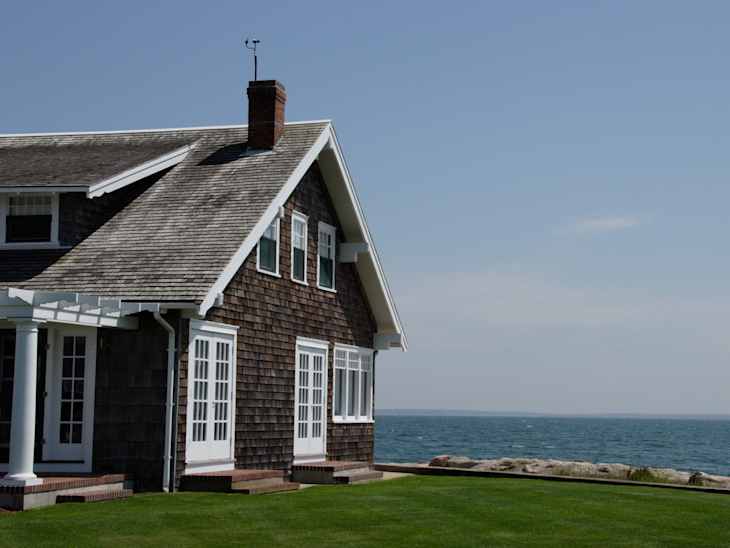
When my husband and I began our house hunt for a cottage on the water a few years ago, we came into the process with a unique perspective. My husband spent nearly seven years working for the Federal Emergency Management Agency (FEMA) in Washington, DC, which is involved in creating the flood maps that determine the risk level of each region in the country. He knew all too well the actual impact of being in a flood zone, and, while I was falling in love with the idea of stepping right outside my door and into the water, he was looking at the reality of rising tides and changing coastlines.
That reality shaped our house search and taught me that when you’re buying on the water, flood zones have to be the top priority.
Avoiding any risk of flood zones is how we ended up with a cottage that sits up on a 16-foot hill, far out of the reach of the water. Here’s what I learned in the process, what I wish others knew, and what a real estate expert with experience in a flood-prone coastal area had to share about how she guides clients.
Look Past that On-the-Water Feeling
When you’re looking at homes on the water, it’s easy to get swept away (no pun intended) by the ones that have the waterfront just steps from the back door. We looked at one that had nothing but a small deck in between the home and the water’s edge. I could picture myself stepping right outside with a cup of coffee in the morning and taking a seat on the dock, which was no more than 10 paces from the back door.
But I quickly learned that with proximity comes risk. My husband often pointed out that there’s a reason you don’t see old houses right on the water. Either the houses no longer exist because of floods and changing coastlines or the people building houses a century ago knew that building right on the water could put them in the path of flooding. In those days, they were more focused on practicality than views.
I’ve now been at our house through a few storms where the water rose over my neighbors’ docks, and I’ve wondered what the scene might look like at the houses that we bypassed.
Validate the Location with the Flood Zone Letter
When you’re looking at properties, you can get a vibe check on whether it’s going to flood just by looking, but the flood plain map will give you validated information. The zones are designated by letter, and, ideally, you want to find one with the letter X, which means it is not in a flood zone. B and C are low to moderate risk. It is possible to find properties on the water with these lower risks, but they’re likely going to be properties that are elevated high above sea level.
If you see a property that’s marked V, that means it’s high risk in a coastal area. How do you find this information? Not all online real estate platforms have flood zone info, but Realtor.com and Redfin both do.
Jen Turano, a licensed real estate salesperson at Compass in coastal Connecticut, says, “A flood zone does not have to be an automatic deal-breaker for every person. I work with some buyers who will not consider a home if it is in a flood zone, and I also work with others who are comfortable with it when they are informed and knowledgeable about the pros and cons.”
She also points out that proximity to water isn’t necessarily an indicator of being in a flood zone or not.
Understand the Expense of Flood Insurance
In our home’s listing, the description noted right up front that it was waterfront living without flood insurance, thanks to being in an “X zone.” Though we decided to get flood insurance anyway, there’s a reason the listing agent made a big to-do over that fact — flood insurance is expensive!
If you’re in a high risk coastal flood zone, you could be looking at $10,000 or more annually in flood insurance premiums — that’s compared with an average of under $1,000 for those in low risk areas.
“Flood insurance is not only an added cost, but it’s also another step in the mortgage process,” explains Turano, though she points out that flood insurance can often be transferred from seller to buyer.
But Buy the Flood Insurance … Just in Case
We always say, if our house ever floods, we’ve got far bigger problems than whether or not we have flood insurance. But, the reality is, we’re on the water. And we have family who did not live on water and did not live in a flood zone, and their neighborhood suffered significant flooding during a hurricane. That experience — plus, my husband having worked for FEMA — taught us that it’s always better to be safe than sorry. We may need an arc if our home actually floods, but at least we’ll be financially prepared.
Know Whether a Home is Compliant
Again, my FEMA alum husband wasn’t going to let us buy a house in a flood zone, but, every time we looked at one, he pointed out that these houses typically weren’t taking the necessary precautions to prepare for the inevitable. For example, we did not see a single house in a flood zone that was elevated.
Turano explains, “If you decide to buy in a flood zone, you will want to understand whether or not that home is compliant.”
But what does compliant mean, exactly? Turano explains that compliant homes follow “the rules and regulations that ‘protect life and property from flooding.’”
She notes that this means the house is elevated above what is deemed to be the Base Flood Elevation or BFE. These rules can change from town to town, but they work to make sure the risk of flooding is mitigated as much as possible.
“If a home is not compliant, there are some challenges you may have to navigate. In our town, for instance, homeowners may only invest up to a certain dollar amount on permitted home improvements before they must take measures to make the home compliant,” says Turano.
She also recommends asking if the current homeowner has an Elevation Certificate. “This is a helpful document that will show the elevation of the structure in relation to the designated flood zone. It may also help lower the cost of flood insurance. A land surveyor or engineer can provide one for a fee.”
Pay Continued Attention to Shoreline Restoration
Beyond the risk of flooding, we’re also acutely aware of the risk of erosion. We’ve had to pay careful attention to the state of our coastline and spent money we hoped would go toward a bathroom renovation instead on repairing our riprap (the stones that sit at the water’s edge).
We’re thrilled to see oysters rebuilding their habitat along the stones, because that’s another natural step toward preventing erosion. While this may not prevent flooding or rising sea levels, it does help prevent us from falling into the water one day, and, when you’re on the water, these are your new priorities.