
16 Sneaky Spots Microplastics Are Hiding in Your Home (and 16 Easy Swaps for Them)
Recently, I’ve gone down a slippery, synthetic rabbit hole all about one unsettling buzzword: microplastics. I know plastic is bad for the planet. It’s essentially never recycled, and the plastic I use today will be here long after I’m gone. But the knowledge that those plastics “shed” micro and nano particles, which I eat, drink, breathe in, and absorb through my skin makes me spiral. It’s impossible to avoid plastic. It’s everywhere: in the clothes I wear, in the food I eat, in the home cleaning products I handle every day. What am I supposed to do? Do I need to know how to avoid microplastics? Should I be as freaked out as I am?
I spoke to two experts, who said that my fear is not unwarranted. But Melissa Valliant, the communications director at Beyond Plastics, an advocacy group, is not in the business of fearmongering. Neither is Ryan Zimmerman, the director of communication and partnerships at Grove Co.
“We can turn off the ‘plastic tap’ and not consume as much,” Zimmerman says. “That’s the best thing that consumers can do [for] health outcomes.”
Below, they explain everything you need to know about microplastics and offer some advice on minimizing your plastic usage overall at home.
What Are Microplastics, and Why Are They Everywhere?
“Microplastics are tiny particles of plastic, smaller than 5 millimeters in size,” Valliant says, which is less than a pencil point. Smaller than that are nanoplastics, which are even more concerning to health because they can be absorbed by your cells.
Microplastics are everywhere because plastic is everywhere. Research from 2018 found that about 76 million pounds of plastic are created in the U.S. every single day. That plastic bag I used at the store because I forgot to bring my reusable bags? Research says I’ll use it for an average of 12 minutes, but it will take 1,000 years to break down in the environment. Another study found that 79% of every piece of plastic that has ever been created still sits in landfills. Those plastics turn into microplastics, which then wreak havoc on people and the environment.
“[Microplastics] come from a multitude of places, they exist in our water and air supply, and they find homes in our bodies,” Zimmerman shares. “Every plastic container, whether it’s a plastic water bottle, straw, takeout fork, or a container, breaks down in some capacity.”
Rather than decompose like paper might, research shows that plastic actually “sheds.” It leeches and flakes off into “whatever is inside of it, whether that’s food, detergent, or soap,” and/or it goes into the environment and breaks down because it’s not recycled, Zimmerman explains. (Only 9% of plastic ever created has been successfully recycled, and 12% incinerated.)
Those “leeching” micro and nanoplastics make their way into the body, the water supply, oceans, landfills, air, and soil. They’ve been found in clothes, food, and most products people use daily. They’re even found in the brain. One lab discovered that there are about five bottle caps worth of plastic in the human brain. Those plastics in human bodies are linked to increased risk of heart attack, stroke, diabetes, certain cancers, and death.
Part of what makes microplastics so dangerous is the chemical additives they are made of. “There are 16,000 chemicals that are used in the making of plastic. Any plastic product can have any combination of those chemicals,” Valliant says. “4,200 of them are hazardous to human health and/or the environment. Thousands more of those haven’t even been studied for their safety.”
Common and Unexpected Places for Microplastics in the Home
At this point in my rabbit hole, I was terrified and overwhelmed. But I found comfort in knowing there’s no way to 100% get rid of all the plastic in my life. Plastic is unavoidable, but it’s all about “progress over perfection,” Zimmerman says. Both experts listed common sources of microplastics in the home that you should focus on swapping, and say to take your plastic swap project room by room.
In the Kitchen
Start in the kitchen and swap out plastic cutting boards with wooden ones. “Every time that you chop something on one of those plastic cutting boards, it releases microplastics right into your food. Your food probably already has a decent amount of microplastics if it was packaged in plastic, but it’s just going to make the situation worse,” Valliant says.
She also suggests ditching plastic water bottles. “Every time you take that little plastic cap off of a bottle of water and twist it, microplastics fall into that water,” she says. Instead, use reusable metal water bottles or simply pour your water into a glass.
Additionally, avoid shrink-wrapped produce or frozen meals you have to microwave in plastic as the heat can cause those chemicals in the plastic to leach out more. Valliant even gave up her sous vide, which is a cooking appliance that vacuum-seals your food in a plastic bag and cooks it in a water bath, and tries to avoid any highly processed foods, which tend to be higher in microplastics.
If you’re using microfiber towels as a swap for paper towels, just know that it may not be a perfect swap. They’re made from plastic, but they’re more reusable than paper towels, which is good for the environment. One alternative is cotton towels like UNpaper Towels, or using a mix of microfiber and UNpaper Towels for different cleaning needs. (Be careful washing your microfiber towels — wash in warm water and it’s best to air-dry them!)
In the Bathroom
Instead of buying single-use plastic bottles — like hand soaps, dish soaps, cleaners, shampoos, and conditioners that are predominately water based — opt for concentrated formulas with refillable metal or glass canisters. You’ll also use less plastic by buying a much smaller multipurpose cleaning concentrate bottle or even tablets that then goes into a glass or even non-single-use plastic spray bottle. Not only will your cleaning products spend less of their lifetime inside plastic, but it’s also “a much better product for the environment overall,” Zimmerman says.
He also suggests swapping out your traditional toothpaste (some brands sell toothpaste in recyclable metal tubes or toothpaste tablets) and plastic toothbrushes (buy bamboo).
Valliant recommends replacing your favorite poly-vinyl chloride shower curtain with a fabric one. Vinyl chloride has been a known carcinogen for 50 years, and it’s not just bad for consumers, but for the communities that surround factories where they are made.
In the Closet
Avoid buying fast fashion, and instead focus on buying cotton and natural material clothing as you can afford to do so. “Fast fashion is actually the number one contributor of microplastics,” Zimmerman says. “Lycra and poly blends [are] a plastic by-product.” In those blends are thin strands of plastic fabric, which then break off when you’re wearing or washing your clothes. From the washer, they can get into your water supply. Through the heat in your dryer, they can also break off.
Valliant recommends checking out thrift or consignment stores for all-cotton clothing.
16 Plastic Items to Replace in Your Home
Generally speaking, experts say to buy household items made of aluminum, glass, and paper over plastic. Below are 16 plastic items you can swap out immediately.
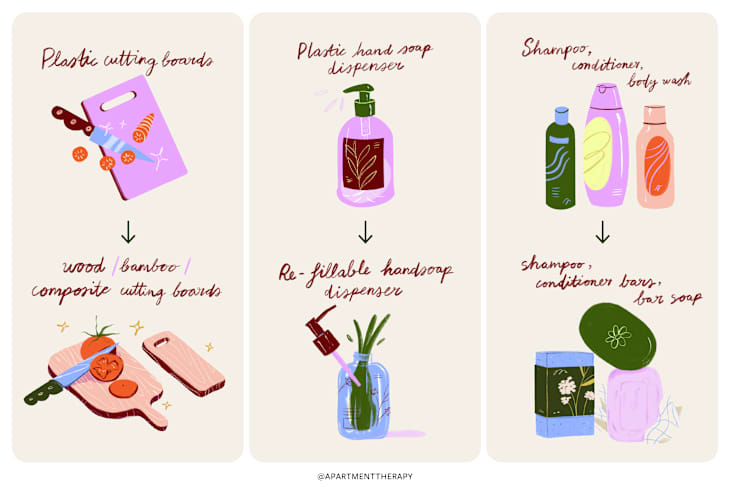
- Plastic cutting boards → wood/bamboo/composite cutting boards.
- Microwaving on plastic → microwaving on ceramic or glass
- Plastic toothbrush → bamboo toothbrush.
- Traditional, plastic-packaged toothpaste → metal packaged toothpaste or toothpaste tablets.
- Plastic bottled water → metal bottled water.
- Traditional bottled shampoo, conditioner, and body wash → shampoo and conditioner bars, or bar soap.
- PVC plastic shower curtains → non-vinyl, fabric shower curtains.
- Synthetic plastic loofahs → natural, organic loofahs.
- Plastic food storage → glass or metal storage.
- Nylon, lycra, or poly-blend clothing → cotton, wool, or natural material clothing.
- Plastic grocery produce bags → cotton produce bags.
- Plastic hand soap dispenser → re-fillable glass or metal handsoap dispenser.
- One-time use plastic bottles of cleaners → concentrate and metal or glass refill bottles.
- Plastic packaged or ultra-processed foods → less plastic packaged or ultra-processed packaged foods.
- Dryer sheets → wool dryer balls, which can last for up to 1,000 cycles.
- Traditional plastic-packaged liquid laundry detergent → detergent tablets.
How I’m Starting to Reduce My Plastic Usage
Turning off the “plastic tap” will take widespread action. “The hard reality is that it’s very difficult to limit your exposure to plastics at the moment, especially in the United States,” Valliant says. “We don’t have a lot of policies that force companies to reduce their production and use of it. You should do everything you can to get involved in [your] community to pass policy change.”
In the meantime, I can also do my part individually. Replacing every single plastic item isn’t something I can afford to do all in one sweep, so I’m going to start slowly. For instance, I’m replacing my plastic food storage containers with glass ones from places like Wegmans, IKEA, Aldi, and Costco and swapping plastic cutting boards with solid wood cutting boards and composite cutting boards, which are more affordable than solid wood.
I’m just trying to reduce my exposure to, and use of, plastic overall day by day. Every step is a good step, and I’ll never be able to fully avoid plastic because it is everywhere. It’s up to businesses to move away from plastic, and the rest of us to fight for those changes to be made on a systemic level.