
7 Habits That Helped Me Finally Wake Up at 5 a.m. (and Actually Look Forward to It)

I am a self-proclaimed sleep-lover, and will often joke that I’m of zero use to the world if I don’t get seven to nine hours each night. Although I’ve read countless articles over the years praising an early wakeup time, I never once thought it was possible for me to actually love waking up before the sun.
But I’ve always secretly admired those early birds who seem to fit in a whole day before the day’s even started. Waking up early has tons of benefits, like less stress, heightened productivity, a positive state of mind, and more. Yet I’d never found a reason compelling to adopt the habit myself. That is, until I listened to a podcast that made the argument so crystal clear, I couldn’t refuse it.
Author Glennon Doyle began her career waking up at 4:30 a.m. to write her blog Momastery, and forced herself to hit “publish” before her three young kids woke up. Even after multiple bestsellers and a successful career, she still chooses to wake up early. Why? “The second anyone else in my house wakes up — now I’m a mom, now I’m a wife, now I’m doing whatever I have to do that day,” she shares on an episode of The Beautiful Writers Podcast. “Culture sets in. But I still get up at 4:30 in the morning, and I have until 6:30 [to myself] — and it’s utter heaven to me.”
I’m an introvert, so the idea that an early morning could provide uninterrupted time to myself before tending to the various responsibilities of the day was a pretty compelling argument. Inspired, I decided to try this whole waking-up-at-5 a.m. thing myself. After more than a month, I can now say I’m a converted believer. Here’s how to wake up at 5 a.m., based on my experience and expert insight.

Have an honest reason for waking up early.
Before you set that 5 a.m. alarm, sleep researcher Dr. Rebecca Robbins suggests considering why you want to wake up early in the first place. “While we live in a morning person’s world, many of us are hardwired to be evening people, do their best work, exercise, and generally ‘come alive’ at night — and there is nothing wrong with that,” Robbins says. If that’s you, you don’t need to rewire your physiology — you just need to pick a reason for waking up that feels meaningful and important to you, instead of one that feels trivial or like a chore.
As a natural night owl, finding a compelling reason to wake up early was absolutely vital to my success. Eventually, I found that even if I got that same amount of time to myself in the evening, I was so burnt out from the day that I was partaking in revenge bedtime procrastination more than I was getting things done. To that end, my reason for waking up early was uninterrupted quality time with myself before the day set in. For you, it might be the chance to work out before you go to work. Whatever it is, make it a reason compelling enough to want to make a change.
Lean into the rituals you’ve already created.
Take stock of favorite mornings you’ve had in the past. What’s already working? Lean into the morning habits you truly enjoy and want to spend more time doing, instead of starting from scratch. For example: brewing a fresh cup of coffee, drinking two glasses of water, listening to jazz music, and journaling are all things I already do in the mornings no matter the time. Waking up early allows me to savor the routines I already love, while also giving me a starting place for new rituals.
For my first foray into the 5 a.m. Club, I chose a love seat in my apartment that’s next to a window overlooking the avenue below. Not only is it one of my favorite spots in the apartment, but it allows me to watch the sun rise. Knowing where I was going to spend my morning helped me feel like I had a sense of place, or what J.D. Adams defines as “the lens through which people experience and make meaning of their experiences in and with place.”
Having a dedicated “early morning spot” might seem like an inconsequential detail, but for me, it was crucial to creating — and maintaining — consistency.

Splash your face with cold water.
This might be the most unexpected part of my early-morning musts: I wash my face with cold water. If you’re not all-in on taking an icy shower first thing in the morning, I’ve found that splashing cold water on your face works just fine. And at 5 a.m., it does make me feel like I’ve gotten an extra shot of espresso without the caffeine, which is reason enough for me to keep going.
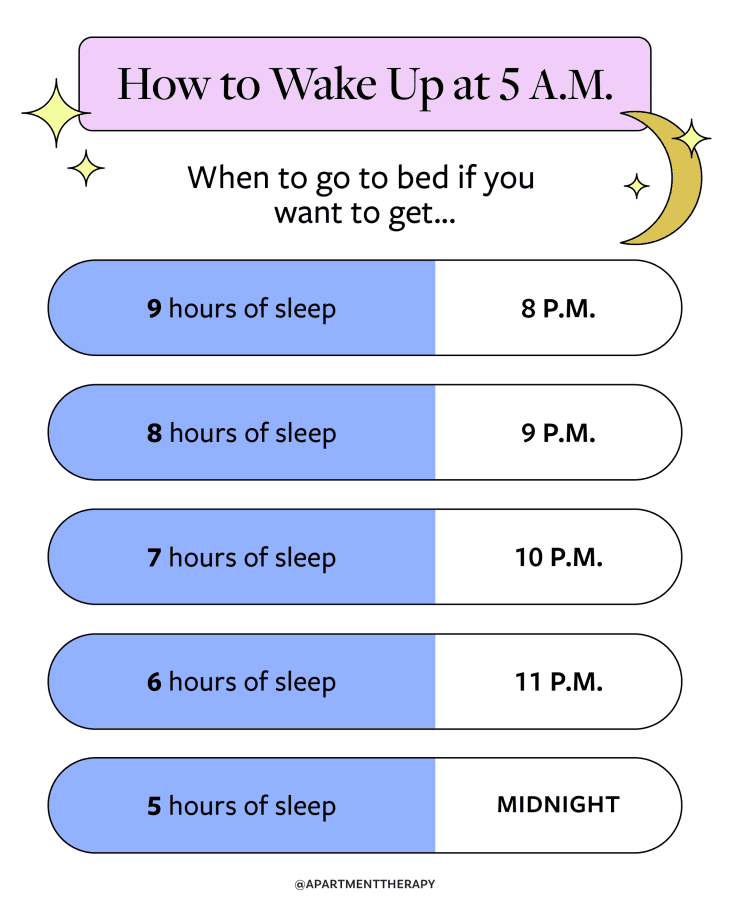
Calculate your ideal bedtime based on your new ideal wakeup time.
Don’t just expect that waking up early will be sustainable if you’re constantly robbing yourself of sleep. “Many of us must operate on schedules that conflict with our circadian rhythm and preference for mornings or evenings,” Robbins says. Your ideal bedtime, she says, is one that will allow you to get at least seven hours of sleep, though your own “ideal” number may vary.
What works for me is calculating my bedtime by counting backward from my ideal wake-up time. For example, if I want to wake up at 5 a.m., I need to go to sleep no later than 10 p.m. and no earlier than 8 p.m. Those parameters, which stick to Robbins’ prior suggestions regarding time, make it more likely I’ll hit my 5 a.m. goal well-rested even if my 8:30 p.m. bedtime plans are foiled by my playful puppy … or, more realistically, an “accidental” extra few episode of Friends.

Allow yourself a little wiggle room (within reason).
If waking up at 5 a.m. every single morning sounds daunting, know you have some wiggle room — but don’t go overboard. “Ideally, our rising times and fall asleep times are ones that we can keep Monday to Monday, including the weekends,” Robbins says. It’s not just for consistency’s sake, she points out — it’s for your long-term health.
“If we keep widely disparate schedules — schedules that differ more than one to two hours from one day to the next — we expose ourselves to the risk of poor sleep, reduced performance and, in the long term, health risks.”
If you do want to vary your wakeup times, Robbins suggests no more than a one- to two-hour difference. Give yourself a “wake-up range,” so that if you accidentally sleep in a little or hit your snooze button, you’ll be less inclined to beat yourself up — and if you wake up even earlier for some reason, you don’t make the rookie mistake of going back to bed because you think you “have 30 more minutes of sleep left.”

Set your alarm to a soothing tone.
Sure, it might get you out of bed, but waking up to foghorns or sirens at any hour is not an enjoyable way to start the day. Instead, pick a sound you not only like, but that relaxes you when you hear it. Adjust the volume so it’s loud enough to hear, but not loud enough to startle you awake. If your budget allows, it might be useful to check out a specialty alarm clock — like this one from Hatch — that allows you to craft your perfect wake-up call by selecting from an array of sound and lighting options.
Focus on what you want to do, not what you have to do.
Part of my resistance to being a “morning person” was the sense of obligation I’d felt in the past: I’d only wake up early if I had a flight to catch, a deadline to meet, or something else demanding my attention. It was important for me to uncouple my relationship to early mornings from a sense of obligation or stress. When you’re creating your new early bird routine, focus on those passion projects, hobbies, or simple pleasures that bring you joy instead of dread. You can always pay the bills or respond to emails later — remember, this time is for you.