
The Obscure 1940s Home Type I Wish Was Still Around (It’s So Futuristic!)
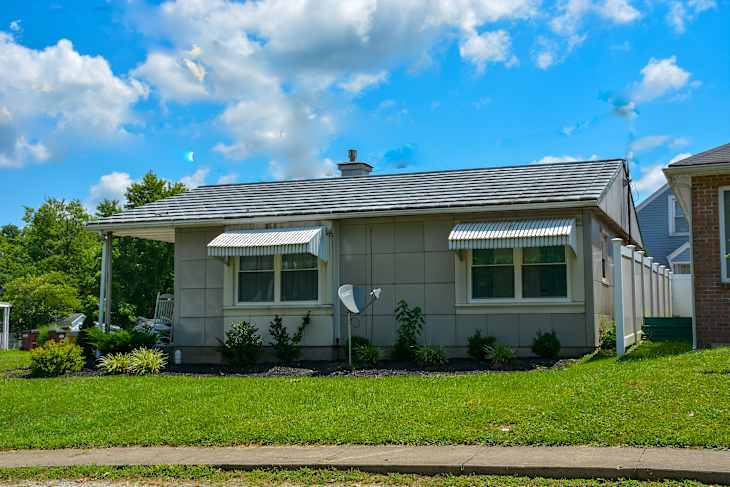
Some vintage homes can gain cult followings — Frank Lloyd Wrights, Sears Kit homes, Victorians, Cape Codders. But one home type that I think deserves just as much attention and enthusiasm is a Lustron Home — prefabricated steel-built homes that had a brief explosion in popularity in the post-World War II era.
Although they never became widespread, you can still find them today — mostly in the Midwest. And while they might look like unassuming ranch houses, they’re visually distinct, and more sustainable than you could even imagine. Read on to learn more about these homes and decide if you might want to live in one of these 1940s time capsules.

What Are Lustron Homes?
After World War II, a lot changed in the United States. The wartime industrial boom — and rapid suburbanization of America combined with the purchasing power of the G.I. bill, alongside economic recovery after the Great Depression — radically reshaped American society. Home building soared as all those folks who would birth the Baby Boomers needed places to live that were quick to build (and affordable, to boot). Some of these homes were built out of prefabricated steel, while others were made out of wood.
Companies viewed these homogenized homes as the wave of the future. Lustron, for example, referred to their homes as “a new way of life.” Justin Miller, an architectural historian at the University of Wisconsin-Milwaukee, explains that Lustron homes were only manufactured for a few years in the late 1940s. But they’ve maintained a cult-following across the United States — and I consider myself a big fan as well.
“They look like small ranch houses, but Lustrons are immediately recognizable by their enameled steel wall panels,” Miller says. “Lustrons were created as a solution to the housing shortage in America after World War II as millions of veterans returned home.”
Each house contained over 3,300 parts, Miller adds, including steel structure, interior and exterior enameled porcelain-coated steel wall panels, mechanical systems, and even bathtubs. All components of a Lustron were mass-produced on a factory assembly line, then shipped and assembled on site.
“Buying a Lustron home was kind of like buying a car,” he says. “Homeowners could choose from several models, based on square footage and number of bedrooms, and then select from four exterior colors: Maize Yellow, Surf Blue, Dove Gray, or Desert Tan.”
Additional accessories were also available, like steel venetian blinds, built-in storage, and even garages, although Miller says that the garages were extremely rare.
While they were undoubtedly cool and novel for the time, and experienced a brief burst of popularity, Miller calls Lustron homes a “short-lived experiment,” saying that they were only manufactured between 1948 and 1950.
“But they’re a fascinating snapshot of postwar innovation and technology,” he says. And even though they were only produced for a short time, Miller says that they became surprisingly and hugely influential.
“They laid the groundwork for the prefab houses of today,” he says.
In fact, Miller says that there continues to be a lot of fascination around Lustron homes. They can be discovered through Lustron subreddits, online databases, and a nationwide photography project.
“MoMA even relocated and partially reassembled a two-bedroom Lustron inside the museum for a 2008 exhibition,” Miller notes.

Where Were Lustron Homes Most Popular?
The Lustron Corporation was headquartered in Columbus, Ohio, “in a huge former airplane factory,” Miller says. “As part of its initial advertising campaign in 1948, the company built model homes in major Midwestern cities like Chicago, Detroit, and Milwaukee, which accounts for their popularity here.”
Lustron houses could be purchased through franchised dealerships, just like cars.
“Wisconsin actually had two dealerships: one in Milwaukee and one in Madison,” Miller says. In all, there were dealerships in 35 states across the country.
Illinois, Ohio, and Indiana have the top three highest concentrations of Lustron homes in the country. Wisconsin, where I live, has the fourth-highest, with about 100 known examples. Miller says that according to company records, about 2,700 Lustron homes were produced while the factory was in operation, and about 1,500 are still in existence today.
What Are Some of the Defining Features of a Lustron Home?
Miller says that the biggest quirk of Lustron homes is that their interior walls are made of metal, not drywall, which can certainly make it challenging to hang pictures. He also points out that they are much smaller in square footage (about 1,000 square feet) compared to new-build homes.
“This was intentional, in order to qualify for post-WWII federal mortgages, which had square footage requirements,” he says.
He also says that Lustron homes were carefully designed as a single interlocking structure, “so it’s almost impossible to change room sizes or remove interior walls,” he says. “No open floor plans here.”
But that doesn’t mean it isn’t impossible to renovate a Lustron. Miller says that Lustron homeowners don’t have to feel as if they’re living in a museum exhibit from 1948.
“It’s pretty common for owners to renovate the kitchens and install more efficient heating systems,” he says.
Even though there are only around 1,500 Lustron homes still in existence, Jean Fetters-Conner, who catalogs Lustrons at the website Lustron Research, says that they actually are often on the market. Paradoxically, she says that this is actually “unfortunate.”
“Many people inherit them and want to sell [them] for the land,” she says, which means that these Lustrons turn into tear-downs. But she adds that some people opt to disassemble and move them somewhere else.
Lustron Homes Are Surprisingly Sustainable
“Lustrons weren’t really designed in the way we think about sustainability today, but the durability of their materials is more sustainable than a lot of current building products,” Miller says. “With the proper care, the enameled steel panels on a Lustron home are going to last a lot longer than vinyl siding or synthetic trim, meaning they don’t need to be replaced every 20 years.”
Because, according to the Environmental Protection Agency (EPA), around 20% of the trash in the U.S. comes from construction and demolition, Miller says that saving existing buildings, and keeping that material out of landfills, is inherently a greener choice.
If you’ve spotted a Lustron for sale in your area, perhaps you’re thinking about going retro and living in one of these prefab wonders — and maybe there are benefits to be had. But just like any home, Lustrons have drawbacks. Fetters-Conner says people complain about leaky windows, but that the maintenance of the home is very reasonable, and that they’re ideal for people with accessibility needs.
And if you decide to sell your Lustron one day, is the resale value amazing, as is often the case with, say, a Frank Lloyd Wright or an Eichler? The answer is … probably not, with Fetters-Conner saying that they have more “historian enthusiast value.”
Miller says that “a lot of retro houses — Lustrons included — have quirks, and they are never going to be a McMansion, no matter how hard you try. Embrace the quirks, because that’s what makes a home authentic. And I think authenticity is something that all of us need much more of these days.”