
6 Things I Wish I Knew Before Putting a Pool in My Backyard
I’ve gone swimming in ponds, lakes and oceans, but nothing beats the convenience of having a private pool a few steps away from the back door. After sweating out one too many summers, I decided to ahem, take the plunge and invest in a private pool of my own. I thought an inflatable kiddie pool might scratch the itch, but it only made me more determined to get the real deal. How could I ever afford a real pool, though?
After weeks of research, I decided a plunge pool was the perfect fit for my small backyard and limited budget — or so I thought. At first, it was everything I had dreamed of. Then, the budget trouble started.

I Spent Money Like Water on My Plunge Pool
A plunge pool is the miniature version of a standard pool. Karen Larson, cofounder of Soake Pools, notes that plunge pools take up less space, use about 80% less water than a standard in-ground pool, and require less energy as well as fewer chemicals to maintain.
Plunge pools are usually about 200 to 400 square feet of surface area and are anywhere from 3 to 7 feet deep. They can be in-ground, above-ground, or semi in-ground, aka partially buried in the ground or built into some sort of decking.
Since I own my property, I opted for in-ground. It’s still compact and just deep enough for wading without crouching, which is excellent for cooling off when the temperature climbs. Small above-ground plunge pools cost as little as $3,000 but can also reach $30,000, depending on their size and type. For example, vinyl is much more affordable than fiberglass or concrete.
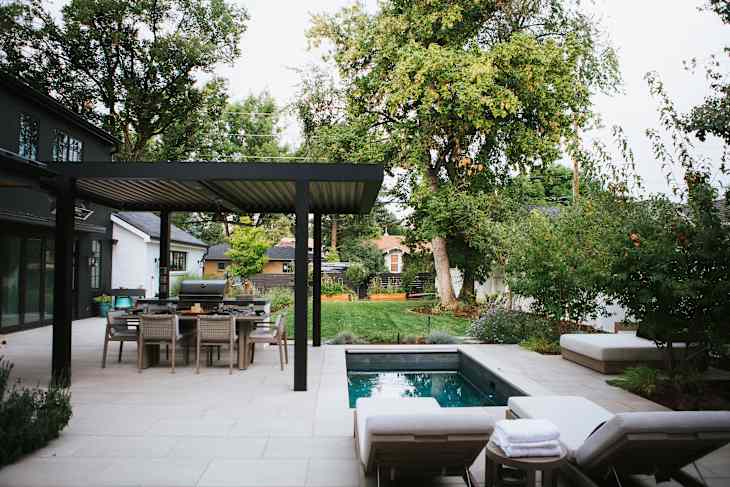
My pool (pictured below) was $18,000 and made from fiberglass. I saved money by getting an off-the-shelf fiberglass model instead of a custom concrete design — but I later spent those savings on surprise expenses. Learn from my mistakes!

6 Things I Wish I Knew Before Putting in My Pool
There are some sneaky costs associated with plunge pools that I didn’t anticipate, all of which added substantially to my overall spending. Here’s what I wish I’d known before buying.
There will be installation costs upon installation costs.
Sure, plunge pools are cheaper than putting in a full-size pool because of their small square footage, but that doesn’t mean they won’t cause some upheaval to your yard. “To get your plunge pool up and running, you’ll need to hire an excavator, plumber, and an electrician and usually a stone mason for finish details,” Larson says.
I also added a shaded section with patio chairs and a bamboo fence to my pool area. This made it 10 to 15 degrees cooler, which was worth it to me — I love the way it looks and feels like a permanent part of my home — but again, it’s not something I included in my initial budget. I just advise all my friends to plan these aspects from the start.
Pool water evaporates.
“Water loss is a real thing that almost nobody takes seriously,” John Uhle, the founding partner and product expert at Discount Salt Pool, says. “Evaporation is constant, especially in summer, and if you live in a hot or dry area, you’ll notice how it adds to your water bills. Just expect to top off the pool every week or so, which will cost you around $10 to $30 monthly, depending on your pool size.”
Your utility bills will be higher across the board.
In addition to your water bill potentially spiking to keep your pool full, think about your electric bill. Mike Dornan, retail general manager at Carlton Pools, with 28 years of experience in the pool industry, says your electric bill will likely see a $750 spike for the season to run your pump and filter, but it varies depending on where you live.
If you have a pool heater (which I plan to add to extend my pool usage season), it might impact your gas bill. The pool heaters I’ve priced cost about $1,500 — roughly $1,000 for the unit and $500 for professional installation — but it’ll cost $100 to $500 monthly to run, depending on which type I go with. Natural gas is relatively cheap, but I’ll probably use electricity because gas fumes can collect and settle on the pool’s surface.
It takes a lot of money and time to keep a pool clean.
Pool maintenance costs vary depending on whether you’re keeping your pool clean yourself or hiring a pro to do it. “If you wanted to care for your own pool, you would want to start with some cleaning tools,” Andrew Brody, the founder of Palm Beach Pool & Spa Services says. (Think: a pool pole, a net, a pool brush, a vacuum.) And “the main ongoing cost would be the chemicals,” Brody adds. He estimates that would cost about $45 to $80 per month.
I paid for a skimmer, vacuum, pool filters, pH test kit, and chemicals. Even with the small square footage, I had to dump in an eye-watering amount of chlorine tablets, shock, and clarifiers. Balancing the water chemistry is essential for preventing algae growth and skin irritation.
I have to add more chemicals whenever there’s heavy rainfall or if I add more water. Since the local water is iron-rich, my pool water can turn a murky green or brown, which I have to fix. To be honest, cleaning has been less of a financial burden and more of a time investment. Scrubbing algae off the walls takes ages and leaves my arms aching. Afterward, the water is murky for a while.
The older a pool is, the more things will break.
“Year after year, a pool tends to become a bit more expensive to maintain, as parts are likely to break,” Uhle says. “Of course, you’re not buying new gear every month, but you’ll still spend around $100 to $300 a year on small repairs and replacements.” You might have to replace things like filters, seals, and pumps. Uhle says you’ll likely spend about $100 to $300 per year on small repairs and replacement, but larger pieces, like a pool heater, could cost up to $2,000.
City permits and property taxes are important to factor in.
I had to get permission from the local government before installing my plunge pool. Most cities require permits for anything larger than a kiddie pool. I paid a fixed fee — less than $50 — but some places charge a percentage of the pool’s value.
Also, adding a plunge pool can increase your property taxes. Adam Hamilton, CEO at REI Hub, points out that “when you install a plunge pool, generally your home value will increase as a result. It’s a permanent fixture that creates a new benefit to your property, making it more valuable as a whole. When your home value increases, so do your taxes.”
Putting in a $20,000 pool shell in Polk County, for example, might cause an increase in the assessed value of the home by $15,000, or $300 per year in additional property taxes, Jacob Naig, owner and real estate investor/agent at We Buy Houses in Des Moines, Iowa, notes.
In some cases, you might be able to write off some plunge pool expenses if your doctor recommended a pool for exercise or disease prevention or if your pool is part of a vacation rental, Lisa Greene-Lewis, CPA and TurboTax spokesperson, and Naig add.
I wish I’d calculated the “real cost” sooner.
To think about what a pool might actually cost you, Uhle recommends to “calculate what it’ll cost you approximately each year, and even over the next 10–15 years.” I’m calling this a “real cost” calculation.
The “real cost” of my pool, for example, factors in legally required add-ons like permits, fencing, and covers into the installation price. Then I can combine the monthly chemical, utility, accessory, and heater expenses, and multiply that total by 12 to get the annual cost, plus build a contingency budget for repairs.
Do I regret getting my backyard plunge pool?
At the end of the day, I love my plunge pool and think it was a great addition to my home. My backyard used to be empty and full of patchy grass. Now, it is a relaxing space that I look forward to hanging out in. That said, I’d do things differently if I got the chance.
For instance, I might get a saltwater pool instead of a chlorine pool. You can sanitize the water using a salt chlorine generator instead of the chlorine tablets I use, so the chemicals cost less and are also gentler on skin. Installation may be more expensive because of the added equipment costs, but a lower maintenance cost is a great trade-off.
Alternatives to Plunge Pools That Won’t Break the Bank (or Lease)
I’m happy with my plunge pool, but I know it’s not a realistic option for everyone. I initially planned to spend around $20,000 total on the project. The final tally, after everything was said and done, came closer to $38,000 (approximately). So, it nearly doubled my initial budget.
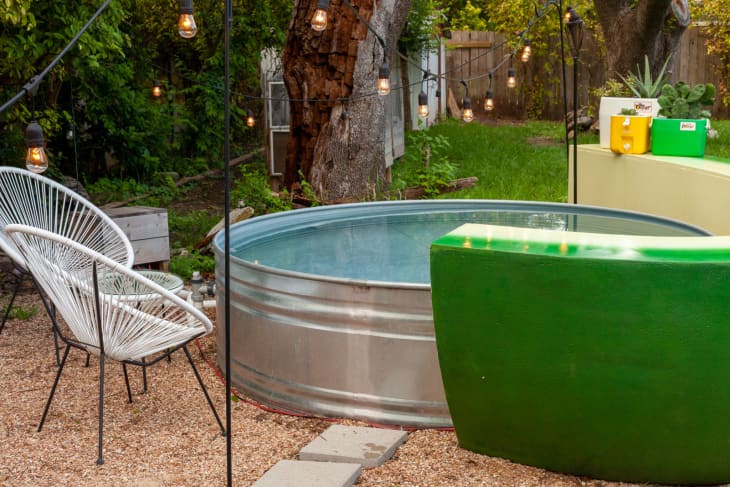
If you’re looking to cool off in a pinch without the cost commitment (or permanence) of a plunge pool, I’d recommend the stock tank or pop-up route, or some good old-fashioned yard fun.