
I Sent a Pro Organizer a Photo of My Cluttered Closet, and Now It’s Actually Organized
Even as someone who’s been writing about cleaning and organizing for over a decade, I’m always amazed by how much I learn when I bring in a pro. I can tame the wildest junk drawer and even give my mom decluttering advice, but when I ask a professional organizer for their advice, it’s a whole other level of organization.
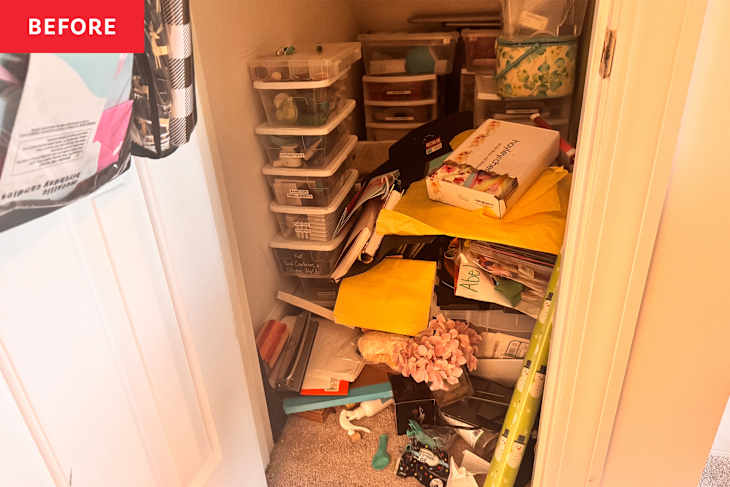
This is exactly what happened when I worked with Kim Jones of Lock and Key Home. She helped me transform one of my most chaotic storage spaces: a closet under the stairs. This closet had become a black hole of not just craft supplies, but also papers, kids’ artwork, and sentimental stuff I didn’t know where else to put. When I couldn’t deal with something, I tossed it in there. Eventually, it became overwhelming.
But Jones, as always, cut straight through the chaos. She offered clear, doable advice — and now the closet actually supports my current hobbies and doesn’t stress me out. Here’s how we made it happen.
Start by taking everything out and categorizing.
First up: Take everything out. Yes, everything. “Go ahead and take everything out of the space and place into categories,” Jones says. While it’s not always feasible to empty a space entirely, this method gives you a literal and mental blank slate — and allows you to clean as you go.
As I emptied the closet, I sorted things loosely into categories: water color supplies, scrapbooking materials, kids’ artwork and schoolwork I might want to keep, and miscellaneous stuff that had piled up. It didn’t take long to see what I actually used and what was just taking up space.
Be honest about the hobbies you’re actually doing.
The scrapbooking supplies? I hadn’t touched them in years. But I couldn’t quite bring myself to donate them, either. I told Jones I wasn’t using them now, but I also wasn’t ready to say goodbye. Her suggestion was the perfect middle ground: “If you don’t think you will be scrapbooking going forward, I would likely place somewhere else to maximize the real estate in the closet.”
She gave me a few options: store the supplies in the attic (as long as it’s insulated), place them at the back of the closet since they’re not used often, or keep the supplies in stackable bins on top of a shelving unit so I wouldn’t have to dig through a pile every time. The key idea? Your space should reflect the life you’re living now — not the hobbies you might return to someday.

Make access effortless.
Next, we talked about the layout. My sewing supplies were already in labeled rolling drawer units (organizer win!), but Jones recommended a smarter setup: “Put them on the right wall with a path on the left so that you can walk into the closet and easily get what you need.” So simple — but so effective.
I turned the drawers to make an “aisle,” and now everything is easy to reach. No more moving things out of the way just to access one bin. Even having to kneel to reach the lower drawers is fine because I don’t have to shift a bunch of stuff first. It’s a small change that’s made a huge difference in how peaceful the space feels.
Remember the purpose of your space.
Jones brought up a point that really helped me prioritize: “Since the closet is designated for arts and crafts, and it looks to be tight on space, I would suggest moving the kids’ memorabilia items to a different space if you can.”
She was right. So I gathered the kids’ art and schoolwork into a separate bin and moved it out of the closet. Since most of it still needs to be sorted, it felt especially good to get it out of the way for now (as long as I remember to tackle it later!).
Jones also shared a great idea for long-term storage. Give each kid their own bin with folders by year and be selective on what you keep. Think awards, special notes, or artwork with names or years.

Create a closet that supports your life — not your clutter.
Thanks to Jones’ thoughtful, realistic advice, this space no longer feels like a chore I’ve been avoiding. I didn’t have to buy a single new item, and yet the closet feels completely transformed. I removed the things that weren’t serving me right now and made space for the ones that are.
Maybe best of all, I wasn’t pressured to make every decision right away. Jones encouraged me to create a space that works now, even if some categories need to be revisited later. It’s a great reminder that organizing doesn’t have to be “once and for all” to be worthwhile. Sometimes, small shifts are enough to help a space start supporting you again.