
I Tried the “Reverse Decluttering” Method, and It Showed Me What Items I Truly Love (and Don’t!)
If you have tried to declutter before but reached a standstill, you’re definitely not alone. Decluttering can be overwhelming. You might not know where to start, you can feel unsure about what you’re truly ready to part with, and you might find yourself exhausted before the task has even begun.
Reframing the way you see decluttering to focus on what you love, use, and need instead of the clutter, though, can make all the difference and help alleviate the tension of decision fatigue. Enter: the reverse decluttering method.
What Is Reverse Decluttering?
“Simply put, the reverse decluttering method focuses on what to keep rather than what to get rid of,’ says Heather Bifulco of Tidy Style Home, who shared this method with me recently. “It’s a shift in thinking from the typical decluttering approach, which is much more focused on what you are getting rid of and, consequently, tends to stir up feelings of guilt — guilt with regard to the money that was spent on the item, guilt with regard to letting go of sentimental items and gifts that were given, and guilt about the general overabundance of stuff in someone’s life.”

How to Follow the Reverse Decluttering Method
Carrying out this decluttering method in your home is simple, and the best part is that you can let go of clutter and still keep what matters most to you. It’s recommended to pick one area of your home to declutter at a time or a singular category (Bifulco suggests linens, board games, or kitchenware) to keep your focus as aligned to getting the task done as possible.
Once you have decided on your category or area, instead of picking out items to declutter, take out everything you love, use, or need, and put it to the side. This will leave your space containing items you don’t use or love as much as others — items that should be far easier to sift through for decluttering.
A way to identify what you love could involve taking time to exist in the space, looking around, and deciding how objects make you feel. Does that vase make you smile? How about that canvas painting? Try to keep in tune with how items make you feel, including gratitude towards functional possessions (your screwdriver likely won’t “spark joy,” but it’s handy to have!).

How I Tried the Reverse Decluttering Method in My Home
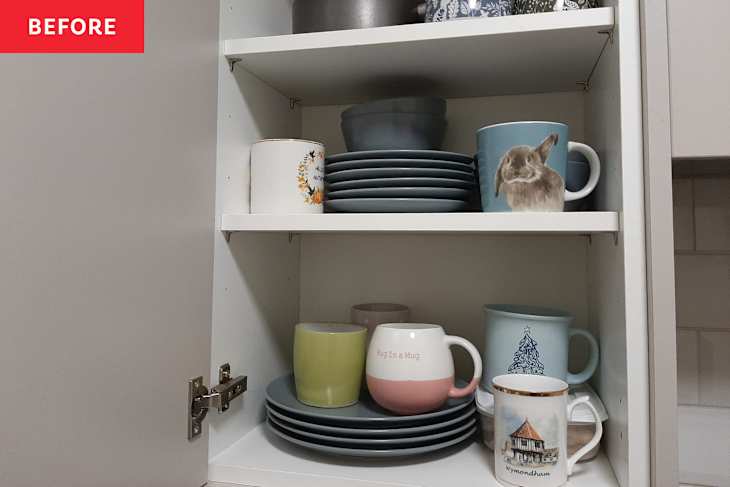
My studio apartment is lovely, but small — which means I need to be mindful about how many possessions I keep to stop clutter from taking over. I decided to look through my mug collection to see what I could cull, as I knew deep down that I didn’t need quite so many.
I started off by looking in my kitchen cupboard to see how many mugs I had. Then, one by one, I removed my favorites. The “hug in a mug” mug from my partner, the rabbit mug I use all the time, and my spacious Christmas mug that’s perfect for winter soups and large hot chocolates were the first to come out, followed by a slender mug with a building on it from one of my favorite local towns.
This left five other mugs in the cupboard, and four of them I easily parted with after quickly realizing why they were never reached for: two were gifts and rather heavy, and the others I used but didn’t overly care for. My kitchen cupboard is now notably emptier and it makes me happy to open it up and see only the mugs I care about. The slender mug found a new home on my desk as a pen pot as well, so I can see the design every day and get more use out of it as an item. I would definitely recommend giving this method a go, whether you’re planning to start big or small!