
I Just Discovered My Grandma’s “One-of-a-Kind” Space in Her House Is Actually a Vintage Home Staple
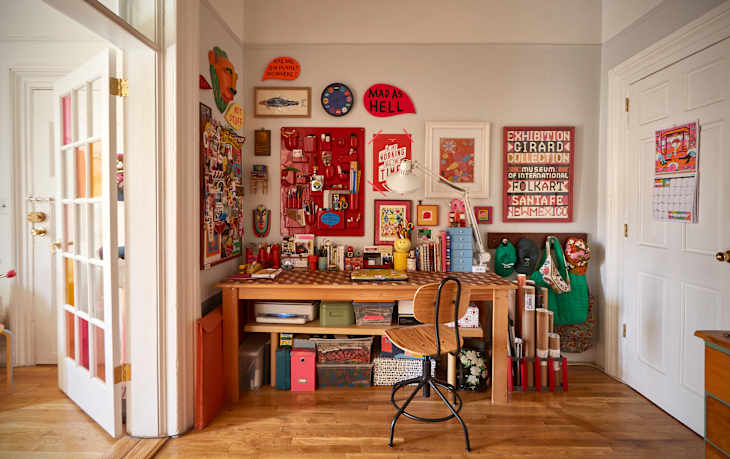
When I was a kid, the soundtrack of my grandma’s home in Michigan was the steady hum of her sewing machine. In her workshop, she transformed the fabrics I chose into dresses and shorts, all while juggling a heap of other projects, whether it was altering dresses for friends or replacing buttons or stitching up clothes for neighbors. We always called it her “sewing room,” but decades later, when I began writing about real estate, I realized that “sewing room” wasn’t just our family’s nickname for her hobby space; it was actually a common home feature — a phenomenon like “witches stairs” or “turret rooms.”
“These rooms served as functional areas for clothing repair, home sewing, and quilting, before the trend of open plan living erased small, dedicated spaces,” says Kristina Allan, a Realtor, real estate appraiser, and the founder of KALLANLVRE in Las Vegas. “The real estate listings now refer to these rooms as ‘bonus rooms,’ instead of their original purpose.”
That updated label suddenly made sense of something that puzzled me last year while house hunting. I had loved a few mid-century homes on Zillow and was half expecting to spot sewing rooms like my grandma’s, but instead, I kept seeing descriptions of bonus rooms and flex space.
The Sewing Room Is a 100-Year-Old Phenomenon
A century ago, many houses were built with rooms designated for specific tasks or household items, explains Martin Horner, cofounder of Soucie Horner Design Collective, a Chicago-based design firm with a hospitality division. “There were linen rooms, there were China cupboard rooms, there were rooms for things — and the sewing rooms were just one of them,” Horner says. Adjacent to sewing rooms, you might even spot pull-down linen cabinets used for storing linens or fabrics.
Mike Bennett, founder and CEO of DealMate Real Estate, says that while he rarely sees these spaces explicitly listed as sewing rooms, he’ll sometimes notice a small room off a hallway or landing — outfitted with original cabinets and a task-height counter — and infer it once served that purpose. In higher-priced historic homes, you may still find a dedicated sewing room, whereas in modest cottages the sewing area was often just an alcove designed for the same function. “In the right vintage neighborhood it’s a regular find,” Bennett says.
When Were Sewing Rooms Most Popular?
Sewing rooms, in particular, were popular in the United States during the early to mid-20th century, says Todd Harmon, principal designer and cofounder of Harmonia Living.
Home sewing began to gain traction in the 1860s, when paper patterns made fashionable clothing more accessible to those who couldn’t afford custom garments. Its popularity continued through World War II — when women were encouraged to sew to conserve resources — and lasted until the 1980s, when fast fashion became more widely available.
“Sewing rooms were very functional, but they could also be pretty, with plenty of natural light, cabinets where you could store fabrics and thread, and a table that could support a sewing machine,” Harmon says.
As far as types of homes they were common in, Bennett says he’s most often spotted them in bungalows and Craftsman homes, as well as Colonials and farmhouses.
“They tend to be small ‘service pockets’ tucked near bedrooms or laundry, often with a narrow window and built-ins,” Bennett says. “Some mid-century ranches didn’t name a sewing room outright, but a utility room or even an enclosed porch may have been used that way.”
What’s Replacing Sewing Rooms?
Horner came across one of these sewing rooms while renovating a historic rental property in Saugatauk, Michigan. It was originally built in 1850 and updated in 1927. Because the room was about 80 square feet — not quite large enough for a guest room — he reconfigured it into a 120-square-foot bedroom to accommodate a queen-size bed for Fairview, a 3-bedroom vacation rental on Michigan’s “Art Coast.” The room includes a tiny closet, a little hobbit hole of sorts, which he’s since turned into an owner’s closet.
Designers and real estate professionals say they are now being converted into bedrooms, guest bedrooms, home offices, nurseries, and reading nooks. A main livability challenge, Harmon notes, is that the rooms can be narrow, and some lack closets.
“As I convert these spaces, I like to pay homage to what has come before, leaving perhaps a small sewing cabinet, a vintage table, or maybe a nook for fabric but making them relevant to modern life,” he says.
Top requests that Bennett has seen include a home office, nursery next to a main bedroom, or a quiet reading nook. “Hobbyists still like a dedicated craft or maker space to keep any messes contained,” he says. “If it’s near the entry or kitchen, some buyers want a mudroom, pantry extension, or laundry-folding station.”
The first question most buyers ask about these rooms is what possible transformation they can undergo, Allan says. “When staging them, the goal is to show simple, uncluttered room designs,” she says. “The combination of clean lines, light colors, and one clearly defined function, helps buyers understand how the space can fit into their lifestyle.”Thomas O’Shaughnessy, a real estate expert and vice president at Clever Offers, adds that these smaller spaces that once served as sewing rooms are still in high demand. They can be turned into micro bedrooms for guests, nurseries, or quiet workspaces — features that resonate with today’s buyers. “These smaller spaces are much in demand because they provide a level of privacy missing in open-concept homes,” he says.