
Verdure Is the Newest Tell of Chic Designer Interiors
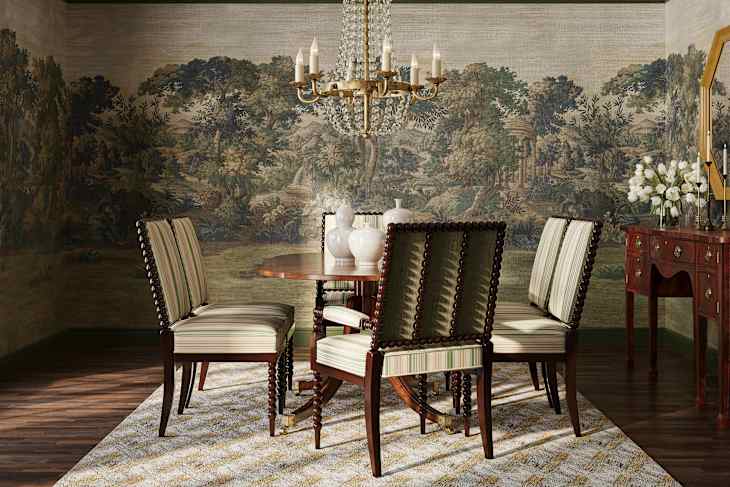
We've scoured markets and feeds to spot the standout looks shaping home style next year. From "Covecore" to bold colors, stripes, and DIY projects, see every trend we're calling in our full New/Next List.
Everything old is new again. Case in point: The look (and feel!) of tapestries popular 400+ years ago in French and Belgian castles has modern designers’ attention for 2026.

The word “tapestry” may have you thinking of embroidered dragons and mythical fauna, or biblical scenes and religious iconography — all just collecting dust against a stone wall. But new patterns found in many retailers today reference a botanical motif that was featured in tapestries centuries ago — a design known as verdure.
Verdure patterns illustrate a rich, detailed design with repeating patterns imbued in nature — namely foliage and vegetation. Designers have spent years customizing interiors with verdure patterns on bedding, rugs, and statement walls — but now, modern home retailers from Arhaus to Williams-Sonoma are catching on to this refined trend. Antique-lovers are spotting these patterns being used in exciting new ways, including plush seating and tufted wall mirrors (more below!).
“Verdure [prints] are very versatile — simultaneously both as a pattern as well as a texture,” says Sarah Stacey, founder and principal designer of Austin-based Sarah Stacey Interior Design. “[Verdure] is a great way to mix a pattern into your space without feeling like you’re drenching in a floral,” she adds.
At a time when Apartment Therapy declared arboreal prints the “it” pattern of 2025, seeing verdure patterns jump off tapestries and onto modern designs just makes sense. Style editors are watching as this trend continues to grow in staying power, given that those in the design industry are finding new ways to highlight the magic of this lush, gorgeously ornamental pattern season after season.
Be the first to hear about new design trends in our Design Defined newsletter — plus, decor finds you just can’t miss.

What Exactly Is Verdure?
Derived from its historical counterpart of woven tapestries, a verdure pattern is rooted in a detailed botanical theme that design pros say is a bold neutral — especially in maximalist interiors.
The agrarian look is a growing trend within a larger sweeping biophilic design movement, a decorating art form that encourages harmony between our interiors and the natural world. And verdure textiles — which have cropped up in furniture upholstery, wallpapers, and even curtain dressings — quite literally pull the outdoors in. Verdure feels as if it were a long-forgotten precursor to classic toile de Jouy motifs and pastoral floral prints designers love to source today.
“The pattern isn’t so glaringly obvious in its repeat, so it’s very fluid, creating a feeling where it recedes,” says Stacey, who first forecasted the rise of verdure wallpapers in 2023. She began sourcing antique verdure textiles at auctions over 10 years ago — and even sourced a vintage tapestry at the iconic Paris Flea Market in the 2010s.
“And I hate to use this example, but it sort of functions like camo; it’s a great way of having a pattern in a beautiful space that doesn’t demand attention in ways that we use it,” Stacey adds.
As part of its magical “whimsy,” as Stacey refers to it, a verdure pattern feels more like a muted detail in an otherwise busy room. It’s refined to where it always feels like you’re registering a new detail each time you gaze upon its print.

Modern interpretations of verdure aren’t all that different from the tapestries that once were a status symbol centuries ago. During the 16th and 17th centuries, tapestry weaving became a noble art form within royal European courts and monasteries — it quickly became associated with immense wealth due to the intricate production involved. In French specifically “verdure” literally translates to “greenery,” which is exactly what historical tapestries focused on — bringing the outside world into otherwise cold, stone-walled castles.
“Verdure tapestries are woven wall hangings that depict lush flora and fauna, forest scenes, and pastoral scenes hidden throughout greenery,” says Lina Deeb Forrester, an interior designer, textile archivist, and historian at Kravet Inc., an international design house specializing in fabric, wallpaper, and trimmings.
“Verdures transitioned from millefleur (or thousand flower) designs that featured multicolored grounds of small, romanticized blossoms, into the more grounded, heavy, largely green forest scenes that they resemble today,” she adds.
Stylish Verdure Wallpapers to Shop Now


These days, reproductions of these historical prints are often digitally printed. They’re presented as wallpapers, upholstery, or drapery, so designers like Stacey can dress everything from beds to windows in a reimagined verdure that nods to its storied history.
“Producers are reimagining the historical motifs — including vines, leaves, stylized fruit, or animals — by changing several elements, including the scale and colorways, and adding or removing shapes or lines,” Forrester adds. “More luxurious, high-end versions are jacquard woven, which allows for more dimension and textures that mimic the original handwoven verdure tapestries, with luxurious patterns remaining bespoke.”
How Verdure Textiles Evolved Through History
Forrester — who has curated exhibits at the Savannah College of Art and Design and Marymount University, among other institutions — says verdure patterns first began trending as early as in the 15th century. Weavers in Belgium and then in France, including provinces such as Aubusson and Lille, began depicting the vibrant countryside that dotted their surroundings in verdure tapestries.
Smaller, 4-foot-wide tapestries took at least three months to produce from scratch, where Forrester says artisans used haute-lisse (vertical) or basse-lisse (horizontal) looms to weave hand-dyed yarns. Larger pieces that hung on walls could require a full year’s work. It’s why authentic verdure tapestries (and even some modern reproductions) can cost upwards of hundreds of thousands of dollars, particularly at auction.
“Unlike narrative, mythological, and biblical tapestries that preceded them, verdures emphasize lush green landscapes with humans or animals playing a secondary role,” explains Forrester, adding that colors were enhanced by rare green and blue silks. “By blending threads to mimic the natural tonal variations found in the forest, artisans were able to achieve painterly texture and depth.”
Historically, verdure prints may have signaled a larger meaning than literal representation, Forrester says. They were associated with fertility, she asserts, and later with a parabolic, Eden-like paradise.


Now, traditional verdure tapestries are privately held in estates and in museums across the globe; before the print became popular among interior designers, auction houses like Sotheby’s and Drouot fetched thousands for these heritage textiles. According to Forrester, many collectors focus on salvaging bits and pieces from larger tapestries that were damaged over the centuries and frame them as art.
“Ultimately, verdure tapestries were more than just beautiful; their main purpose was to insulate and soundproof drafty castles and grand homes of the past,” she adds. “They became a form of visual storytelling heavily rooted in symbolism with nature and foliage.”
Where to Source Verdure Pieces Today
Sourcing real verdure prints from centuries ago through common antique dealers is quite rare, as Forrester will tell you — and even designers like Stacey now have to hunt for accurate reproductions at market. But as verdure’s allure in the interior space grows, retailers are growing their selections rapidly in 2025.
“Before the hype, I would tell you to go look at an auction, but now they’re popular and far from affordable; but, that said, there are several different manufacturers that make great patterns,” says Stacey, who cites Italian textile house Dedar’s Schwarzwald pattern as her all-time favorite. But the surprising solution she also recommends? Etsy, where sellers are currently reproducing even this gate-kept print in the form of throw pillows.
As many designers currently do, you can make it a game of yours to spend time at your local antique malls to see what reproductions you may find in the wild; Stacey says that her first auction buy was a 1920s jacquard woven, which isn’t as old as an original but still felt like an heirloom.
Trendy Verdure Furniture and Home Decor


Stacey says she first remembers seeing verdure used outside of wallpaper as an upholstered mirror at Anthropologie. That’s around when many home retailers began offering accent elements in verdure prints: pillows, bedding, and, of course, in upholstered finishes for all kinds of seating. “I think it’s going to stay popular; it’s kind of hard not to love,” she says.
The Right Way to Style Verdure in Your Space
There are so many ways to incorporate the reprisal of this lush, vibrant pattern into your space. A few years ago, you may have been limited to your walls. In 2025, however, furniture and accents upholstered in jacquard-like materials are possibly even more exciting.
“If you have a space that’s full of patterns and colors, you don’t necessarily want to use something that’s a solid or plain; when you do, it just makes that detail scream, like it’s out of place,” Stacey points out. “But you also can’t have a pattern that conflicts too much, as you don’t want too many stars of the show, so to speak. I feel that [verdure] melds with the larger picture, and [is] subtle enough — but still rich.”
A full wall of verdure might not be in the cards for you, and that’s why a pop of this print often creates a wow factor through the smallest detail. Layering pillows, a rug, or an ottoman within a room that makes use of other curated vintage pieces only adds to the verdure’s authenticity, as if it’s always been there.
Ultimately, though, the best use of verdure may simply present itself to you by chance — if you’re lucky enough to source it in the wild. Don’t be afraid to collect old pieces that are showing signs of age, imperfections that illustrate their handcrafted nature, or have fallen victim to the ravages of time. Those tattered pieces may be the true key to capturing the whimsical nature of the tapestries that captivated royal courts all those years ago.
Design Defined
Never miss the style inspo and recommendations you crave with Design Defined. Follow along each week as our Home Director Danielle shares the best style advice, latest trends, and popular decor finds you just can't miss.