
What Is Considered a “Small” Apartment?
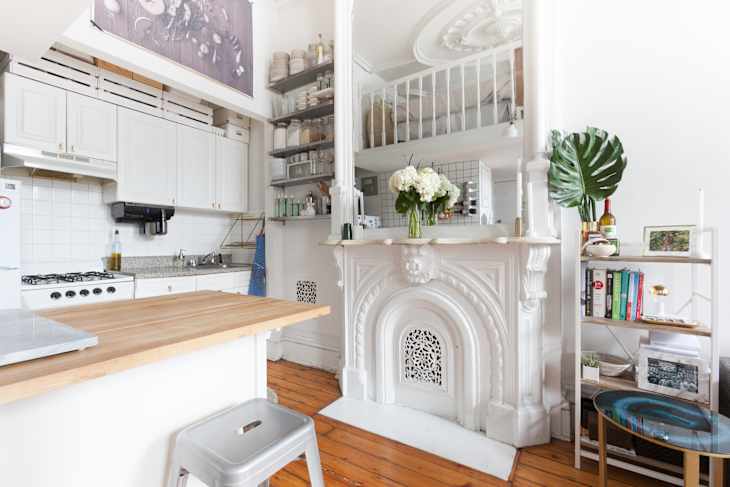
Some words have different meanings depending on where you are. A “biscuit” in England is a “cookie” in America. “Pop” in the South is something balloons do, while in the Midwest, it’s soda. Don’t even get me started on all the different regionalisms for the name for that patch of grass between the road and the sidewalk. And worst of all, the standards for what constitutes a “small apartment” vary wildly based on location. In New York City, a “small” apartment may be 300 square feet. In Atlanta, 300 square feet is practically unlivable. Unfortunately, there’s not an easy way to figure out what a “small apartment” is, size-wise.
An informal survey of Apartment Therapy staff didn’t reveal much — NYC residents all agreed that “less than 500 square feet” seemed small, while one remote Salt Lake City-based employee said, “I have friends here whose ‘small’ studios are like 750 square feet.”
To get a sense of what a “small” apartment truly is, I dug into definitions by government agencies and tapped real estate pros to reveal what they would consider a “small” apartment to be in their market — and turned up some pretty surprising answers.
So What Constitutes a “Small” Apartment?
So is there any way to reach a national consensus on what is “small”? Likely not. “Micro unit” has no standard definition in the United States, according to the Urban Land Institute (ULI). The ULI uses a working definition of “a small studio apartment, typically less than 350 square feet, with a fully functioning and accessibility compliant kitchen and bathroom.”
(There’s a lot of great info in that ULI report from 2015 — and I would encourage you to check it all out for yourself if this sort of semantic squabble lights your fire.)
What Cities Allow the Smallest Legal Apartments?
Seattle boasts the smallest average apartments across the United States. A 2025 study found that the average size of new apartments in Seattle are just 649 square feet, according to RentCafe. Gizmodo reporting from 2015 stated that Seattle’s micro-units were as small as 90 square feet, but in 2025, the City Council “imposed a minimum unit size of 220 square feet on mini-units” while also adding other requirements, per Connectcre.
Los Angeles’ minimum can vary based on type of apartment, but efficiency living units must have a living room of at least 220 square feet and each unit needs 100 square feet of additional space for each occupant if there are more than two people living there. As of 2022, accessory dwelling units (ADUs) in LA have to have a minimum living area of 150 square feet.
In New York City, in buildings built after 1989, living room areas have to have a minimum of 150 square feet and “every other living room of an apartment in a multiple dwelling” must have 80 square feet of space. Studio apartments can be as small as 150 square feet, though this would be considered very small, as the average apartment size in New York City is 868 square feet.
But we’re talking legal limits. Obviously, the guy who paid $450 a month to live in a 9×4.5-foot Brooklyn crawl space didn’t care about your legal limits (and ditto for the landlord who rented it to him).
In Boston, a micro-unit must be 450 square feet and within 1 mile of public transit, unless you’re in a new development with 10 or more units — in which case studio apartments can be smaller than 450 square feet.
And that doesn’t even scratch the surface of the square-footage realities and regulations, different in every city, of more creative living arrangements like accessory dwelling units (ADUs), tiny homes, and RVs.
What Do Real Estate Pros Consider a “Small Apartment” Across Markets?
Erin Hybart, a Realtor and tiny-house enthusiast in Baton Rouge, Louisiana, would call any unit “under 500 square feet” as small — and says most units run somewhere between 500 to 1,000 square feet. Meanwhile, in Des Moines, Iowa, Jacob Naig, real estate investor at webuyhousesindesmoines.com, says anything under 600 feet would be considered small, and anything under 500 feet “is considered a micro-unit and it is very scarce in our market.”
Jake Kennedy, a Realtor at Compass in Nashville, puts “small” between 400 and 600 square feet — and 600 to 1,000 would be considered a “medium-size” unit. In Philadelphia, on the other hand, a smaller studio to one-bedroom unit would be anywhere between 300 to 750 square feet, per Casey Gaddy, Realtor with the Gaddy Group, Keller Williams Realty.
What Is the Average Apartment Size Across the U.S.?
According to 2025 data from RentCafe, the average size of an apartment in the U.S. is 908 square feet. An average studio is 457 square feet, a 1-bed 735 square feet, a 2-bed 1,097 square feet, and a 3-bed, 1,336 square feet.
By city, the average apartment size varies a great deal. The largest new apartments are being built in Tallahassee, Florida, with the average new unit clocking it a 1,130 square feet. Meanwhile, the city with the smallest new builds — Seattle — has average units clocking it at 649 square feet. (You can check out the average apartment size in your state with this table from Rent Cafe.)
If we’re being driven by cross-country data, I’d say a “small apartment” is somewhere between the average of the lower limit — around 200 square feet — and the upper limit — about 908 square feet. So, it’s probably safe to say a small apartment is one around 500 square feet or less. But there’s no definitive answer — so maybe the best answer is what would feel small to you.