
I Tried the “Kidlin’s Law” Method on a Super Busy Day, and It Melted the Stress Away

I would be lost without my paper planner. When I don’t have it, I spiral in two seconds and become instantly overwhelmed by tasks. I’m quick to tell myself there isn’t enough time in the day to get it all done, especially since I know my energy wanes as the day progresses.
Though I’ve always used pen and paper to clear my head and stay organized, I hadn’t always known that by writing my to-do lists and doing my brain dumps, I was sort of practicing a technique called Kidlin’s Law. Even better, once I learned more about it, I tweaked the way I make my to-do lists in a way that’s saved me from feeling overwhelmed quite so often.
What Is Kidlin’s Law?
“Kidlin’s Law suggests that if you write the problem down clearly, then the matter is half solved,” says Dr. Carolina Estevez, Psy.D., a licensed clinical psychologist at SOBA New Jersey. “In other words, putting thoughts into words helps bring clarity and makes overwhelming situations feel more manageable.”
I know this all too well. If I start to feel like I can’t solve a problem or I’m running low on time, my mind will start to snowball into discouragement. But putting those spiraling thoughts down on paper, instead of keeping them locked in your mind, is what Kidlin’s Law is all about. “When we externalize a problem — a stressful workload, a tough decision, or a nagging worry — it becomes easier to break it down into steps and work toward a solution,” Estevez continues.
How I Tried the Kidlin’s Law Method on a Stressful Day
“If you are having a super busy day, applying Kidlin’s Law can be a simple way to relieve stress,” Estevez explains. “Start by writing down everything on your mind — tasks, deadlines, worries — without overthinking it. Just getting it out of your head can make a huge difference. Then, go back and organize your list: What is urgent? What is important? What can wait? This process helps you prioritize and gives you a sense of control, which can make your day less chaotic.”
While I’ve long been a fan of to-do lists, I don’t always take the time to break bigger tasks down into the steps it will take to accomplish them, really spelling out the challenge at hand. I also don’t typically put them in order of priority, because I tend to tell myself I just need to get it all done.
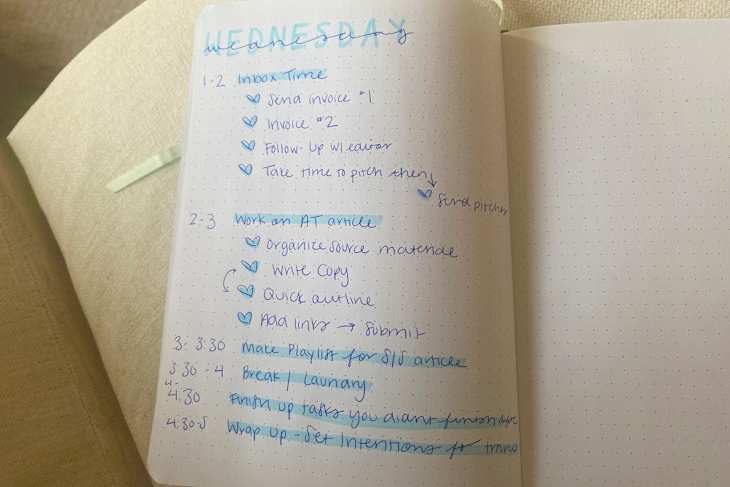
I decided to intentionally put Kidlin’s Law into practice on a day where I had a morning full of out-of-the-house meetings. I freelance and make my own schedule, and I tend to do my best work at the start of the day, during my power hours. I normally reserve my morning for writing, but on this busy day I was in meetings until 1 p.m. I arrived at home feeling so behind.
I knew that the meetings were part of my workday, but something about not getting to my laptop until the afternoon stressed me out. As I started to run through the to-do list in my mind, I quickly started to think things like, “I can’t get to all of this today. This is a waste of a day. I’m going to have to play catch-up tomorrow.” This was the perfect opportunity to brain dump and get these problems out on paper.

My Results with the Kidlin’s Law Method
Every time I do this, I am always surprised by how manageable my task list actually is, and the day I had morning meetings was no exception. My mind almost always makes a mountain out of a molehill, and seeing a list where I specifically write out the “problem” — aka my to-dos — puts everything into perspective. After dumping out all the tasks I wanted to get done that day, I went through Estevez’s list: What is urgent, what is important, and what can wait?
To my surprise, nothing was urgent, a few things were important, but overall, these were just general work tasks I needed to do to stay ahead of my deadlines. Nothing was as pressing as my mind made it out to be. Next, I broke down my list into even smaller steps.
“Breaking down big tasks into smaller, more manageable steps is one of the best ways to ease overwhelming feelings — especially when life already feels stressful,” Estevez says. “When a task is vague or too large, your brain perceives it as daunting. That is when procrastination kicks in, not because you are lazy but because your mind does not know where to start. The solution is to make the task more specific and actionable by breaking it into clear, bite-size steps.”
Applying the Kidlin’s Law method brought me instant relief, just to see that it was actually possible to get everything done by breaking it all down — especially when certain tasks like sending an email only take 10 minutes, if that.
“To make Kidlin’s Law a daily habit, try starting each morning with a quick ‘brain dump’ where you list everything weighing on your mind,” Estevez suggests. “Then, highlight your top three priorities for the day. This simple habit can create structure, boost focus, and make even the busiest days feel more manageable.”
I, for one, am always looking for ways to make my days feel calm and organized, so you can find me practicing Kidlin’s Law from now until the end of the year, at least.