
The One Thing Real Estate Agents Wish You’d Do Before Buying a New Appliance
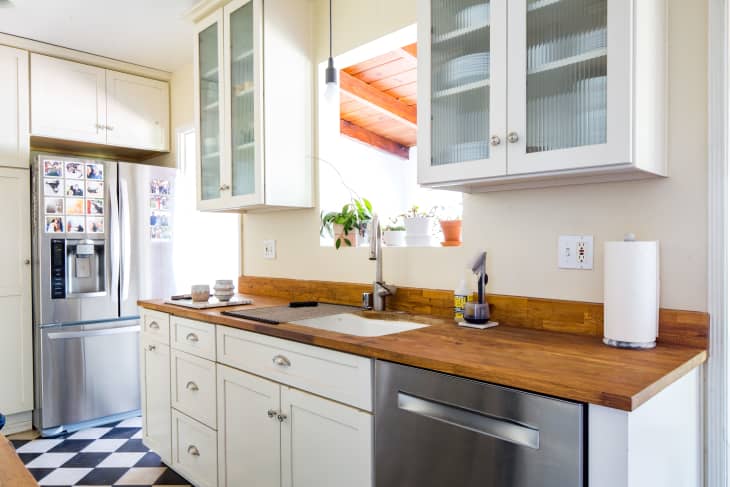
Installing a new appliance is a relatively quick and easy way to add value to your home (not to mention a nice way to improve your day-to-day). But buying a sleek, ultramodern fridge isn’t necessarily a fast-pass to a higher resale value. In some cases, real estate experts say investing in a brand-new refrigerator can actually make your space less desirable to potential buyers.
Why doesn’t new always equate to better? It all has to do with how the appliance fits in your kitchen space.
According to Deb Tomaro, a real estate agent in Indiana, older homes—even those built in the 1980s or ‘90s—weren’t made to fit modern appliances. So as many bells and whistles as that new refrigerator might have, you could end up with an awkwardly-fitting appliance and, ultimately, less space in your kitchen.
“When touring homes, I often see gorgeous new refrigerators that jut out six inches into the walkway because the kitchen wasn’t designed for such a big fridge,” Tomaro says.
This problem might not seem all that glaring in a larger kitchen, but if your space has a smaller footprint or if it’s especially narrow (like in a galley kitchen), it would benefit you to be a little more strategic before updating your appliances.
The solution is simple: Before you buy a new oven, dishwasher, or refrigerator, measure the space. Even if the width and height of the new appliances makes sense for your kitchen, always pay attention to the depth. If the appliance you’re eyeing would protrude from the cut-out that’s already there, it might be wiser to choose a different-sized appliance.
If you’re updating your fridge, Tomaro recommends ordering a countertop-depth version—which is offered by many mainstream appliance brands—so it won’t stick out as much. Typically, counter-depth refrigerators match the depth of standard kitchen countertops in older homes (24 to 25 inches) as opposed to traditional, modern refrigerators, which are usually 35 to 36 inches in depth. Don’t worry too much about losing out on fridge space: Counter-depth appliances are usually wider and taller than standard refrigerators, so they’ll compensate for their narrower depth.
It might cost a little more time and money on the front end to make sure your fridge perfectly fits your kitchen, but as with many investments, your work will be worth it in the long term. Remember: Every choice you make in your home today affects how easy or difficult it will be to attract buyers later on.