
HVAC Pros Say Now Is the Best Time of Year to Try This No-AC Solution (It Sucks Hot Air Out!)

Ah, September. It’s the time of year where some days feel like fall, and some days feel like summer. And it’s a great time of year to use a whole-house fan, especially on those days that feel unseasonably warm, if you live in a dry climate, and if you’re ready to turn your AC off for the season.
Whole-house fans work in some climates (think: states like California and Colorado) year-round, and they’re an alternative to air conditioning that’s been around for centuries.
Yes, personal fans and ceiling fans (and even ice fans) are helpful, but there’s another type of fan that might be worth investing in: a whole-house fan, which helps pull cool air inside while directing warm air outside, creating circulation that keeps your home’s temperature at a comfortable level.
Here’s everything you need to know about whole-house fans, including where they work best, how to use them, and how to install them.
A Whole-House Fan Is an AC Alternative
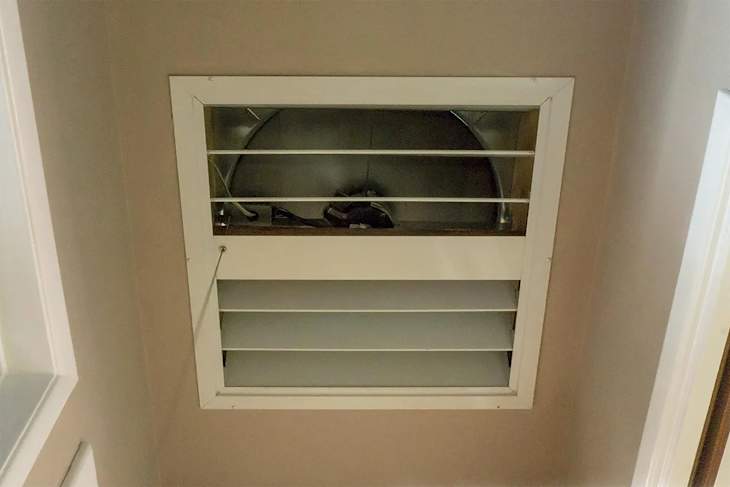
- It’s a fan installed in the ceiling of a home’s top floor. Warm air is pulled up and out through attic vents.
- It’s best suited for use in dry climates and at nighttime.
What Is a Whole-House Fan?
Although the name whole-house fan may evoke mental images of a massive network of circulating blades throughout your home or even one truly massive fan, that’s not the case.
A whole-house fan uses natural airflow to cool a home by directing warm air outside while pulling cool air inside. That means that to get the most out of a whole-house fan, temperatures outside need to be cooler than the temperatures inside, so it operates best at night. At its heart, “a whole-house fan is just a big box fan built into your ceiling,” says Keith Wortsmith, who is the president of DASH Heating & Cooling.
Here’s how it works: “A whole-house fan is just a big box fan built into your ceiling,” explains Wortsmith. It’s located at the ceiling of the top floor of your home and vents into the attic through a large duct. The fan pulls warm air up through the duct and pushes it through attic vents.
Wortsmith notes that it only takes half an hour to cool down your home with a whole-house because the fan draws in cooler night air. “Open a few windows at night, flip the switch, and it sucks the hot air out of your house into the attic and blows it outside,” Wortsmith explains.

When to Use a Whole-House Fan
While a central air system, mini split, or in-window air conditioning unit is more ideal in areas with high humidity, or where temperatures are consistently warmer outside than inside, a whole-house fan can be a great way to bridge the gap between sweltering summer weather and more temperate fall weather without having to run expensive AC.
That’s not to say you can only use one or the other, though. Try a whole-house fan in conjunction with existing air conditioning to save money and reduce reliance on your HVAC system.
“Whole-house fans work best in areas where evenings cool down significantly after hot days,” says Scott Levene, who is a licensed HVAC professional and third-generation owner of Levco. “They’re particularly effective in dry climates or transitional seasons like spring and fall when running an air conditioner isn’t necessary.”
So, if you live in a place where your nighttime temperatures drop into the 60s or below, you’re probably a good candidate for this fan-based method.
According to the Office of Energy Efficiency & Renewable Energy, areas with lower humidity are a fit for whole-house fans, including states like Arizona, Utah, New Mexico, and Colorado, as well as parts of California and Texas.
According to Simon Bernath, who helps homeowners find trusted HVAC companies, you should also consider whether a fan system will work with the structure of your home. “These tend to work best if the home is suited to them, like having a large and open attic with a central opening, and a relatively open home design, or at least one where air will flow well,” he says. Large windows on the lower level will also help with airflow.
How to Install a Whole-House Fan
As with many home projects, you have two options: Hire a professional or tackle the task as a DIY project. And there are benefits to both. “A professional version will tend to have more custom-fitted parts, and contain a more purpose-configured fan with proper mounting, likely better venting, and just more polished workmanship,” Bernath says. A professional may also be able to service your fan or provide a warranty.
Wortsmith says that if you’re handy — and not scared about cutting into your ceiling or splicing wiring — you can try installing your own system. Just make sure that you have openings for the warm air to leave. “Most DIY installs fail because people don’t add vents [to the outside], and then the attic just turns into a furnace and pushes all that heat right back down, making things even worse,” Bernath notes.
On her blog, DIYer Rebecca of Simple Practical Beautiful details how her husband installed a whole-house fan for about $300 by cutting into her top floor ceiling and installing a 24-inch whole house fan in the attic (here’s a similar kit from The Home Depot).
The couple runs their whole-house fan in their 1,400-square-foot-home for a few hours each night starting about 7 or 8 p.m., and they’ve found it to be an effective cooling method. The hard part, though, was that it required adding an outlet to the attic, and it’s actually a little louder than Rebecca would like. In hindsight, she’d go with a quieter model, she says.
Tips for Using a Whole-House Fan
Wortsmith recommends purchasing a quieter model in the 40- to 55-decibel range (about the level of a normal conversation) so that you can get your much-needed sleep.
Make sure that you have a way to seal the fan when it’s not operating. “A model with insulated louvers that close tightly when the fan isn’t in use will prevent heat loss in the winter and air leaks in the summer,” Levene says. (Louvers are like shutters for your ceiling fan!)
There is also nuance to using a whole-house fan, which may take a little getting used to, such as knowing how many windows to open in your home and the best time to open them.
“Open a few in the rooms you actually need to cool,” Wortsmith suggests. “Otherwise, the airflow is weak, and it will hardly make a difference.” You should also shut off the unit and close the windows before the sun comes up to avoid sucking in warm air, which will undo all of your cooling efforts.