
Why 99 Million Americans Have to Live in a Climate Danger Zone — And How to Fix It
Rebuild, Relocate, Rethink: What Happens to Our Homes in a Changing Climate examines how climate change intersects with our homes and the way we live. Check out the stories here.
In January 2025, six months before the typical start of California’s wildfire season, a series of wildfires prompted the evacuation of nearly 200,000 people in the Los Angeles area. At its peak, seven different wildfires were blazing, and the fires lasted for 24 days. By the end of the 24 days of raging fires, entire neighborhoods were razed and at least 30 people died.
The factors that cause wildfires can develop rapidly. In Los Angeles’ case, exceptionally strong Santa Ana winds — raging past 80 miles per hour in some areas — collided with extremes of wet and dry seasons. Drought had returned after a period of rainfall from 2022-2023 that supported vegetation growth. It would later become fire fuel. These realities are becoming more common and hard to control due to climate change.
The Eaton and Palisades fires only burned a fraction of the area of the largest fires in California history (about 1,000 wildfires occur each year), but they became the second and third most destructive blazes, earning the reputation as “the big ones.” Entire blocks in Altadena, a historically Black suburban enclave in Los Angeles County, and Malibu, a wealthy beachside city west of LA, were destroyed. Meanwhile, 11,000 single-family homes burned to the ground — and those burned houses fed the flames.
The 2025 wildfires proved how devastating and unrelenting the damage of these disasters can be when they collide with one of the biggest metropolitan areas in the U.S. Los Angeles County — already grappling with a housing crisis with the number of households growing by over 700,000 over the past three decades and the number of housing units by just under 500,000 — now faces an even tighter crunch. At the very heart of the problem in Los Angeles, and increasingly across the country, is the number of housing units that are being built in what’s called the wildland-urban interface (WUI).
The WUI, per the U.S. Fire Administration, is the “transition between unoccupied land and human development. It is the line, area, or zone where structures and other human development meet or intermingle with undeveloped wildland or vegetative fuels.” Data from SILVIS Lab at the University of Wisconsin-Madison estimates about one-fifth of the county’s housing stock is in the WUI.
But the WUI isn’t just an LA problem; nationally, an estimated 99 million people live in the WUI, about one-third of the total population.
Housing Demand Pushes Into the Wildland-Urban Interface (WUI)
Increasing risk of evacuation and damage from wildfires isn’t just due to more fires, but also the growth of people living on the front lines of the WUI. The most damaged regions in the LA fires — the Pacific Palisades, Altadena, and Malibu — were largely located in the WUI. The share of housing stock located in the WUI has also been expanding across the country, growing from 29.5% in 1990 to 31.5% in 2020. Two percentage points may seem small, but it represents an additional 14 million units. Housing in the WUI is growing faster than it is in areas outside of them.
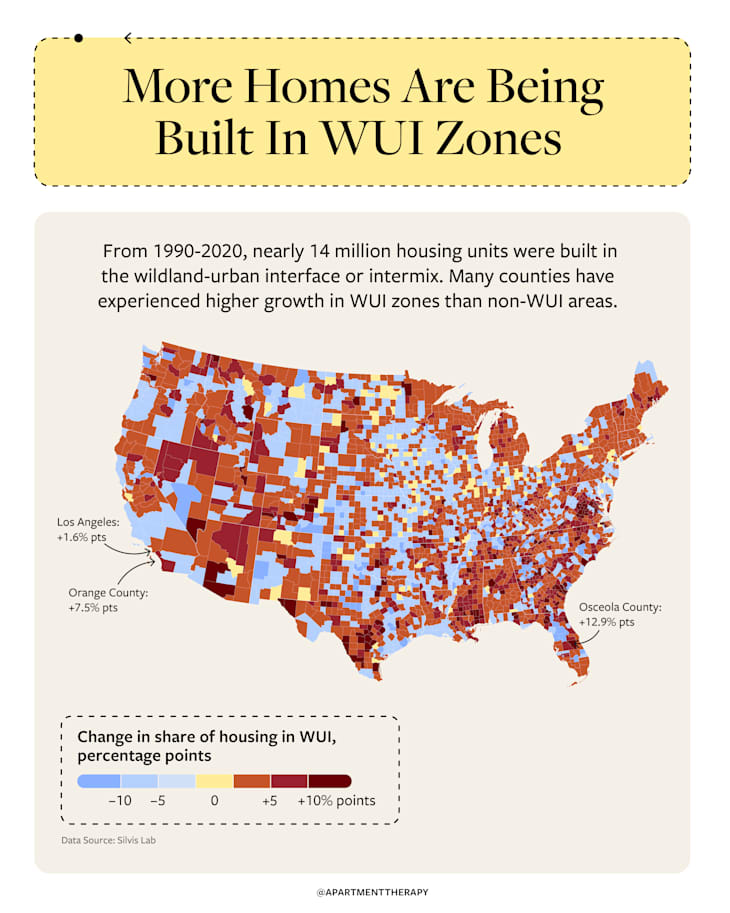
Counties located along the periphery of San Antonio, in Virginia’s Piedmont region, as well as in Clark County (home to Las Vegas), Nevada, have seen some of the fastest growth in the percentage of WUI housing units over the last 30 years. Not every area has equal risk of wildfires, though — Waldo County, Maine, for example, has seen an 11 percentage point growth in share of WUI housing units over the past 30 years, but the chance of a fire breaking out each year according to the USDA Forest Service is just 5%.
By contrast, the Jacksonville, Florida, suburb St. John’s County has seen a 21.5 percentage point growth in WUI housing units, and an annual burn probability of 76.4%. Even with a lower chance of burning, living in the WUI can also increase proximity to bad air quality when fires do break out.
And lower fire risk now doesn’t necessarily mean low fire risk forever. Climate change is lengthening the number of fire-weather days across the U.S., including in Texas, the Eastern Carolinas, and Colorado. The downed trees and other vegetation in the aftermath of Hurricane Helene last spring are providing fuel for a series of wildfires, prompting evacuations throughout North and South Carolina, both of which have seen hundreds of thousands of housing units added to WUI since 1990. (North Carolina accounted for just under 830,000 new housing units in the WUI, while South Carolina had over 530,000.
Homes in the WUI can become fuel for fires — and human activity plays a major part. In Horry County, South Carolina, where most land is zoned for single-family homes and the number of WUI housing units tripled from 1990-2020, one resident was arrested this year for causing a 2,000-acre wildfire after burning debris in her yard. Nearly 85% of all wildland fires are caused by humans.
In California, the five most populous counties all have annual burn probabilities over 92%. Between population and fire risk, even marginal increases in WUI housing could mean devastating consequences.
The Role of Single-Family Zoning in Wildfires and the WUI
Los Angeles is a city known for its sprawl. An estimated 75% to 78% of land is zoned for detached single-family homes. By contrast, in New York City, known for its density and walkability, just 15% of residential land is zoned for single-family units. Sprawl-oriented design has been the standard for many U.S. cities since the early 20th century, spurred by the rise of the automobile and outdated beliefs around how multifamily housing units would negatively change neighborhoods.
This restrictive zoning has fueled the cities’ housing crises for years. In Los Angeles, the median rent for a two-bedroom home is nearly double the national average, and the median sale price of all homes reached $1.1 million this year, according to Redfin. Single family homes sold for around $1.25 million.
Homes in the WUI, especially those further from the city or popular areas, can be cheaper and offer a path to homeownership buyers may not find elsewhere.
“You can see that in most U.S. cities there’s this pattern where areas that are safer tend to have more restricted housing supply,” says Augusto Ospital, an economist and professor at Ludwig Maximilian University of Munich, who has studied how land-use regulations impact proximity to natural disasters. If building limitations were removed (lot size and multifamily bans, for instance), he found that the estimated average rent would fall as much as 28% and the share of people living in high risk zones could drop by 7%.
Ospital recognizes that removing every zoning limitation isn’t feasible, but even modest improvements he says could make a difference. “By upzoning about 5% of the land in targeted central areas, you could get about 80% of the gains in well-being in terms of reduced prices and exposure to wildfire risk,” he says. Passing upzoning programs isn’t always easy, though.
Why It’s Hard to Upzone Housing Everywhere
Under California law, cities must adopt a housing plan and update it every eight years, adding a specified number of housing units during that period. Based on LA’s housing plan, they have to add over 450,000 units between 2021 and 2029. The city’s existing zoning law is equipped to meet only about half of that demand.
The city’s housing plan included a number of programs to meet this shortfall, some of which involved rezoning lots currently zoned for detached single-family homes. The city, however, removed proposals for rezoning single family areas in the plan’s final version.
Under the new plan, existing capacity will increase by 30%, but it won’t be enough to reach the target of 456,000, UCLA researchers found. Instead, it will encourage higher housing costs and potentially sprawl from people seeking to escape them.
Developing in the WUI
California adopted wildfire building codes in 2008, and since then, new developments are required to have fire safety features. But the law didn’t mandate retrofitting older homes, and other states don’t have as stringent requirements.
Even if not legally mandated, making fire safety upgrades can protect homeowners and also lower insurance rates. Kelly Berkompas, cofounder of Brandguard Vents, a fire-rated vent company that protects homes from flying embers during fires, says the first step for people already or considering living in the WUI is completing a wildfire risk assessment, usually available for free from a local fire department.
Homeowners can also get a wildfire prepared home certification which requires a 5-foot zone around the house of noncombustible material. This means removing any plants, flammable landscaping material, and combustible fencing. Other upgrades include using fire-rated roofing, ember-resistant vents, and metal gutters.
Berkompas says the LA wildfires were a wakeup call for how people thought about fire safety. “I’ve been in this industry for almost 20 years, and there have been many fires in that time,” she says. “There’s always a little bit of an uptick in people calling and being more aware after a wildfire … but nothing like what happened after these fires.”
According to Zachary Subin, associate research director at the Terner Center at Berkeley, the focus on making WUI housing more resilient shouldn’t overshadow the need to also build density in areas that aren’t in high-risk zones. Subin, who studies the intersection of housing policy and climate change, warns that, “in the aftermath [of the fires], it’s important to not lose sight of the rest of the city … The more housing you can build that isn’t at risk, the more opportunities you give people to live in that kind of housing. And the lower the cost of that housing can be because there’s less of a constrained supply.”
The LA wildfires were brought on by a perfect storm of events, but scientists don’t expect the level of devastation seen in January to be an anomaly. Across the country, climate change is increasing the frequency of billion-dollar natural disasters, and the places most at risk aren’t always expensive beachside villas, but may also be a starter home in a newly developed suburb or a house in a flood-prone valley.
As cities like Los Angeles continue to grow, it’s not just a matter of building more housing, but building the right kind of housing that can both ease housing prices and keep more people away from the frontlines of wildfires.