
Mold, Mice and 5 Other Red Flags to Watch for When Buying an AC Secondhand

The thing about summer is, it’s easy to forget how brutally hot it is until it’s happening again. You know, when temperatures reach above 80 degrees, you’re down to a tank top and shorts in your apartment (or house!). And if you don’t have central AC, you realize you haven’t installed your air conditioner window unit again for the season — or worse, you don’t have one at all.
’Tis the season to start thinking about air conditioners, and, again, if you don’t have a built-in cooling system, a brand-new window unit will cost you about $200 to $300 — maybe more if you go for one with bells and whistles. But you certainly don’t have to spend that much to stay cool.

Just like with designer bags, clothes, furniture, and more, many people turn to Facebook Marketplace, Craigslist, and other buy-sell-trade groups to buy (and sell) popular AC units. Especially considering your electric bill is probably about to increase thanks to said air conditioner, it’s a great way to save a bit of cash.
But before you drop cash on a used AC unit, make sure you know what to look for when buying these appliances secondhand. To find out everything you need to know about making a worthwhile purchase, I spoke with Muhammad Saigol, CEO and founder of July, and Maggie Breslin Keister, head of customer experience at Windmill, for their best AC unit advice. Here’s what to look for in a used AC unit — and what to look out for.
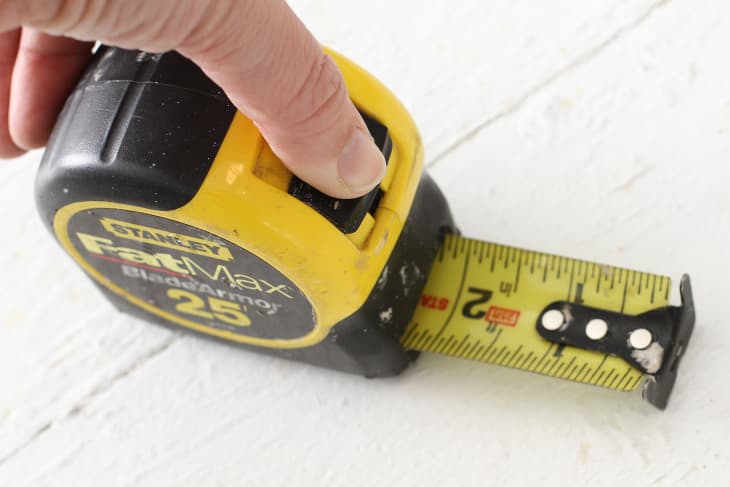
Measure your space.
The first step, Keister says, is to familiarize yourself with your AC unit’s power. “Matching your room size with the correct BTUs (British Thermal Units) is incredibly important and will impact any unit’s cooling capability,” she explains. Often, the BTU is listed along with the unit, but if it’s not, you should definitely DM the seller to ask before buying.
“If the BTUs are too powerful (or too low) for the space, the unit will not work efficiently, and over time can compromise the functionality of the air conditioner, increase your energy bills, and decrease the lifespan of the unit,” Keister says. So in addition to measuring your actual window, make sure you’re measuring the square footage of the space in which the AC will be operating.
Check out the unit’s labels.
Some used AC units will cause you to pay more in electricity bills each month than others. “You should look for an Energy Star label,” Keister says. Check the EER or CEER rating found on the yellow Energy Guide label. A higher rating equals better efficiency.
“Efficient units lower your electricity bill significantly over time,” Kesiter says. She also points out that it’s always a risk to buy secondhand, as you will forgo any warranty from the company. (In short: If you’re buying secondhand, the energy label will help you, but any warranty label stuck to the machine won’t.)
Know how to spot mold.
According to Saigol, mold is the number one thing you should be looking out for when purchasing a used AC unit, and can look like black spotting between the vent slats.
But “mold can lurk within the unit and can’t always be seen from the outside,” Saigol warns. “You’ll want to be sure that you get a photo of the unit’s filter compartment.” (New air conditioners at July get treated with mold-resistant spray, but not every machine does!)

Be skeptical of an AC unit’s aging signs.
In addition to mold, Keister says to scan the coils, if possible. They should never appear rusty. Power cords should have no frays or burning, and the fan should not have a rattling sound. It’s possible that when you pick up a used AC unit, it’ll be unplugged and ready to go, so ask the seller to send a video ahead of time.
It’s also a smart idea to confirm that any remote or WiFi connectivity still works, if applicable to the machine’s settings. Often, the machine can run without it via an on or off button, and it’s not completely necessary, but make sure you’re getting what’s advertised.
Look for signs of pests.
Yes, according to Arizona-based heating and cooling company McMillan Air, mice can get into your home through a window unit air conditioner. “The warm, dry insulation in window air conditioners is perfect for nesting,” the McMillan website reads. “Mice squeeze in through pipe entries, air vents, access panels, and cable ports. They build nests and gnaw on wiring, refrigerant lines, and rubber condenser coils, compromising your unit.”
Look for signs of chewed wires, small holes, mice droppings or puddles around where the unit once was (if you’re picking up the unit from a residence), and fur or dander in the unit.
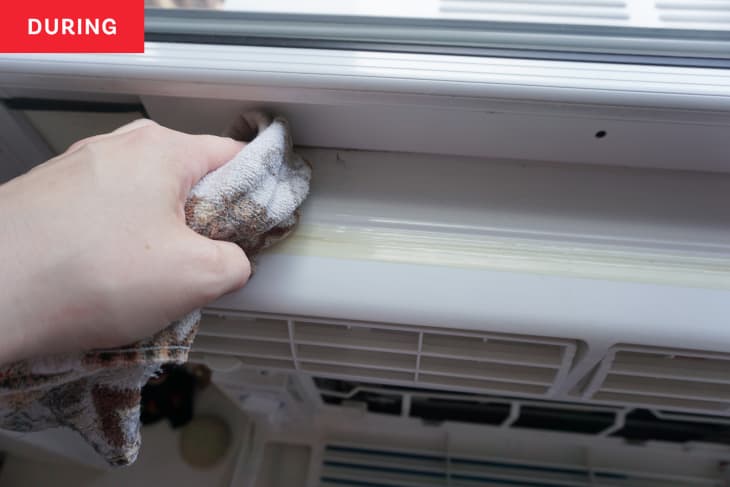
Beware of deep cleaning your machine.
“We never recommend (unless you’re a pro) opening up a unit to clean the internal components,” Saigol says. “There is the risk of injury, and the risk of impacting the components that can lead to degraded performance.”
Instead, he says you can clean the outside with a damp cloth while the machine is unplugged. You can also pop off the front piece to replace or clean the AC filter and dust off the back coils.
Make sure you have the parts you’ll need to install the unit.
On that note, if the filter needs replacing, make sure you can find one that fits the model you’re buying readily at your hardware store or from the original manufacturer or vendor. If your machine requires brackets to install, make sure the seller is also offering those up secondhand or that you have some (or can buy some) to fit the unit.
Some extra insulation materials aren’t a bad idea, either, since it’s likely the original owner used up the materials that came with the original machine.

How much do ACs depreciate in value?
Experts agree an exact number is hard to come by, but in general, Saigol says that “window ACs do depreciate pretty rapidly, since they often can get quite grimy fast, exposed to the elements day and night.” In general, anything over 10 years old might not be a safe bet, as former users could have been damaging the lifespan unknowingly by not using the correct BTUs or EER efficiency.