
This Vintage, Cozy Feature Is Making a Big Comeback — But There’s a Catch
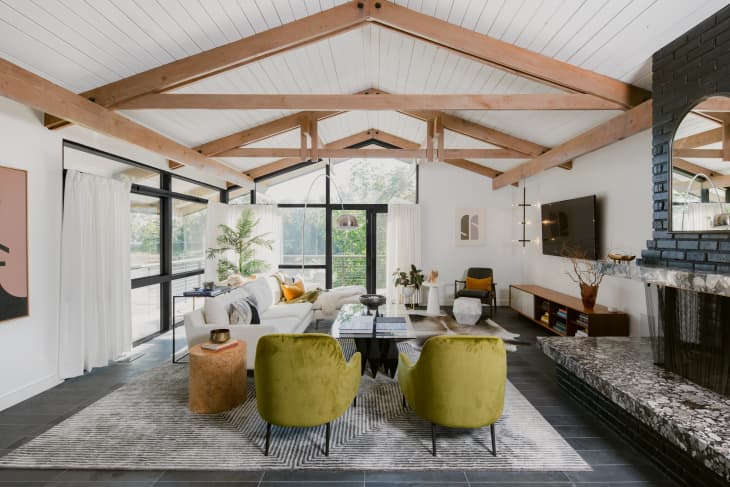
For anyone who loves the architecture of Frank Lloyd Wright, you know that fireplaces were a big deal for him. They were a frequent fixture of the residential homes he designed, sometimes placing even three or four fireplaces within a single home. As Wright once said, “the hearth is the psychological center of the home,” knowing that it was a place where people naturally gathered around and psyches could be comforted and uplifted.
As Jessica Vance, real estate agent and investor, comments, “Frank Lloyd Wright’s idea of a fireplace was that it symbolized illumination, community, warmth, purification, and was a place for refuge and love. Most of his work in his career was centered around a real wood burning fireplace.”
Although wood burning fireplaces served a utilitarian purpose for thousands of years, in modern times, they provide ambience more than anything else. They’ve fallen out of favor in recent decades as gas and electric fireplaces came onto the scene. It’s seemed as if wood burning fireplaces were becoming a thing of the past — that is, until now, some pros say. Are they making a comeback? And should you buy a house with a wood burning fireplace?

Are Wood Burning Fireplaces Making a Comeback?
Casey Gaddy, Realtor and senior agent at Keller Williams Realty, says that wood burning fireplaces are back in a modern way, “not because we need them, but because we love them.” He adds that in a digital world filled with phone screens, a real fire can be grounding.
Vance has also noticed that wood burning fireplaces are making a comeback. “The allure and beauty of a real wood burning fireplace cannot be replaced by an electric or gas option,” she says. “There is something that happens when your sense of smell is engaged that brings back memories of cabins and cozy winter days that simply cannot be re-created with other options.”
And although, as Gaddy says, high-efficiency gas or electric fireplaces have been popular, since they can provide the look and the glow minus the mess and local emissions, wood burning fireplaces have had their own advances in recent years.
“Today’s wood burning fireplaces are cleaner, more efficient, and often installed as architectural showpieces in large, open, modern spaces rather than as the primary heat source,” he details.
The Drawbacks of Wood Burning Fireplaces
Even though strides have been made among wood burning fireplaces, Vance says that, as always, they do need to be maintained and cleaned regularly, which can be a downside for some homeowners.
Gaddy says that they also require a steady supply of wood that you’ll need to stay on top of, and keep in mind that some fireplaces are restricted in cities due to air-quality regulations.
If being eco-friendly is a top priority for you, you may want to steer clear of wood burning fireplaces. While wood is a renewable resource, the smoke in the air isn’t ideal — these fireplaces can release pollutants into the air that add to smog, and they aren’t great for human health either. Current-day wood burning fireplaces, like ones that are EPA-certified, tend to be cleaner than their predecessors, but they still produce more pollution than gas or electric fireplaces.
The American Lung Association says that wood-burning emissions threaten lung health, but they do include several guidelines on how to use one more safely if you have one. Still, if your lung health is top of mind for you, and if you or people you live with have conditions that make particulate inhalation more harmful, it probably isn’t a home feature you really need.
Is a House with a Wood Burning Fireplace More Desirable?
“If a house has a wood burning fireplace, it’s generally desirable, assuming it’s been maintained,” Gaddy says. This involves having a professional inspect it to ensure the chimney is up to code, “and if it’s not, you can often add a high-efficiency wood insert or convert to gas,” he adds.
Are People Getting Rid of Wood Burning Fireplaces?
Yes, people do get rid of their wood burning fireplaces, and it can be a common practice among flippers. “Some flip properties will replace them with gas or electric fireplaces,” Vance says. “However, others will not. It does depend on the area and type of property.”
Gaddy agrees with this thought, saying, “It’s common to eliminate or conceal them for quick flips focused on clean, simple finishes and low maintenance.”
Should You Keep Yours?
Let’s say that you fall in love with a house that has a wood burning fireplace, or maybe you even want to purposely install one in your new-build home. As Vance says, a wood burning fireplace is entirely up to personal preference. “Some people love them and do not want to live without them, and others would prefer an easier option like gas or electric,” she says.
And then, of course, there are the environmental and health aspects to consider as well. In the interest of addressing these concerns, you may want to remove your wood burning fireplace or go with a gas or electric option for your new home.
With all of this in mind, wood burning fireplaces do have the power to increase resale value, if that’s something that you’re thinking about. “You should not underestimate the emotional pull of fire, from the smell of the burning wood to the mesmerizing flames to the charming mantle. Fireplaces ‘speak’ to people. From a Realtor’s perspective, homes that ‘speak’ to people sell better than those without that special something,” Gaddy says.
So, here’s the bottom line: Wood burning fireplaces are making a comeback. However, there are undoubtedly concerning caveats to keep in mind. Wood burning fireplaces are a personal choice, but in today’s day and age, there are alternatives you can explore as well.