
Designers Are Using a 17th-Century Detail to Seriously Upgrade Walls in 2025
Anyone who follows the cyclical nature of design trends knows the age-old adage of “what goes around comes around” certainly rings true. But sometimes, what “comes around” is something you, well, never actually saw coming. The return of certain features makes sense, like the resurgence of workhorse British kitchens or textured wall finishes — these styles and elements are just so timeless and practical. Other revivals may seem less obvious, and therefore, they can be harder to warm to.
Those of us who came of age in the mid-’90s may recall that wall adornments were everywhere. Many of them, including wallpaper borders, have come back in new and fresh ways in recent years. The next iteration to hit it big in 2025, though? Fabric buntings. Once reserved for preppy New England country clubs and European seaside resorts — and before that, patriotic uses and ceremonial uses — fabric bunting is now being used as a way to bring a bit of whimsicality and texture to interiors.


A Brief History of Fabric Bunting
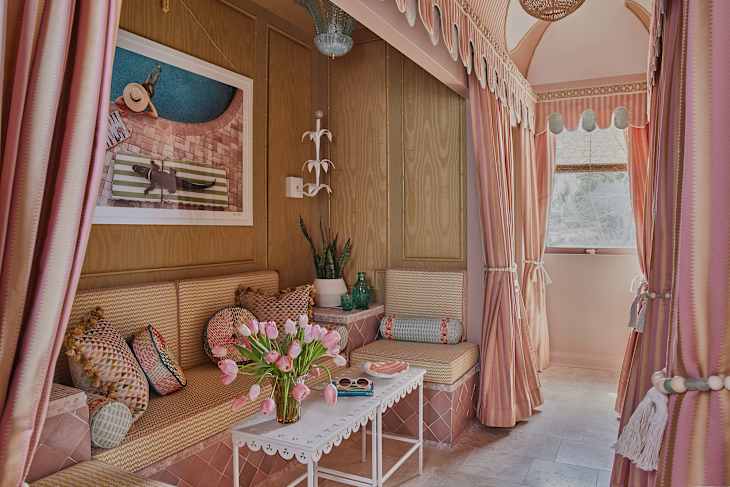
“Fabric bunting has such a rich, layered history; it’s long been used in celebratory contexts, from seaside resorts to political rallies,” says designer Meghan Jay, who recently incorporated this charming element into a cabana-inspired room she designed for the Lake Forest Showhouse (pictured here above and just below). “There’s something inherently joyful and nostalgic about the look. Bunting is decorative, but it’s also deeply atmospheric. It’s playful without being frivolous, and it signals that something special is happening in the space.”
Like any personality-packed design feature, bringing bunting into your own home requires a special formula that’s one part gusto, one part know-how. This is not an element that’s well-suited to an oversized room or a function-first space, like a kitchen, that has a lot of other elements going on.
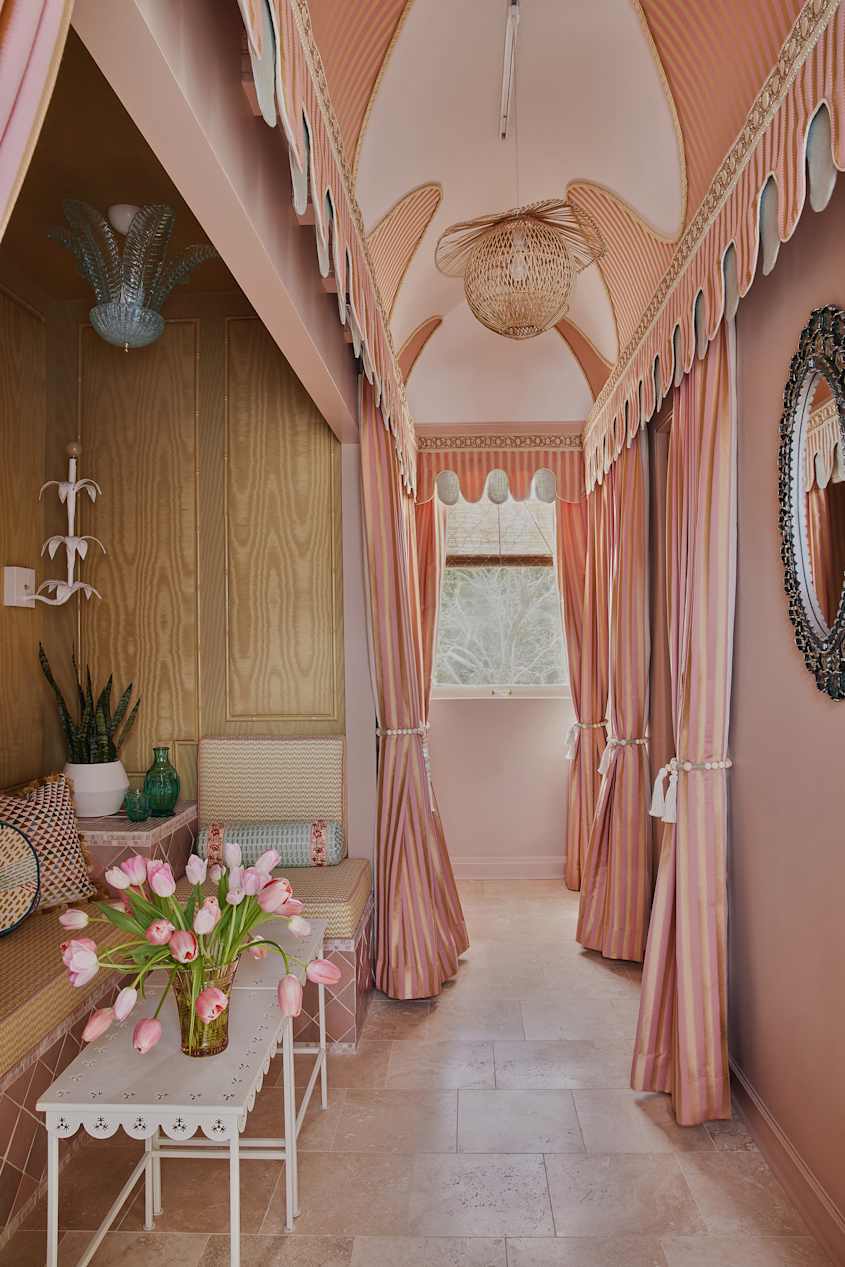

Jay suggests using fabric bunting as a way to pack personality into a smaller, oft-forgotten space. It’s also a wonderful solution for mimicking the feel of architectural details (think: crown molding) in a more playful and less permanent way.

How Fabric Bunting Will Be Used in 2025 and Beyond
“I think we’re going to see designers using fabric more playfully, particularly as we continue to look for ways to soften architectural lines and introduce a handmade feel,” Jay says. “Bunting is a beautiful way to do that. It adds whimsy and motion and can be surprisingly versatile depending on scale and material.”
Jay recommends trying out the trend in a transitional space, like a hallway or entryway, as a means of setting the mood of a space and playing into the transportive nature of the detail. “Like anything, it comes down to execution,” she adds. “If the palette, shape, and texture are dialed in, it can add warmth and narrative to just about any space.”