
Designers Say These 6 Design Trends Make Your Living Room Look *Way* Smaller
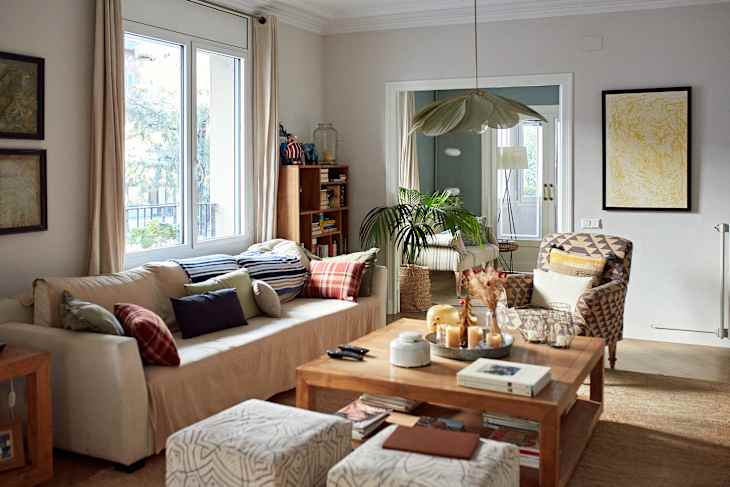
For many people who live in tiny apartments or other smaller spaces, the living room is often the heart of the home. Any space you use that often should be easy enough to move around in — and not so cluttered or distracting that you can’t settle in for a movie or game of cards. And that’s an especially precarious line to walk in the age of maximalism style today.
Everything from the way your furniture is arranged to the colors you choose to decorate with — even how you position art on the walls — can have an impact on whether or not your living room feels cozy or claustrophobic. So I spoke to interior designers to find out which trendy styling tips might inadvertently make your living room feel smaller and more cramped. Avoiding these design pitfalls could actually make your room appear larger.


Careless Clutter
“The trend of ‘more is more’ isn’t always the case when it comes to decor,” explains Leigh Lincoln, co-founder and principal designer for Pure Salt Interiors. “Too many vases, trays, or other decorative objects can overload a space and contribute to a feeling of clutter.” Instead, Lincoln says to focus on being intentional with an economy of pieces. This allows the negative space in your living room to be more noticeable, which can create the illusion of a larger, more sophisticated space.
The same is true when it comes to the color scheme you decorate with, according to designer Purvi Padia, founder of House of REVELRY. “Small spaces cannot handle an onslaught of decor or multiple color palettes if the goal is to maximize the visual space,” says Padia. “Try choosing one to two anchor or statement pieces, and keep the rest of the selections a little more understated and all in a similar color palette.”
You’ll still want some visual variety, though, and Padia has ideas there, too. “Don’t be afraid to add interest using layers and play with silhouette and decor for height and perspective,” she says.
The Big Light (Without a Supporting Cast of Characters)
It’s OK to use the big light sparingly — and to go a little bit dramatic overhead — in a small room. The key is making sure that you don’t just use only that light in a vacuum. “I generally love the idea of statement lighting, and a small space can house a statement light if it is done right,” says Padia. “First, it must be proportionately sized. And second, add one to two other light sources at varied heights to draw the eye to multiple places in the room. The scattered lighting creates beautiful depth and an illusion of larger space.”

Layered Rugs
Putting a smaller rug on top of a larger one can add texture and more color to a room. But it’s a design move that’s sometimes better suited to larger spaces, according to designers. “I still love a layered rug moment, but this is another thing that can chop up a room,” explains designer Jessica Ahnert Davis, owner and creative director of Atelier Davis.
Instead, Davis recommends choosing a rug that’s large enough to truly anchor a small room. “If you want a room to feel bigger, select a rug that continues under the furniture, and use just one rug to keep your eye moving,” she says.
Oversized Furniture
Amber Guyton, interior designer and founder of Blessed Little Bungalow, says that no matter how much you might want that giant sectional, picking the right size furniture for a space is a non-negotiable. “Oversized furniture can swallow a room whole and disrupt an easy flow in navigating the space,” she says. “Don’t be so tempted to purchase the largest sectional sofa you find just because it’s comfortable and nap-worthy. A smaller sofa and/or chairs may be just enough seating.”
Davis agrees that big, boxy furniture can take up too much visual space. Just like layered rugs, she also thinks that giant sofas with multiple seat cushions can read as choppy and disjointed in a room, particularly in a smaller space. Look for a more streamlined sofa instead. “A single bench cushion is cleaner and allows your eye to move around, which helps the space feel larger,” she says.
Too-Tiny Furniture
On the other hand, you don’t want to use teensy furniture in a smaller living room space, either. “As wild as it sounds, small, undersized, underscaled furniture that does not fill a space correctly actually makes a room feel smaller,” says Jennifer Beget, owner and principal designer for J Beget Designs. “Invest in pieces that will fit the space correctly.”
Furnishing a smaller room is somewhat of a Goldilocks situation. If you can, take the time to find that sofa that’s “just right” because your room will look more spacious for it. You might even consider going semi-custom with a brand that carries sizes beyond what’s standard, like BenchMade Modern.

Dramatic Accent Walls
Turns out the accent wall trend could actually be bringing your small living room down. “Covering only one wall in wallpaper or a pop of color actually shrinks the overall appearance of the space, as a single bold or dark wall can visually ‘stop’ the eye, breaking up the room’s flow and making it feel smaller and more boxed-in,” says Aly Morford, co-founder and principal designer for Pure Salt Interiors. “It’s much better to either color or pattern drench, or keep it uniform — either direction will maximize the look and feel of the room to be more spacious.”