
7 One-Wall Kitchen Design Rules Pros Want You to Know
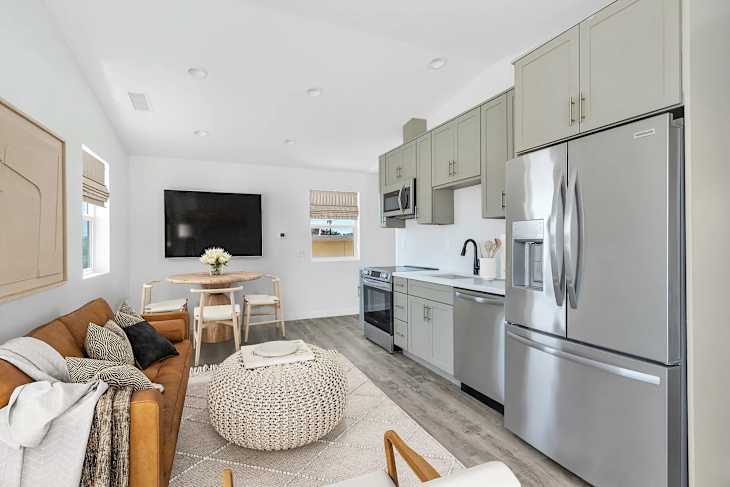
More often than not, the simplest designs make the most sense — and in terms of kitchens, a one-wall kitchen is definitely one of them. As its name suggests, this style of kitchen is purposefully designed with all the counters, cabinets, sink, and appliances installed against a single wall.
One-wall kitchens existed for some time before they were common features in 21st-century design, particularly in open-concept layouts. But you don’t have to be short on space to embrace a one-wall kitchen in your home.
Unlike an efficiency kitchen that has fewer or compact-sized appliances, a one-wall kitchen affords space for all the regular-sized necessities: a refrigerator, oven, microwave, and even a dishwasher. Unless you crave extra cabinet space, a one-wall kitchen is usually designed to include each of these necessities.
Designers typically prefer a counter-depth refrigerator versus standard-depth options to keep a one-wall kitchen looking streamlined, but it’s a small sacrifice for a truly gorgeous, space-saving aesthetic. The tightest kitchen layouts keep everything relegated to one wall, which sounds rigid in theory — but there’s flexibility in practice for a dining and living space.
The beauty of a kitchen is indeed in the eye of the beholder, but there’s a lot for even pro chefs to admire about smart one-wall kitchen layouts. Below, take a closer look at how to make the most of a one-wall kitchen layout in your home.

Why You Should Consider a One-Wall Kitchen Layout
Despite the often smaller footprint, especially in accessory dwelling units (also known as ADUs), the one-wall kitchen is “completely livable,” says Associate AIA Luis Calderon, head of design at SnapADU, an ADU design and build firm serving greater San Diego.
“I think as a society, a lot of people are moving more and more towards a minimalistic lifestyle,” Calderon says, adding that there’s less need for “40 million different appliances that you’ve got to plug in everywhere.”
Chelsea Bothe, brand and marketing manager at True Residential, says that one-wall kitchens are popular in urban dwellings where space is hard to come by — especially in New York and San Francisco. But even homeowners with sprawling spaces are leaning into the one-wall design — particularly if they want their kitchen to “demand attention” in their open floor plan.
“[Homeowners] are really thinking through the finishes that they’re choosing,” Bothe explains, including the cabinetry profile, the stone for the surfaces, and the appliances. “They are really putting a lot of thought into all of these choices because it has a much larger impact.”
While one-wall kitchens can be an affordable choice for homes, they also offer the opportunity to make a splash with high-end finishes and appliances that are on display for all guests to see.
Where to Install One-Wall Kitchens
One-wall kitchens can be installed in any open-concept floor plan (including hybrid living rooms!). They’re great for more compact spaces, including ADUs, but they also work well as showcase kitchens in larger homes. Bothe explains that it’s not uncommon in luxury properties for a one-wall kitchen to exist alongside a butler’s pantry, and they’re also popular formats for outdoor kitchens.
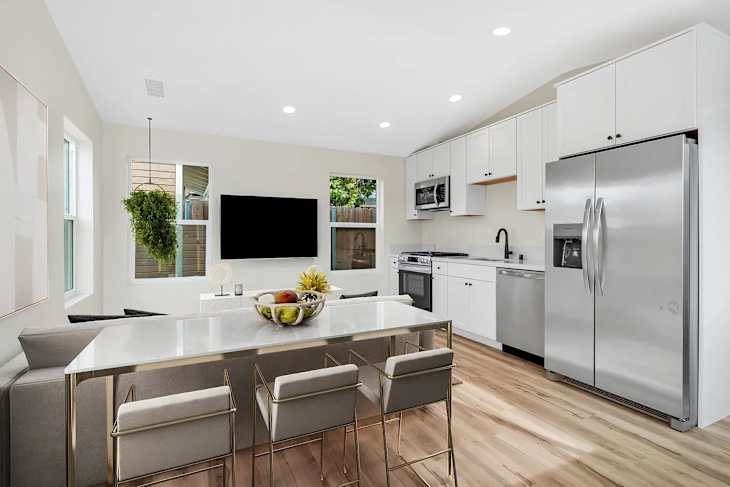
There are some smart variations on the one-wall concept. In particular, the addition of an island with a sink — or even a cooking range — allows for more countertops and storage off the wall. Islands or peninsulas offer dining space as well as extra storage, whereas the simple addition of a table and chairs turns the space into an eat-in kitchen.
But even if you keep your kitchen to the true one-wall layout, you’ve got more flexibility with the space than meets the eye.
One-Wall Kitchen Design Pros and Cons
As with all kitchen designs, one-wall kitchens have their advantages and disadvantages. Here’s what to consider when installing one or purchasing a house with an existing layout.
Pro: It saves space.
One-wall kitchens fit everything you need for meal prep in a space-saving layout. Counter-depth appliances help keep things compact; otherwise, you do not have to choose smaller appliances to fit the footprint.
Minimalism is returning to popularity when it comes to kitchens, says John Dean, owner of Connecticut-based Dean Cabinetry. “A lot of people are trying to do more with less, and I think that a one-wall kitchen is minimal; [it] absolutely feels modern and clean.”
Pro: It’s the most affordable to design.
Dean explains you’ll save money on installation costs simply because there’s less cabinetry and appliances to install. The one-wall design makes it much easier for contractors to install components, as opposed to having to wrangle corners and other tight layouts. “The installation is quicker and less expensive,” he adds.
Pro: It offers an open, airy layout.
Don’t have a window in your kitchen? No problem. Your kitchen will still feel brighter and more airy because it opens up to the rest of your living space. Plus, with a one-wall kitchen, If you’re hosting a gathering, you’ll feel a part of the action as you prep in the kitchen. But even if you’re simply cooking a weeknight meal for yourself, you won’t feel closed off as you might in a galley kitchen.
Con: The design may feel too exposed.
Open-concept floor plans are not for everyone. And even those who favor flexible space may find that they prefer some type of separation from the meal prep. However, adding an island or a well-placed kitchen table can usually counter this concern.
Con: There’s limited counter space and storage.
Galley kitchens often get a bad rap because they can be confining — but they do offer more counter and cabinet space. One-wall kitchens are essentially half a galley kitchen, so storage and surfaces are even tighter. Unless you have a very long anchor wall to fill with countertops and cabinets, you may find yourself scrambling to create more kitchen storage.
Con: Your appliances may be limited.
Dean explains that taller appliances more often than not have to go on either side of your wall for both aesthetics and utility — unless you want your refrigerator standing smack dab in the center of your kitchen, that is.
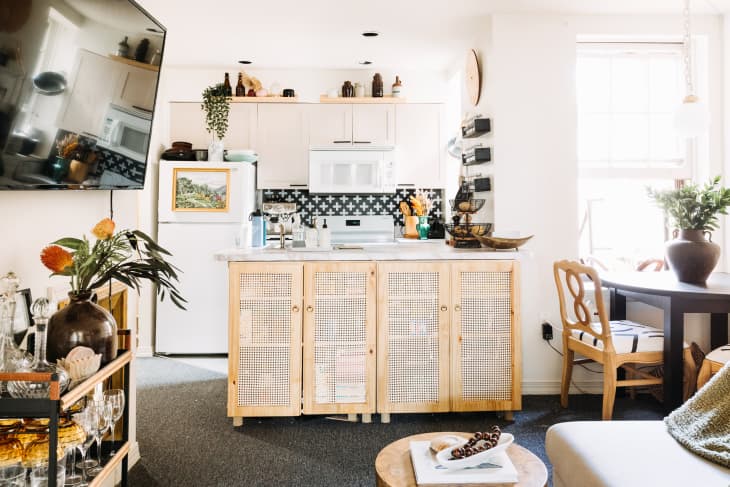
7 Key Design Rules for One-Wall Kitchens
Open-concept living leaves homeowners, well, open to many different design styles. Here’s a look at some of the many ways you can style one-wall kitchens, from the cabinets, appliances, and counters themselves to the finishes and overall aesthetic.
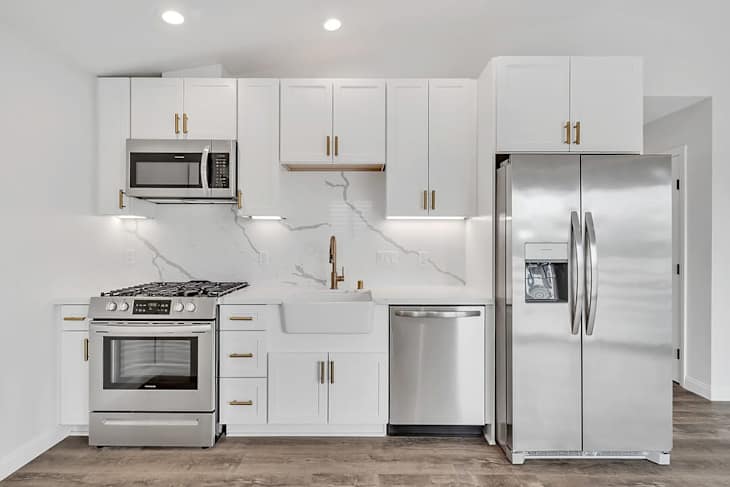
Elevate finishing touches.
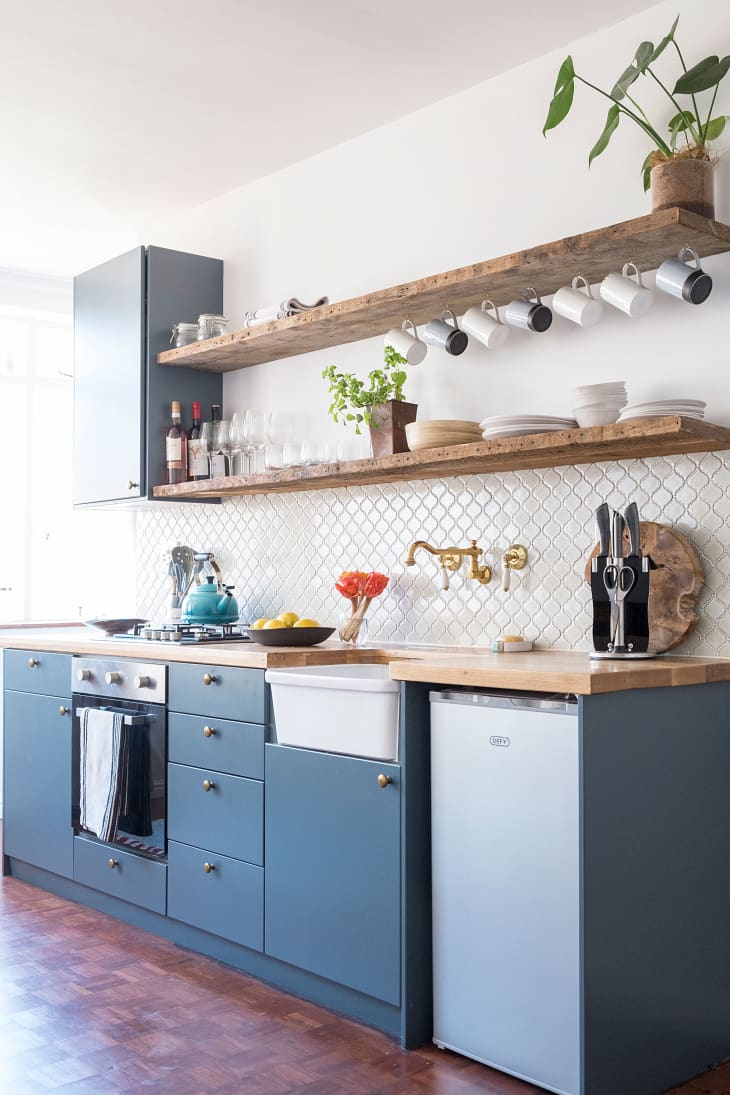
Smaller kitchens are, by nature, more affordable than larger ones, thanks to fewer cabinets and shorter countertops. Having more room in your budget means you’ve got more to spend on finishes — and this is when you shouldn’t skimp, as hardware and finishes can elevate the entire project. Here, white cabinets with gold hardware, a farm sink, and a smooth marble backsplash show that a luxurious kitchen can be created in a small footprint.
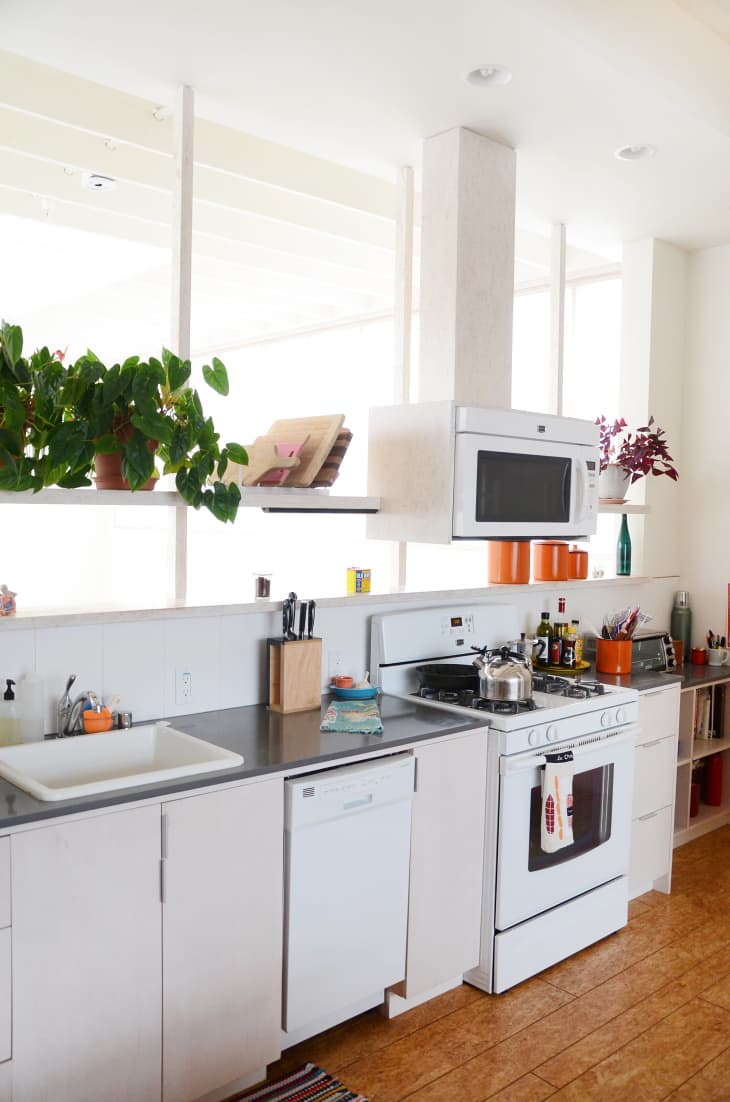
Look beyond exterior walls.
Despite the name of the design, it’s OK if you can’t dedicate an actual side of your home to a one-wall kitchen. Here, slim columns create the kitchen space in a larger, open-concept floor plan. Rather than building a solid wall, the openings between the columns permit more light while also offering shelving, including a clever shelf extending from the ceiling to house a microwave.
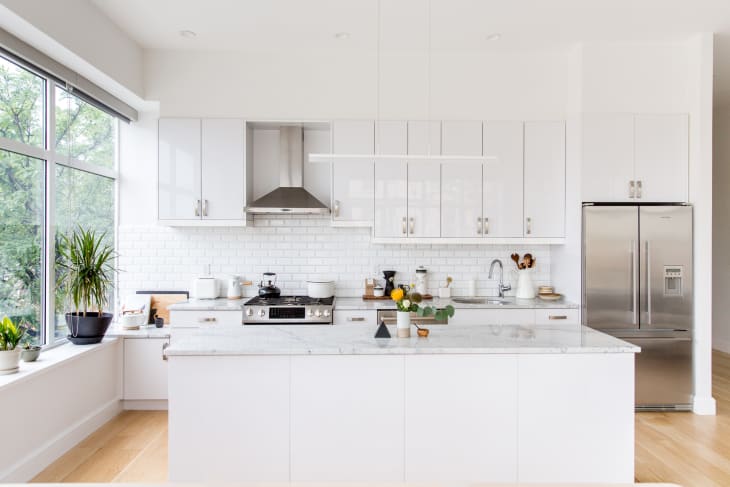
Consider an island to add extra counters and define the space.
An island or peninsula is highly desirable in open-concept kitchens, because it creates extra work surfaces and casual dining space. But it also works to define the space cleanly away from other features in a home. For those homeowners reluctant to embrace this design, an island offers an entryway for guests to follow into an airy kitchen.
Create room for a flexible dining space.
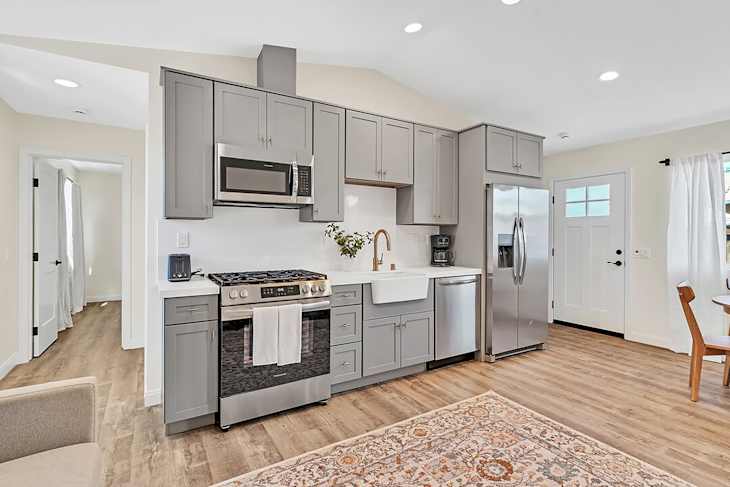
Many homeowners may prefer to add an island or a small dining table directly opposite the one-wall kitchen, but that’s not the only way to imagine this space. That’s the beauty of an open-concept floor plan. Here, a living room faces the kitchen instead, with a small table off to the side. Even in a small space, the homeowner has created two dining areas; one for more casual eating, and another for sit-down meals.

Get creative with the other walls.
While one wall does all the work of housing counters, cabinets, and appliances, you can’t forget the three other walls flanking the kitchen. Here, freestanding shelving and a wall rack for pots and pans add extensive storage — while also allowing for plenty of wall space for decor.
Blend in any style you choose.
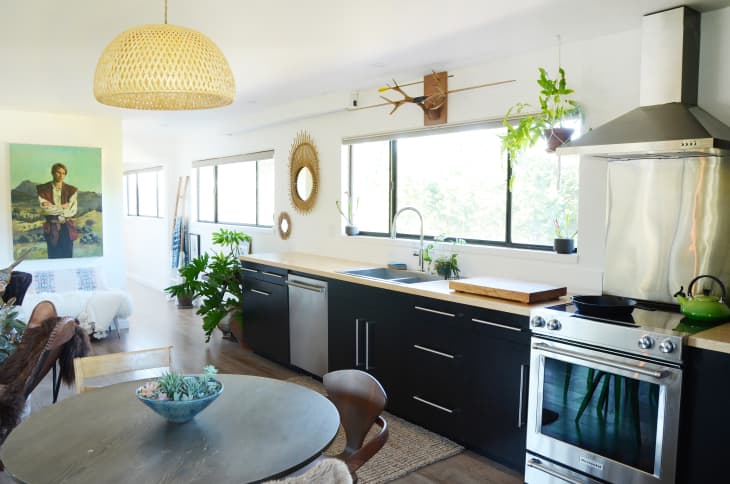
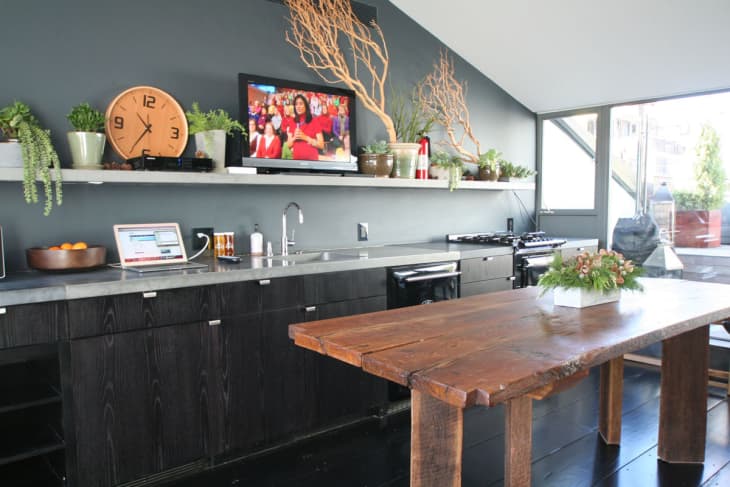
One-wall kitchens can reflect any design aesthetic you choose, depending on how much or little you want features to stand out in the open space. Here, a dramatic black-and-gray kitchen gets an infusion of wabi-sabi style with plenty of greenery as decor and a rustic wood table that’s perfect for meal prep or dining.

Consider minimalist cabinetry.
Lean into an even sleeker look for a one-wall kitchen by choosing cabinets that skip hardware, knobs, or handles. While cabinet hardware doesn’t take up much space at all, these cabinets (and hidden refrigerator) create a smooth, modern aesthetic that’s very pleasing to the eye.