
What Is Wabi-Sabi Style? 6 Key Rules to Understand, According to Designers
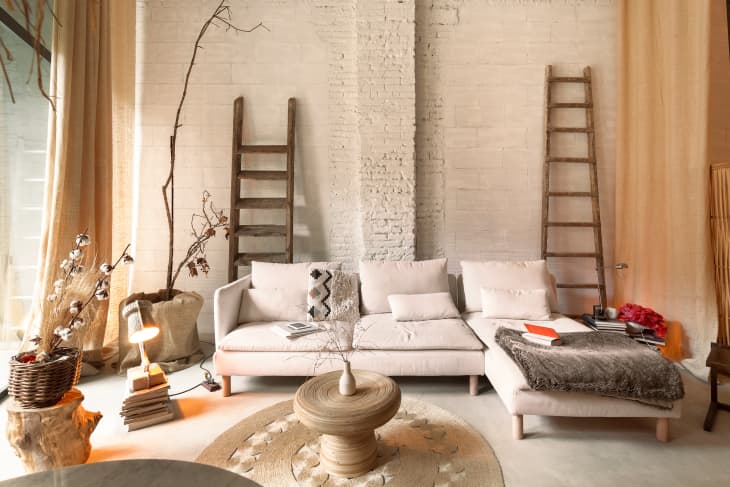
Some interior design aesthetics look so flawless, you’re afraid to touch something for fear of upsetting the perfect display. But if you’re more inclined to create a space that’s meant for actual living, then you’ll love wabi-sabi, the Japanese philosophy of embracing simplicity and finding beauty in life’s imperfections.
While some Pinterest-worthy interiors feature polished surfaces, carefully curated gallery walls, and quaffed throw pillows, wabi-sabi is all about creating casual and comfortable spaces that are better suited for everyday living. It’s all about softer curves, weathered edges, and natural textures in muted, earthy color palettes.

Here’s what you need to know about the simple beauty of wabi-sabi and how you can apply it to your home and life.
What Is Wabi-Sabi Design?
Based on principles central to the culture of 16th-century Japan, wabi-sabi has been adapted as an art style as well as a philosophy that highlights the austere, refined beauty of aging, per materials published by the University of Colorado Boulder’s Center for Asian Studies. At its core, some of the tenets of the wabi-sabi philosophy are influenced by Buddhism, as well as other aspects of Japanese culture.
Modern designers have interpreted these tenets into a more cohesive approach that usually focuses on raw beauty.
“Wabi-sabi is less about the specific style and more about a mindset,” says Asha Winn, principal designer and founder of California-based Studio Asha. “[It’s] about creating spaces that feel grounded, real, tactile, and lived in. And it’s not about perfection more than it is about the simplicity and letting natural materials and the little imperfections of those materials bring character and soul to the home.”
Joyce Huston, cofounder and lead designer at Decorilla, adds that the philosophy embraces flaws as they naturally appear.
“It’s the beauty of the imperfection, where you can see the human touch has come into play,” she says. “[Wabi-sabi] is where what’s broken and aged is what makes pieces so worthy and deep.”
6 Essential Wabi-Sabi Design Characteristics
Since wabi-sabi is so much more than just a specific style, it can fit into a variety of aesthetics. Here are some of the key principles of this perfectly imperfect way of living.

Creating Beauty in Imperfection
This bedroom is a great example of how wabi-sabi principles can be layered into various, already existing interior design styles. “The exposed ceiling is part of the beauty,” Huston explains. “You can see the pipes. You can see the ugliness.”

From a decor perspective, if you’re normally a fan of perfectly placed, karate-chopped throw pillows, you can be rest assured — quite literally — that you don’t have to be as perfect with your placement.
A linen sofa in a wabi-sabi living room is the perfect place to take a nap, says Nina Venice, associate design director at Four Hands. “You don’t need to get up and fluff the pillow. You can move it around. It doesn’t need to go in the corner,” she says, adding that nothing is too precious for wabi-sabi.

Highlighting Worn, Time-Honored Pieces
Impermanence is a hallmark aspect of wabi-sabi style. The idea that time is fleeting and life marches on does indeed evoke a mix of sadness and joy. But loyalists of modern wabi-sabi principles view it as a celebration of the aging process, in all its messy imperfection.
A broken bowl or chipped vase need not be discarded; in fact, the changes in the original piece can transform it into a star of a wabi-sabi-designed room. “The form that it was originally in is not necessarily the form that it’s going to be in throughout the rest of its life,” Huston says.
That’s not to say that you can’t add brand-new decor or furniture to your wabi-sabi environment, but you’ll want to choose materials that will age beautifully in their texture and patina. One material you’ll certainly want to pass up is plastic, as it retains its form. “Plastic is absolutely the antithesis of wabi-sabi,” Huston adds.

Honoring Simplicity
The “less is more” philosophy is evident in wabi-sabi, with furniture and decor leaning more rustic and organic. For a bedroom, Venice chooses a low headboard, linen bedding, and a nightstand with a live edge (a term used for furniture that’s typically handcrafted and leaves at least one edge natural and unfinished).
While maximalism continues to dominate trends in interior design, wabi-sabi style, on the flip side, honors minimalism.
“I feel like [minimalism is] never going to die because the philosophy of minimalism is a timeless philosophy, says Huston, adding that the “less is more” principle is also innately human.“As humans, we’re always trying to find that one solution that explains everything, and that is translated into minimalist design.”

Connecting to Nature
Arranging your houseplants is one of the easiest ways to connect interior design to the external world. Beauty is in the eye of the beholder when it comes to choosing the right ones for your space, with one notable exception: “It is a faux pas to do faux with wabi-sabi,” explains Huston.
That’s because nature is an integral part of any wabi-sabi space, from its live color palette to abundant plant life. And yes, wabi-sabi style is always clearer when plants are the real deal.
The best part about incorporating real greenery is that it’s OK if things dry out over time. “You can still use it as part of the design,” Huston says. That’s why real plants are such a perfect match for the wabi-sabi philosophy: “You can’t control nature. You can’t control how a plant grows, really. So it goes hand in hand with wabi-sabi, given that it does what it wants.”
Although many wabi-sabi interiors feature more of a neutral palette, there’s still plenty of room to experiment with color, even saturated hues.
“Nature has every color,” Winn says, adding that your color choices should be based on the mood or feeling the room is gravitating toward. “So I don’t feel like there’s necessarily a right or wrong way to approach it. … I take cues from what’s already presented in the nature that surrounds the design.”

Seeking Balance in Asymmetry
While symmetry provides visual balance, wabi-sabi celebrates asymmetry. It’s not only in terms of how furniture and decor are placed, but the shapes of the furniture and decor themselves.
Mirrors work well in establishing wabi-sabi style, but save geometrical models for another aesthetic. Free-form contour mirrors like the ones shown in the above bathroom and bedroom are better suited for wabi-sabi, says Venice. “I think that kind of goes back to the simplicity of them being handmade and imperfect,” she explains.

Mixing Materials and Textures
Wabi-sabi loyalists do not seek out interiors that feel “matchy-matchy.” Mixing wood and other natural elements creates a tactile aesthetic that is pleasing to the eye and the touch.
In the entryway [above], there’s a mix of natural materials over the wooden floor and distressed bench. The moody walls and door frame also demonstrate that you can go darker and more dramatic with a wabi-sabi color palette.
The second entryway [below] illustrates utilitarian elements of wabi-sabi, with a mixture of closed and open storage. The hat, scarf, and jacket even seem to double as decor, although they are certainly in use as the season calls for it. “When everything’s too perfect, everything’s put away, you can’t see any of the functional items. That is, again, the antithesis of wabi-sabi,” Huston explains.

How to Create Wabi-Sabi Style Interiors
A wabi-sabi home is by no means flawless, but it’s also no less beautiful. From rustic furniture and broken decor to free-form mirrors and live-edge tables to plants that are living their best lives, you can create a comfortable space that revels in its simplicity and imperfections.
Perhaps the true beauty of the wabi-sabi principle is that it can be layered into many different interior design styles without the need for a full overhaul. And given the “less is more” theme, simplicity works well for smaller spaces.
Hygge Meets Zen
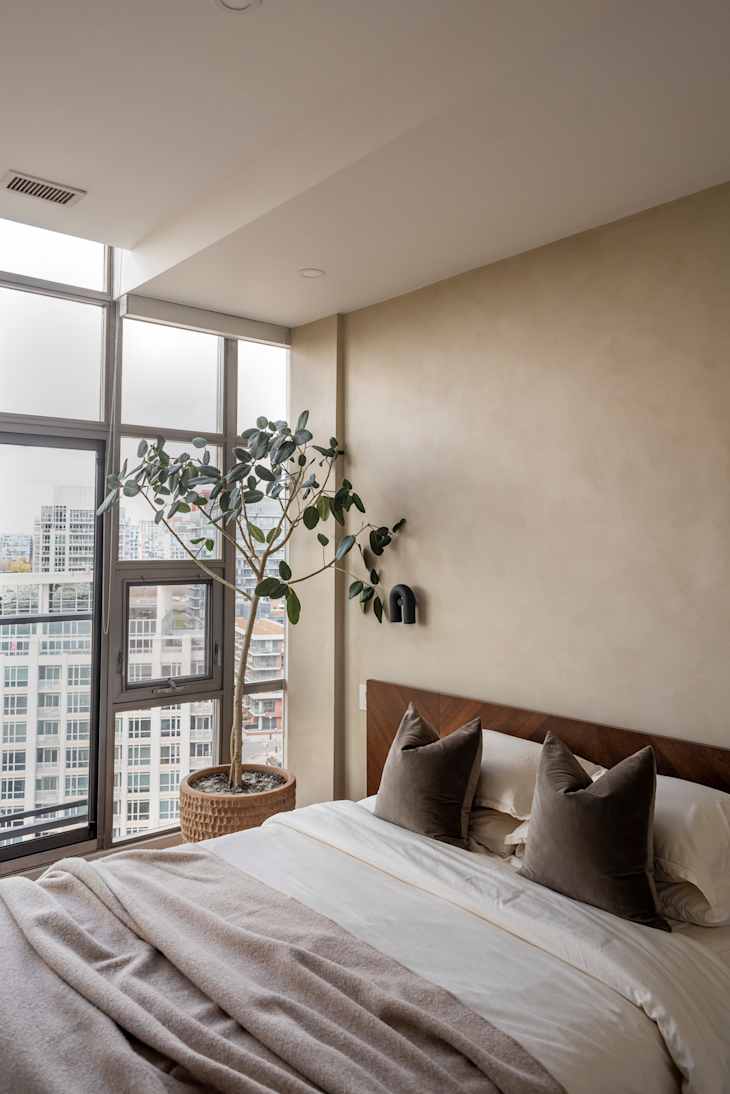
In this Toronto loft owned by content creator Abhishek Dekate, the Japanese philosophy coexists beautifully with the Scandinavian aesthetic. “The warmth of wabi-sabi combined with the cozy essence of hygge, results in a calming and inspiring environment. At the same time, it doubles as an office, for building a brand and growing my team,” Dekate told Apartment Therapy editors.
Rustic Coastal Chic
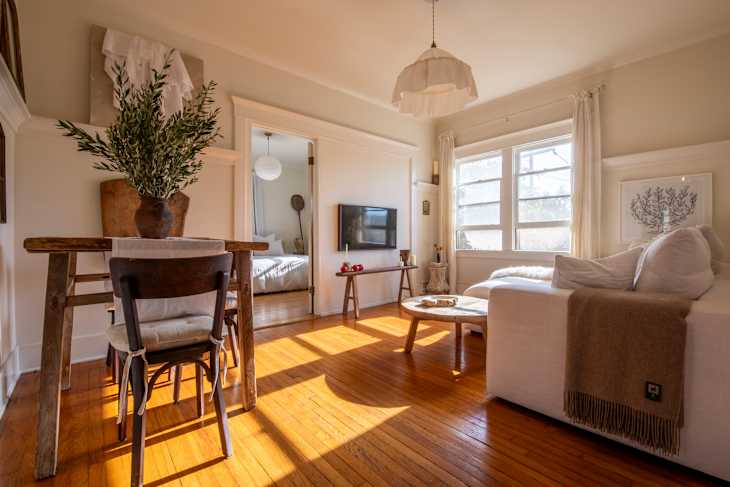
A light-filled apartment in Santa Monica, California, gives plenty of coastal vibes, but it’s the wooden accents, warm neutrals, and bursts of greenery that welcome in the wabi-sabi. The natural textures, mix of wood, and lived-in look of the rustic furniture play very well together.

Mixing Old-World Charm and Modern Accents
In this historic apartment in Barcelona, a rustic door — through which you can see one of around 20 house plants thriving — leads to a comfortable bedroom that features textured layers and neutral colors accented by the tenant’s own artwork. The area rugs over the mixed hard flooring add warmth and texture.
Bringing the Outside In
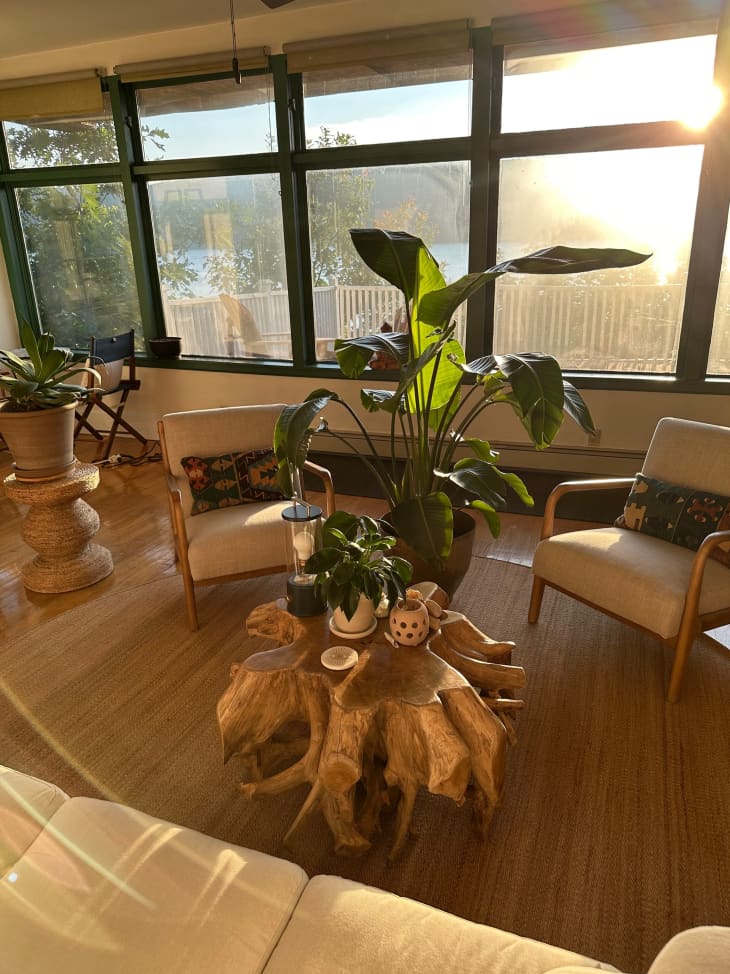
Owner Ashley Hogan describes her one-bedroom historic apartment in Yonkers, New York, as a “light-filled rustic wabi-sabi hideaway.”
Plants thrive here and bring natural pops of color to the neutral palette and mixture of woods and natural materials. Can we have a moment for that cocktail table with the live edges that looks like it was dragged in from the forest? Talk about connecting with nature!