
I Just Found Out About the “S” Technique for Cleaning, and It’s Mind-Blowing
Okay, I’ll admit it: I didn’t think I could find out much more about basic mainstream residential cleaning. After all, I’ve been writing about cleaning for over a decade. Of course, I’m always learning about new methods and strategies, but I thought I had the fundamentals down (things like cleaning from top to bottom and cleanest to dirtiest, for example). Well, I was wrong.
I recently came across the idea that cleaning surfaces in an “S” pattern is the best practice. My mind was blown. Not only because I’d never heard about it (and it’s nothing new), but also because it’s so simple and smart.
What Is the “S” Technique for Cleaning?
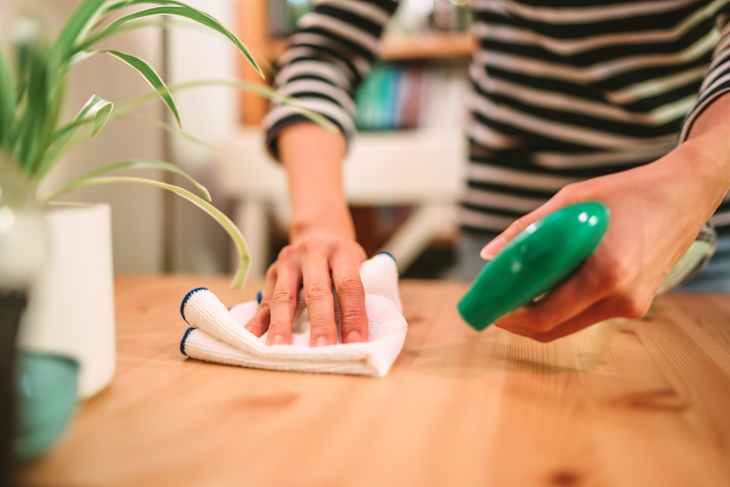
I first came across this technique when I was doing research for an article on whether or not you really need to close the toilet before flushing. Essentially, the “S” technique refers to the way you wipe horizontal and vertical surfaces, such as tabletops, countertops, mirrors, and even floors. You want to wipe surfaces in an S-shaped pattern, or trail, so that every part of the surface is wiped and in order to avoid wiping over an already-cleaned area with a dirty rag or tool.
The strategy appears as a protocol in janitorial guidelines, suggesting that it’s a bit of “insider” knowledge. For example, Office Pride Commercial Cleaning says to “wipe in a consistent pattern, such as an ‘S’ pattern starting from right to left to limit streaking.” Similarly, the Buckeye Honors Custodial Training Program talks about this in relation to mopping: “Mop the remainder of the room in an ‘S’ pattern with the mop angled towards the entrance.”
And house cleaning company Sweep also discussed the method, detailing how cleaning in an “S” pattern differs from cleaning in the typical and more haphazard “O” pattern. “Simply put, the ‘S’ pattern is a way of taking a cleaning tool (rag, sponge, brush, etc.) and cleaning a surface in a back-and-forth ‘S’ pattern. This motion will essentially move from one end, across to the other end, and back and forth without overlapping … this way nothing is missed, and no clean areas are overlapped.”
Why the “S” Technique of Cleaning Is So Great
This technique has a lot going for it. In fact, even CDC documents and Gama Healthcare education documents call for wiping surfaces with the “S” pattern. Cleaning this way is beneficial for three reasons.
- It prevents cross-contamination. When cleaning in this pattern, you avoid wiping your rag or cleaning tool over the part of the surface you previously cleaned. Compare cleaning in a circle, where you’d run a dirty rag over an area that had already been cleaned, to cleaning in an “S” shape from top left to bottom right, where all the contaminants are gathered and swept to the end of the surface being cleaned.
- It ensures full coverage. Using a systematic approach to cleaning a surface, like covering the area with an “S” pattern, means you’re sure to cover every inch of that area. When you’re done cleaning, there won’t be any parts of the surface that haven’t been touched.
- It enhances efficiency. Because this technique prevents cross-contamination and ensures full coverage, it enhances efficiency. You don’t have to go back and spend time, energy, and resources re-cleaning dirty areas or spots you may have missed. Cleaning gets done thoroughly the first time around.
I’ve been humbled by learning this new-to-me, extremely effective cleaning strategy — and I will definitely be using it for every surface I clean from now on.